
Depression in Patients with Dementia
Depressive symptoms in older people are pretty standard. However, disabling and sustained signs are more common in elderly persons with dementia than those without dementia. Depression is approximately 30% in persons with Alzheimer’s Disease (AD) and vascular dementia, while 40% of dementia is linked to persons with Huntington’s and Parkinson’s diseases (Enache et al., 2011; Reijnders et al., 2008). Nurse practitioners caring for persons with dementia should be aware of the significant depression symptoms as these call for specific management strategies. The manifestation of major depression in persons with dementia often differs from depression in other groups (Engedal et al., 2011). The mood is commonly low, but one can also be anxious, angry, or irritable. The interfered biological rhythms occur for energy, appetite, and sleep, and patients may be nihilistic, hopeless, or pessimistic altogether. Ideas of self-harm, guilt, and hopelessness may also occur. Overall, a person’s cognitive ability may decline in a significant way because of depression alone. Attributing cognitive impairment to the depressive disorder or cognitive impairment to dementia can be challenging until an adequate treatment trial for depression occurs. This paper will discuss a case study of a geriatric patient with dementia who reported to the clinic with an aggravated mood. The nursing theory applicable to this case will be addressed, and so will the ideal evaluation instrument for depression in the patient.
Watson’s Theory of Caring
According to Watson, the main principle in the Theory of Caring posits that humans ought not to be managed as objects and that they can not be separated from the larger workforce, nature, others, and self. The theory also confines the entire nursing profession, mainly emphasizing the process of inter-personality between the care recipient and the caregiver. The approach focuses on human caring’s centrality, the transpersonal caring-to-caring relationship, and the potential of healing for the caregiver and the recipient of care (Watson & Woodward, 2020).
Watson’s theory has three sub-concepts: the phenomenal field, which is the totality of a person’s experience of their world. It refers to the frame of reference of an individual that only a person knows. The self is another sub-concept and is the conceptual gestalt organized in a way comprising characteristic perceptions of the Me and I and the perceptions of the Me and I relationship to various life aspects and others. The third sub-concept is when the present is subjectively real while the past is objectively real. It is in a different mode or before the present, though it is not easily distinguished. The history, the future, and the present incidents fuse (Watson & Woodward, 2020).
In this case, the patient had started feeling depressed because of dementia. He also stated that he felt confused and unaware of the time phenomenon. He thought that his future was jeopardized by his failure to connect to the present and the past. Additionally, the patient was unable to relate to the world around him as he sometimes felt as though those he was once close to would avoid him. He had many friends before dementia, but since his diagnosis, friends, and family who visited him and enjoyed spending time with him have become fewer as the days passed. He increasingly felt like an outsider looking into a life that was not his own.
Martinsen’s Theory of Care
Martinsen’s theory of care may be interpreted as describing good care fundamentals (Martinsen, 2011). Martinsen described care as being practical, moral, and relational. Relational care involves concern and care for others. The moral aspect involves treating persons equally and showing them respect while requiring the caregiver to understand the situation. The practical dimension refers to care always dependent on a reasonable, concrete solution.
Brief Literature Review
Dementia and depression are common syndromes that nurse practitioners manage. Comorbidities in patients compound these illnesses’ impact on the patients’ health services, and carers (Wimo & Prince, 2010; Meeks et al., 2011). Yet, there is a complex relationship between the two with overlapping features, with each appearing as a possible risk factor, consequence, or symptom of the other. Therefore, it is important to identify and effectively manage depression in persons with dementia as this remains a demanding task for nurse practitioners. The rate of reports of depression in persons with dementia varies widely and depends on the sampled population, assessment means, and caseness definition. Generally, most studies conducted based on population, report prevalence rates of 8-30% (Huang et al., 2011; Lyketsos, 2011). In nursing home residents and hospitalized patients, the prevalence may go as high as 40% (Huang et al., 2011). The prevalence estimate variances are higher in mild cognitive impairment studies. Mild cognitive impairment patients with depression have been found to be 16% in samples from communities and 44% for samples of patients hospitalized in facilities (Enache et al., 2011). The limited investigations on persons with depression and having vascular dementia, dementia related to Parkinson’s and Lewy body dementia, suggest that the occurrence of dementia is more common than it is in persons with Alzheimer’s disease. The reported risk factors include recent losses, past history of emotional problems or dementia, and female gender. The repercussions of depression in persons include the burden on caregivers and patients, increased depression in caregivers, exacerbation of functional and cognitive decline, behavior disturbance that is dementia-related, poor outcomes from other surgical and medical interventions, increased mortality, and earlier nursing home admissions (Bennett & Thomas, 2014).
Depression in persons with dementia is a problem that remains under-diagnosed and more so in residential settings (McCabe et al., 2006; Snowdon, 2010). Accurate assessment may be hindered by system, family, clinician, patient, and disease-level factors. Curran and Loi (2013) point out that depression may have diverse presentations in persons with comorbid dementia and more so when it is advanced dementia. Although MDD is seen, the clinical presentation of depression in dementia will most times be lack prominent guilt, hopelessness, and sadness and is also not as severe as MDD. Other common symptoms that may be present include hallucinations, delusions, irritability, anhedonia, loss of appetite or energy, psychomotor retardation, and anxiety compared to persons without dementia. These manifestations may also be part of dementia or suggestive of delirium. A rapid or unexpected change in cognitive deterioration or mood, or increased psychological and behavioral manifestation of dementia such as aggression, anxiety, agitation, or disinhibition may be the only superimposed depression indicators.
Description of the Case
The patient was a 79-year-old male Hispanic patient with a past medical history of dementia, coronary artery disease, hyperlipidemia, aortic valve replacement (AVR), and s/p coronary artery bypass graft (CABG). He was referred to the memory clinic because of his agitated behavior. The patient’s kin stated that he had memory problems for the last 4+ years and worsened significantly following his AVR and CABG in 2017. When he presented at the clinic, the patient had functional deficits in IADLs, shopping, cooking, driving, and handling finances. The patient was also reported as irritable and agitated for some time and referred to the hospital for showing physical and verbal aggression toward others and his wife. A primary physician reviewed The patient recently because of this issue. The brain MRI and lab exams were ordinary and unremarkable. The patient was also reported as having a poor appetite and had problems with sleep. He had also lost a little over 6.5 lbs in three weeks. The patient denied any suicidal ideations or auditory/visual hallucinations.
Case Study Discussion
According to Robinson, Smith, and Segal (n.d), depression is a common yet not normal part of aging. Studies show that most elderly people are satisfied with their lives even when experiencing physical problems or illnesses. However, several life-changing events occur, such as feelings of sadness, stress, and uneasiness. Dealing with a severe disease can make some people experience anxiety or sadness. After adjusting to the new life event, some elderly persons can regain their balance regarding their emotions; In contrast, others cannot achieve this resulting in depression.
Some signs and symptoms of depression can strongly resemble major depression, such as a lack of interest in others and self, as well as social withdrawal, low motivation, and low initiative. Depression diagnosis can be complicated due to a previous failure to recognize the illness. Apathy is a confounding diagnosis sign requiring assessment by a specialist. Also, there are some people whose cognitive style throughout their lives has always been depressive and negative as opposed to this being a change recently observed. This information can only be revealed by kin close to the patient (Robinson et al., n.d).
A major depressive episode will develop over weeks to a short number of months and is often a significantly new impairment. On the other hand, dementia can develop insidiously in months or years and may progress slowly (Zahodne et al., 2014). In this case scenario, the patient was already diagnosed with dementia but had taken some years for depression to manifest. The recent physical and verbal abuse activities were cues that the patient was experiencing emotional and mental problems outside of dementia. The patient had also lost a lot of weight following his disinterest in eating. The patient was experiencing sleep apnoea, a classic sign of depression in dementia.
Summary of the Case
The patient scored 17/30 and an eight on the Mini-Mental State Examination and the Cornell Scale for Depression in Dementia, respectively. The patient exhibited a few typical symptoms in addition to his wife’s irritability and agitation. In this case, the patient may be unaware of or minimize the symptoms because of his dementia. The patient was started on an SSRI 25mg PO qD, which was increased to 50mg PO qD after a week. The patient’s wife was educated on how to help the patient manage aggression and agitation and was also encouraged to contact caregiver support from the Alzheimer’s Association.
The patient returned for follow-up after four weeks. The wife stated that the patient had complete symptom resolution, with the patient denying feelings of being depressed and saying he was now a happy man. The patient’s wife also added that she had visited the Alzheimer’s Association and joined caregiver support. She learned the different strategies for caring for her husband and minimizing his symptoms.
Application of Watson’s Theory of Care
A transpersonal caring relationship involves individualized, creative, aesthetic, ethical, and scientific giving and reception, as well as the reactions between practitioners and patients (Lukose, 2011). During these interactions, the nurse practitioners will approach the patient in an ethical, friendly, respectful, harmonious, and sensitive way full of empathy in fulfilling a relationship that is caring. Interactions and communications will occur between the practitioner and the patient during the caring moments. When the practitioner approaches the patient lovingly, it will help facilitate healing. Healing and caring can be realized when caring is based on the consciousness of healing. The humanistic values will be a result of the arts, culture, and beliefs (Gönen, Küüükgüülü, & Watson, 2017). These will involve love, concern, empathy, and kindness on the part of the nurse practitioner for the self and others. Therefore, the nurse practitioner must have a positive attitude and be loving, tender, tolerant, and cheerful.
Gönen et al., 92017) add that it is critical that the nurse practitioner respects, honors, and encourages the beliefs that the patient holds so as to promote and protect health. Irrespective of the individual’s medical regimens and health status, the nurse practitioner will need to provide the patient with hope and faith support. To improve the patient’s sensitivity to self and others, the patient will be encouraged to acknowledge his feelings. The patient will become psychologically mature and accept the health condition by being sensitive. It will be necessary for the nurse practitioner to explain emotions and feelings and consider the emotions in caring for the patient and the experiences, behaviors, and thoughts. By utilizing this caritive element, nurse practitioners can establish authentic, honest, and more in-depth caring. The nurse practitioner needs to listen to the patient’s feelings and give their stories value so that the patient can heal and find meaningful things in his life (Gönen et al., 2017). It is through listening to the patient’s emotions and feelings that the nurse practitioner can contribute positively to the patient’s healing process.
Proposed Solutions
Conventional instruments and techniques may be insufficient in the assessment of depression and may not be practicable or reliable in persons who have dementia. When the nurse practitioner obtains the patient’s history, the patient may under-report while the carer may over-report depression symptoms (Watson et al., 2011). As the patient’s dementia advances, communication and cognitive difficulties may also be a hindrance to intrapsychic symptoms assessment of depression, together with thoughts about self and others, subjective mood states, and the general perceptions one has about the future.
Using standardized questionnaires is only helpful when this population validates the same, which is not so for most of the standard rating scales for depression (Rozzni et al., 2011). The Cornell Scale for Depression in Dementia is helpful. Obtaining as much patient history from the carer and the patient regarding the patient’s behavior and mood symptoms is essential, especially when there is evidence of communication difficulty. This ought to be done frequently, such as at intervals of 6 months or when there is evidence of a behavior change (Curran & Loi, 2013). The nurse practitioner needs to inquire about the patient’s past history regarding depression as well as any treatments received; alcohol and drug history, medical history, and family history. Prescription medications, physical illnesses, social isolation, functional disability, losses and bereavement, and life stresses, are all important as these can increase the patient’s vulnerability to depression. Where the nurse practitioner suspects clinical depression, such as mood change or a behavioral change that is difficult to explain, it is worthwhile to start the patient on a definitive treatment plan, mainly where there are difficulties in communication because of dementia (Curran & Loi, 2013).
Research Instrument for Evaluation
Cornell Scale for Depression in Dementia (CSDD), unlike other screens and scales, considers other depressive signs that a person may fail to verbalize clearly. For example, if a person has vascular dementia, AD, or any other cognitive impairment, such a person may fail to verbalize the exact feelings consistently. The CSDD measures physical signs and observations that are an indication of depression (Herema, 2019).
The CSDD covers five areas in question format (Herema, 20190. The Mood-Related Signs determine the sadness, anxiety, irritability, and lack of reaction to events that are pleasant. Behavioral Disturbances resolve speech and retardation (that is, slow movements), agitation, loss of interest in previously essential or exciting activities, and multiple physical complaints. Physical Signs include weight loss, loss of appetite, and easily fatigued. Cyclic Functions have difficulty falling asleep, with symptoms increasing in the evening, waking up several times when sleeping, and waking up earlier than usual. Ideational Disturbance includes poor self-esteem, suicidal thoughts, delusions of poverty, pessimism, loss, or illness.
Evaluation of the CSDD and Rationale for Use
The CSDD is effective in the identification of a person experiencing depression. Research has been used to determine its effectiveness in different cultures. For example, a study by Lim et al. (2012) showed good validity and reliability when the Korean version of the CSDD was used in testing for depression in ethnic participants.
In the case study, the patient was an elderly male of Hispanic descent. A study by (Harwood et al.,1998) compared Hispanic and English-speaking participants using the CSDD. The results are relevant to this case because the patient was Hispanic. The author’s research showed that in Hispanics, the Irritability assessment was linked to psychosis and psychic manifestation for patients with depression. Physical Complaints assessment was conducted to have minimal relation to depression; hence, a nurse practitioner should be wary of the patient reporting physical complaints and linking these to depression. Physical complaints are a characteristic of Hispanic patients more than a sign of depression.
Additionally, the worse mood in the morning reported among the Hispanic patients was closely related to sleep disturbance and, notably, the early morning awakening. The authors’ analysis supports the CSDD validity in Hispanic patients with depression and dementia. However, specific interpretations need to be viewed with a degree of difference from that of English-speaking patients.
Conclusion
Depression in persons with dementia often happens progressively. Sometimes, it is difficult to identify signs of depression, especially when the person has a negative personality. The CSDD is an ideal instrument for measuring depression in dementia. The nurse practitioner caring for the patient can draw from Watson’s theory of care in ensuring holistic care for the patient and the kin. Follow-up of a patient should take place after four weeks, and this should be preceded by medication during this period.
References
Bennett, S., & Thomas, A. J. (2014). Depression and dementia: cause, consequence or coincidence? Maturitas, 79(2), 184-190.
Curran, E. M., & Loi, S. (2013). Depression and dementia. The Medical Journal of Australia, 199(6), S40-S44.
Enache, D., Winblad, B., & Aarsland, D. (2011). Depression in dementia: epidemiology, mechanisms, and treatment. Current opinion in psychiatry, 24(6), 461-472.
Engedal, K., Barca, M. L., Laks, J., & Selbaek, G. (2011). Depression in Alzheimer’s disease: specificity of depressive symptoms using three clinical criteria. International journal of geriatric psychiatry, 26(9), 944-951.
Gönen Şentürk, S., Küüükgüülü, Ö., & Watson, J. (2017). Caring For Caregivers of Individuals With Dementia: From the Perspective of Watson’s Theory of Human Caring. Journal of Hacettepe University Faculty of Nursing, 4(1).
Harwood, D. G., Ownby, R. L., Barker, W. W., & Duara, R. (1998). The factor structure of the Cornell Scale for Depression in Dementia among probable Alzheimer’s disease patients. The American Journal of Geriatric Psychiatry, 6(3), 212-220.
Herema, E. (2019). Is the Cornell Scale for Depression in Dementia Accurate? https://www.verywellhealth.com/the-cornell-scale-for-depression-in-dementia-98620
Huang, C. Q., Wang, Z. R., Li, Y. H., Xie, Y. Z., & Liu, Q. X. (2011). Cognitive function and risk for depression in old age: a meta-analysis of published literature. International Psychogeriatrics, 23(4), 516.
Huang, C. Q., Wang, Z. R., Li, Y. H., Xie, Y. Z., & Liu, Q. X. (2011). Cognitive function and risk for depression in old age: a meta-analysis of published literature. International Psychogeriatrics, 23(4), 516.
Lim, H. K., Hong, S. C., Won, W. Y., Hahn, C., & Lee, C. U. (2012). Reliability and validity of the Korean version of the Cornell Scale for Depression in Dementia. Psychiatry investigation, 9(4), 332.
Lukose, A. (2011). Developing a practice model for Watson’s theory of caring. Nursing Science Quarterly, 24(1), 27-30.
Lyketsos, C. G. (2010). The interface between depression and dementia: where are we with this important frontier? The American Journal of Geriatric Psychiatry, 18(2), 95-97.
Martinsen, E. H. (2011). Care for nurses only? Medicine and the perceiving eye. Health Care Analysis, 19(1), 15-27.
McCabe, M. P., Davison, T., Mellor, D., George, K., Moore, K., & Ski, C. (2006). Depression among older people with cognitive impairment: prevalence and detection. International Journal of Geriatric Psychiatry: A Journal of the psychiatry of late life and allied sciences, 21(7), 633-644.
Meeks, T. W., Vahia, I. V., Lavretsky, H., Kulkarni, G., & Jeste, D. V. (2011). A tune in “a minor” can “b major”: a review of epidemiology, illness course, and public health implications of subthreshold depression in older adults. Journal of Affective Disorders, 129(1-3), 126-142.
Reijnders, J. S., Ehrt, U., Weber, W. E., Aarsland, D., & Leentjens, A. F. (2008). A systematic review of prevalence studies of depression in Parkinson’s disease. Movement disorders, 23(2), 183-189.
Robinson, L., Smith, M., and Segal, J. (n.d)). Depression in Older Adults: Signs, Symptoms, Treatment. https://www.helpguide.org/articles/depression/depression-in-older-adults.htm
Snowdon, J. (2010). Depression in nursing homes. International Psychogeriatrics, 22(7), 1143.
Watson, L. C., Lewis, C. L., Moore, C. G., & Jeste, D. V. (2011). Perceptions of depression among dementia caregivers: findings from the CATIE‐AD trial. International journal of geriatric psychiatry, 26(4), 397-402.
Wimo, A., & Prince, M. J. (2010). World Alzheimer Report 2010: the global economic impact of dementia. Alzheimer’s Disease International.
Zahodne, L. B., Stern, Y., & Manly, J. J. (2014). Depressive symptoms precede memory decline, but not vice versa, in non‐demented older adults. Journal of the American Geriatrics Society, 62(1), 130-134.
ORDER A PLAGIARISM-FREE PAPER HERE
We’ll write everything from scratch
Question 
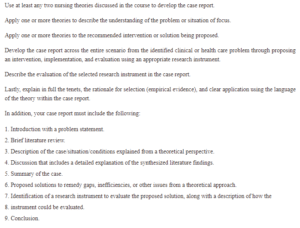
Use at least any two nursing theories discussed in the course to develop the case report.
Depression in Patients with Dementia
Apply one or more theories to describe the understanding of the problem or situation of focus.
Apply one or more theories to the recommended intervention or solution being proposed.
Develop the case report across the entire scenario from the identified clinical or health care problem through proposing an intervention, implementation, and evaluation using an appropriate research instrument.
Describe the evaluation of the selected research instrument in the case report.
Lastly, explain in full the tenets, the rationale for selection (empirical evidence), and precise application using the language of the theory within the case report.
In addition, your case report must include the following:
- Introduction with a problem statement.
- Brief literature review.
- Description of the case/situation/conditions explained from a theoretical perspective.
- Discussion that includes a detailed explanation of the synthesized literature findings.
- Summary of the case.
- Proposed solutions to remedy gaps, inefficiencies, or other issues from a theoretical approach.
- Identify a research instrument to evaluate the proposed solution and describe how the
- device could be considered.
- Conclusion.
 Complete the order form and upload all of your files, including any instructions, rubrics, or other materials provided by your instructor.
 Complete the order payment after filling in the order form. We’ll receive your order and assign it to a writer.
 The assigned writer will complete your paper and forward it to our Editing Team for review and approval.
 Once approved by the editor, the completed paper will be uploaded to your account for you to download, review and approve.