
Death and Dying
Whereas death is a natural phenomenon that forms part of life, its implication to society is marred with discomfort and emotional pain. Death in hospitals also presents the caregivers with considerable difficulties regarding handling the entire issue, from the decision to the medical task required handling as well as reporting to the kin. The terminal phase of life requires special and keen consideration by family members and the caregivers of the patients (Isaacs, 2017). Such concerns are tailored to each individual at this stage since the terminal phase of life differs among individuals.
Dying has often been troublesome for many individuals. The loss of a loved one and the uncertainty of ever having to meet them again takes an emotional toll on most people. The emotional pain depends on how closely connected you were with the individual, with minimal pain being felt by strangers or people not close enough. However, in its painful nature, death sometimes offers relief upon realization and acceptance of the end itself. It is easier to come to terms with the death of someone close who has been chronically ill for a long time and has since been undergoing severe pain in their terminal phase of life and the elderly persons who have accomplished most of their missions in life. These individuals’ death can be viewed as a reprieve for their suffering, and most often, their lives are usually celebrated.
Advances in medical technology have revolutionized medical treatment and patient management in the chronicity of the disease. These technologies have found use in prolonging life expectancy in terminal disease cases, as seen in cancer. Resuscitative technologies have been used to keep patients biologically alive as they wait for their eventual death. However, it poses an ethical question on its justification if the clinicians are confident of the impending death. Death and dying differ in that death is approaching death, whereas death is the natural process where life ends. Good death could be characterized by peace from the inner self and those around you, a lack of pain that may make the process troublesome to self and caregivers, and having those closest to you around you in the process.
Death, despite being a natural process anticipated at some point by most people, often presents with uncharacteristic difficulties. The emotional pain associated with death and the imagination of the uncertainties surrounding death make it unbearable to most people. However, death can be viewed as a reprieve to some individuals, especially those very old and those suffering from chronic illnesses and pain. Technology advancements have provided resuscitative technologies that increase life expectancy in some chronic disease states.
References
Isaacs, D. (2017). Death and dying. Journal Of Paediatrics And Child Health, 51(6), 569-570. https://doi.org/10.1111/jpc.12864
ORDER A PLAGIARISM-FREE PAPER HERE
We’ll write everything from scratch
Question 
Guidelines
Death and Dying
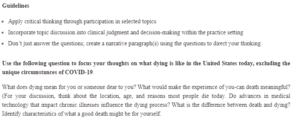
- Apply critical thinking through participation in selected topics
- Incorporate topic discussion into clinical judgment and decision-making within the practice setting
- Don’t just answer the questions; create a narrative paragraph(s) using the questions to direct your thinking.
Use the following question to focus your thoughts on what dying is like in the United States today, excluding the unique circumstances of COVID-19.
What does dying mean for you or someone dear to you? What would make the experience of you-can death meaningful? (For your discussion, consider the location, age, and reasons most people die today. Do advances in medical technology that impact chronic illnesses influence the dying process? What is the difference between death and dying? Identify characteristics of what a good death might be for yourself.
 Complete the order form and upload all of your files, including any instructions, rubrics, or other materials provided by your instructor.
 Complete the order payment after filling in the order form. We’ll receive your order and assign it to a writer.
 The assigned writer will complete your paper and forward it to our Editing Team for review and approval.
 Once approved by the editor, the completed paper will be uploaded to your account for you to download, review and approve.