
Cultural Interview
Cultural interviews focus on understanding an individual’s culture with an open mind and no judgment. Patients and healthcare workers may have different cultural beliefs and practices affecting treatment (Sadeghi et al., 2022). I conducted a cultural interview to help understand how cultural values vary across distinct cultures and how I can apply that knowledge in my professional nursing practice. The interviewee was a 46-year-old African American female, while I am Hispanic. The African American culture considers people who share the same culture and have grown up in the same household to be a family despite their friendship and trust.
In contrast, the Hispanic culture regards anyone you can count on and trust to be family. African Americans are given cultural leadership positions depending on age and generation; therefore, when a grandparent dies, one of his adult children can take over as the family head. Conversely, Hispanics grant leadership positions in the family based on one’s financial muscle and job; therefore, family members strive to be financially independent. Nonetheless, African Americans and Hispanics believe success is one’s ability to achieve their dreams and goals.
Get in touch with us for any assistance on your assignment. Our team of experts is ready to help.
Comparative Analysis of Both Cultures
Culture is passed down from generation to generation, including types and how to prepare traditional foods. Individuals’ ability to maintain their culture depends on their effort, and the freedom in their current residential area allows them to practice their culture. Religion is mainly dependent on a person’s family and upbringing. Religious parents trickle down their faith and beliefs to their children. Children brought up in a spiritual environment grow up believing in religion. However, adults can deviate from the religion they were taught as children. Parents and grandparents teach native languages to their children. People who do not speak or understand their cultural language are mostly from bicultural families or grew up in non-cultural surroundings. In addition, culture and traditions dictate gender roles in society. Accordingly, there are gender-specific roles for women and men, as men are also considered the head of the household. However, as time passes, gender roles slowly become vague and less dictated. Regarding holidays, Christmas is primarily celebrated by both African Americans and Hispanics.
Integrating Key Learnings from the Cultural Interview into the Nursing Practice
During the interview, I learned that cultural beliefs between patients and nurses could be very diverse. Nurses must understand a patient’s culture and religion to ensure good patient outcomes. Some cultures and religions are against physical touch by the opposite gender except among the married. Therefore, a nurse must consider such factors before assigning nurses and healthcare workers to patients. Nurses should ensure compliance with treatment by understanding a patient’s beliefs. A patient whose culture or religion does not support modern medicine will not take their medication despite being prescribed. Although nurses have their personal beliefs and religion, they are trained to respect a patient’s culture, choice, and religion (Červený et al., 2022). Cultural competence increases patients’ trust in the nurses. Also, continuous medical education on culture ensures quality health services to all despite their beliefs (Sadeghi et al., 2022). Cultural competence emphasizes language diversity since some patients cannot speak or understand English. Notably, the interviewee highlighted that communities such as African Americans experience much discrimination even in the healthcare system (Carlo et al., 2022). Therefore, in conclusion, it is the role of nurses to ensure all patients feel welcomed and loved. Patients tend to be more open about their conditions when they do not feel judged. Subsequently, a detailed patient history makes it easier for healthcare workers to make an appropriate diagnosis and prescribe the right therapy.
References
Carlo, G., Murry, V. M., Davis, A. N., Gonzalez, C. M., & Debreaux, M. L. (2022). Culture-Related Adaptive Mechanisms to Race-Related Trauma Among African American and US Latinx Youth. Adversity and resilience science, 3(3), 247–259. https://doi.org/10.1007/s42844-022-00065-x
Červený, M., Kratochvílová, I., Hellerová, V., & Tóthová, V. (2022). Methods of increasing cultural competence in nurses working in clinical practice: A scoping review of literature 2011-2021. Frontiers in Psychology, 13, 936181. https://doi.org/10.3389/fpsyg.2022.936181
Sadeghi, N., Azizi, A., Tapak, L., & Oshvandi, K. (2022). Relationship between nurses’ cultural competence and observance of ethical codes. Nursing ethics, 29(4), 962–972. https://doi.org/10.1177/09697330211072365
ORDER A PLAGIARISM-FREE PAPER HERE
We’ll write everything from scratch
Question 
Cultural Interview
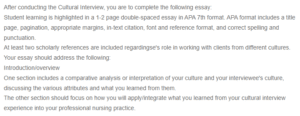
After conducting the Cultural Interview, you are to complete the following essay:
Student learning is highlighted in a 1-2 page double-spaced essay in APA 7th format. APA format includes a title page, pagination, appropriate margins, in-text citation, font and reference format, and correct spelling and punctuation.
At least two scholarly references are included regardingse’s role in working with clients from different cultures.
Your essay should address the following:
Introduction/overview
One section includes a comparative analysis or interpretation of your culture and your interviewee’s culture, discussing the various attributes and what you learned from them.
The other section should focus on how you will apply/integrate what you learned from your cultural interview experience into your professional nursing practice.
 Complete the order form and upload all of your files, including any instructions, rubrics, or other materials provided by your instructor.
 Complete the order payment after filling in the order form. We’ll receive your order and assign it to a writer.
 The assigned writer will complete your paper and forward it to our Editing Team for review and approval.
 Once approved by the editor, the completed paper will be uploaded to your account for you to download, review and approve.