
Critiquing an E-learning Case Study in Education (K-12 or Higher Education)
Lithuanian Case Study
What makes this report or case study important?
The study holds significant importance because it extensively assesses higher education students’ interactions with IT tools within technology-enhanced learning (TEL) spaces. Expanding online learning demands better comprehension of student satisfaction levels and acceptance of tools and their resulting educational effects. Kurilovas and Kubilinskiene (2020) establish a standard method for assessing digital learning tools that uses TAM alongside MCDA as two tested evaluation frameworks through their research.
What are the key issues?
This research analyzes evidence-based decision-making practices for selecting IT tools in higher education settings as its main focal point. Several educational institutions introduce new technology before validating its compatibility against student learning objectives, educational content, and student expectations. The research shows how inappropriate tools produce diminished student interest, substandard satisfaction levels, and educational results (Kurilovas & Kubilinskiene, 2020). The study brings attention to an essential problem that derives from mismatched connections between instructional goals and functionalities of teaching tools.
What online model was used for instruction? Did it seem appropriate?
These learning platforms studied in the case analysis belong to the blended and fully online educational models, which leverage IT tools like Moodle, Edmodo, and various other learning management systems (LMS) (Kurilovas & Kubilinskiene, 2020). The platforms enable students to participate in real-time sessions and complete their studies when their schedule suits them. This educational model felt suitable because it provided students with independent learning opportunities without losing the chance to communicate with instructors and classmates. The model’s success relied strongly on selecting IT tools suitable for its execution.
How were teachers trained to deliver online learning?
The study touched on teacher readiness for using the technologies and then dedicated its main sections to assessing student tool evaluations and perception. Online instruction tools will work most efficiently when teachers receive technical training about tool operations and training on using these tools for instructional purposes. Teachers need training to create interesting content while monitoring online chats and technical feedback. The implementation of TEL initiatives needs simultaneous attention to teacher professional development as a complementary initiative.
How was learning assessed?
Assessment of learning occurred through traditional performance measurement methods as well as student perception surveys regarding different information technology tools. A validated measurement system operated by researchers assessed student contentment levels, tool utilization effectiveness, and learning effectiveness results. They combined Technology Acceptance Model (TAM) with Multi-Criteria Decision Making methods to understand student-rated effects on educational processes. Using these two methods, researchers gained deep insights into which tool features boost student interaction and produce measurable educational results, thus supporting the combination of quantitative metrics with student evaluations in assessment processes.
What best practices in student learning were presented?
Multiple effective approaches developed from the examination process. Evaluation participation from students during IT tool assessment helps to boost satisfaction levels and improves the future use of digital resources. The evaluation process entry highlighted the necessity of matching digital tools with content materials and learner cognitive style patterns. Students benefit from different learning modes, including videos, discussion boards, quizzes, and simulations, because these multiple approaches serve different learning needs while stimulating active student engagement (Pisutova, 2019).
What questions do you have that you would like to see answered?
How do students respond to sustained use of highly rated information technology tools when measuring their academic performance and enrollment outcome over time? Do faculty members rate tool usability similarly to the way students evaluate different tools used for the course? Institutional policies must enable the effective selection of technology and its smooth integration into the curriculum. Can the research results be extended beyond the specific Lithuanian educational environment?
How can the online teaching model described in the case study be implemented in other educational sites (K-12 or Higher Education)?
Different educational institutions can adopt the essential elements of this case study model: evidence-driven tool selection, student-led decision processes, and ongoing assessment systems. The evaluation method from this study enables institutions to evaluate educational technology effectiveness before deployment in K-12 and higher education sectors (Pisutova, 2019). Professional training for educators becomes essential when implementing new tools to guarantee educators effectively incorporate them into classroom instruction.
References
Kurilovas, E., & Kubilinskiene, S. (2020). Lithuanian case study on evaluating suitability, acceptance and use of IT tools by students – An example of applying technology enhanced learning research methods in higher education. Computers in Human Behavior, 107, 106274. https://doi.org/10.1016/j.chb.2020.106274
Pisutova, K. (2019). Innovation of elearning at Comenius University. In 2019 17th International Conference on Emerging eLearning Technologies and Applications (ICETA) (pp. 644–648). IEEE. https://doi.org/10.1109/iceta48886.2019.9039958
ORDER A PLAGIARISM-FREE PAPER HERE
We’ll write everything from scratch
Question 
Critiquing an E-learning Case Study in Education (K-12 or Higher Education)
Instructions
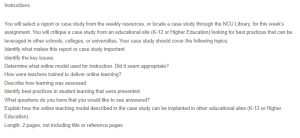
You will select a report or case study from the weekly resources, or locate a case study through the NCU Library, for this week’s assignment. You will critique a case study from an educational site (K-12 or Higher Education) looking for best practices that can be leveraged in other schools, colleges, or universities. Your case study should cover the following topics:
Identify what makes this report or case study important.
Critiquing an E-learning Case Study in Education
Identify the key issues.
Determine what online model used for instruction. Did it seem appropriate?
How were teachers trained to deliver online learning?
Describe how learning was assessed.
Identify best practices in student learning that were presented.
What questions do you have that you would like to see answered?
Explain how the online teaching model described in the case study can be implanted in other educational sites (K-12 or Higher Education).
Length: 2 pages, not including title or reference pages
Resources:
African American males learning online: Promoting academic achievement in higher education
Salvo, S.G., Shelton, K., & Welch, B. (2019). African American males learning online: Promoting academic achievement in higher education. Online Learning, 23(1), 22-36. doi:10.24059/olj.v23i1.1390.
This case study looks at factors to increase retention of African American males enrolled in online higher education. Research into increasing student retention helps ensure e-learning programs are effective and students can complete their studies.
Broward virtual school: Preparing students for success
Fuller, A. (2017). Broward virtual school: Preparing students for success. Distance Learning, 14(2), 35–40.
Broward Virtual School (BVS) provides programs for full-time and part-time students. Part-time students are students that are enrolled in another public school in the school district or are homeschooled. This paper provides a high-level overview of the approach BVS has taken to become a school of choice.
Innovation of Elearning at Comenius University
Pisutova, K. (2019). Innovation of Elearning at Comenius University. 2019 17th International Conference on Emerging ELearning Technologies and Applications (ICETA), Emerging ELearning Technologies and Applications (ICETA), 2019 17th International Conference, 644–648.
This paper describes the current state of e-learning at Comenius University and the steps they are taking to increase the use of e-learning. This paper provides insight into institutional planning for e-learning.
Innovating Pedagogy 2019
Ferguson, R., Coughlan, T., Egelandsdal, K., Gaved, M., Herodotou, C., Hillaire, G., Jones, D., Jowers, I., Kukulska-Hulme, A., McAndrew, P., Misiejuk, K., Misiejuk, K., Ness, I.J., Rienties, B., Scanlon, E., Sharples, M., Wasson, B., Weller, M., & Whitelock, D. (2019). Innovating Pedagogy 2019. The Open University.
This publication is a series of reports that explore innovative approaches to learning. Reports in this publication range from drone-based learning, learning through wonder, action learning, and virtual studios. Reading some these reports will provide you with insight to unique approaches to learning.
Lithuanian case study on evaluating suitability, acceptance and use of IT tools by students – An example of applying Technology Enhanced Learning Research methods in Higher Education
Kurilovas, E., & Kubilinskiene, S. (2020). Lithuanian case study on evaluating suitability, acceptance and use of IT tools by students – An example of applying Technology Enhanced Learning Research methods in Higher Education. Computers in Human Behavior, 107.
Technology can be used to enhance an individual learner’s experience. This study looks at the use of technology to enhance learning. This study is an example of how technology is used more along the lines of traditional on-ground education.
 Complete the order form and upload all of your files, including any instructions, rubrics, or other materials provided by your instructor.
  Complete the order payment after filling in the order form. We’ll receive your order and assign it to a writer.
 The assigned writer will complete your paper and forward it to our Editing Team for review and approval.
 Once approved by the editor, the completed paper will be uploaded to your account for you to download, review and approve.