
Critical Thinking: Mama Might Be Better Off Dead
Why Jackie Has a “Patient”
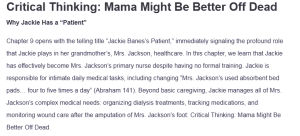
Chapter 9 opens with the telling title “Jackie Banes’s Patient,” immediately signaling the profound role that Jackie plays in her grandmother’s, Mrs. Jackson, healthcare. In this chapter, we learn that Jackie has effectively become Mrs. Jackson’s primary nurse despite having no formal training. Jackie is responsible for intimate daily medical tasks, including changing “Mrs. Jackson’s used absorbent bed pads… four to five times a day” (Abraham 141). Beyond basic caregiving, Jackie manages all of Mrs. Jackson’s complex medical needs: organizing dialysis treatments, tracking medications, and monitoring wound care after the amputation of Mrs. Jackson’s foot: Critical Thinking: Mama Might Be Better Off Dead.
Crucially, she must coordinate between multiple specialists who “were part of a separate system, and none of them communicated with one another” (Abraham 142). This leaves Jackie to synthesize scattered information and make life-or-death healthcare decisions alone. The examples throughout Chapter 9 show clearly that Mrs. Jackson has become Jackie’s “patient” not by choice but because the healthcare system has abdicated its responsibilities to the family. Jackie’s unpaid, untrained labor is essential for Mrs. Jackson’s survival, fully justifying the chapter’s powerful title.
The Restrictions of Medicare Policies
Throughout Mama Might Be Better Off Dead, the severe restrictions of Medicare policies are repeatedly exposed. Medicare only covers narrowly defined “skilled services,” such as brief nursing visits or specific therapies. It does not pay for essential daily care needs like cooking, bathing, cleaning, or long-term in-home assistance, all of which Mrs. Jackson required after her surgeries (Abraham 145). Many patients, including the Banes family, only learn about these restrictions after enrollment.
Medicare is portrayed as confusing, bureaucratic, and filled with technical rules that ordinary people, especially those living in poverty, do not understand ahead of time. If patients knew in advance how limited Medicare’s coverage truly was, some might hesitate to rely on it—but in reality, few underprivileged families have alternatives. Private insurance is unaffordable, and Medicaid has even stricter eligibility requirements. Therefore, even if the flaws of Medicare were more transparent, it likely would not deter participation; it remains the only realistic option for seniors like Mrs. Jackson who need basic healthcare access.
The Secondary Effects of Caregiving
While Jackie is the primary caregiver, the emotional and financial strain she experiences impacts the entire Banes family. Caregiver stress does not occur in isolation—it trickles down to children, spouses, and extended family. Jackie’s exhaustion and anxiety affect her ability to care for her children. For example, Jackie feels relieved when family members are hospitalized because it gives her “a chance to regroup” from the overwhelming caregiving demands at home (Abraham 144).
Her daughter Latrice, at just eleven years old, memorizes hospital phone numbers instead of focusing on childhood activities, revealing the premature responsibility placed on her. Financially, Jackie’s caregiving duties prevent her from working consistently, increasing the household’s economic instability. Emotionally, constant medical crises create a tense, survivalist atmosphere in the home. Thus, Jackie’s burdens radiate outward, shaping the experiences of every member of the Banes household and demonstrating how caregiving stress creates widespread, generational effects.
Why Mrs. Jackson Is Not Getting Better
Mrs. Jackson’s ongoing illnesses are not solely the result of her aging or personal choices but of systemic failures in the healthcare system. Although she had chronic conditions like diabetes and peripheral vascular disease, these illnesses were worsened by fragmented, delayed, and inadequate care. No one doctor oversaw her full case; instead, Mrs. Jackson had a nephrologist, internist, ophthalmologist, podiatrist, and surgeon, “and none of them communicated with one another” (Abraham 142). After her foot surgery, outpatient care was inconsistent, and home follow-up was limited because Medicare would not fund necessary supportive services.
As a result, her infections worsened, leading to further amputations and hospitalizations. While some responsibility may rest with Mrs. Jackson’s occasional noncompliance, it is clear that her repeated illnesses could have been prevented with early intervention, coordinated care, and sufficient at-home support. Therefore, the primary blame lies not with Mrs. Jackson herself but with a fractured healthcare system that fails to support vulnerable patients once they leave the hospital.
Works Cited
Abraham, Laurie K. Mama Might Be Better Off Dead: The Failure of Health Care in Urban America. 2nd ed., University of Chicago Press, 2019.
ORDER A PLAGIARISM-FREE PAPER HERE
We’ll write everything from scratch
Question 
Critical Thinking 2
Please answer each critical thinking questions based on the book “Mama Might Be Better Off Dead”
Critical Thinking: Mama Might Be Better Off Dead
Critical Thinking #2 “Mama Might Be Better Off Dead”
- Chapter 9 opens up with a very telling title, “Jackie Banese’s Patient.” What do we learn in this chapter that justifies Jackie having a “patient?” Provide examples to support your answer.
- Throughout this book, we see the restrictions of Medicare policies. In what ways is Medicare restrictive? Do patients know of these restrictions before signing up for Medicare? If patients knew the restrictions, would it deter them from participating in Medicare plans?
- Oftentimes, we see the negative effects that being a caregiver has on the person who is providing the care such as, Jackie. Who else is at risk of this secondary effect? In other words, how have we seen the trickle-down effect that the caregiver’s stress plays on other family members?
- Why isn’t Mrs. Jackson getting better? Who, if anyone, is to blame for her repetitive illnesses, and could these illnesses have been prevented?
 Complete the order form and upload all of your files, including any instructions, rubrics, or other materials provided by your instructor.
  Complete the order payment after filling in the order form. We’ll receive your order and assign it to a writer.
 The assigned writer will complete your paper and forward it to our Editing Team for review and approval.
 Once approved by the editor, the completed paper will be uploaded to your account for you to download, review and approve.