
Create an Integrative, Holistic, Caring Environment
Hello everyone, my name is (your name). Today’s presentation is on interventions promoting an integrative, holistic, caring environment. Welcome
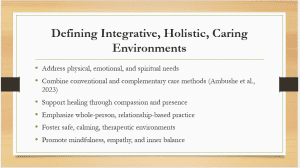
Integrative, holistic, caring environments are created to address the full range of human needs, including physical, emotional, and spiritual understanding beyond disease management in healing. Such environments combine standard medical care and evidence-based alternative treatments like mindfulness, relaxation, or aromatherapy to promote overall well-being (Ambushe et al., 2023). Compassion, presence, and profound connection are fostered in such environments, and authentic relationships between patients and caregivers are formed. More than isolated symptoms, holistic care addresses the person as a whole, considering the person’s values, beliefs, and life circumstances. Providing safe, peaceful, and therapeutic environments makes patients and staff feel comfortable and relaxed, minimising stress and maximising healing. By cultivating mindfulness, empathy, and emotional well-being, these settings not only enhance health outcomes but also support the culture of care, leading to more compassionate, effective, and sustainable provision of health care.
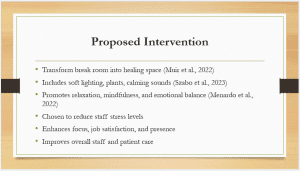
The intervention suggested is to renovate a staff break room into a healing room, specifically, and it will be used to facilitate relaxation and emotional renewal (Muir et al., 2022). The room will include soft lighting, natural elements such as indoor plants, and soothing sounds, all of which are components of a restorative and calming environment (Szabo et al., 2023). The aim is to provide a peaceful environment where nursing staff can stop, relax, and be present at work (Menardo et al., 2022). This intervention was selected to address increased stress and burnout among healthcare staff, issues that profoundly impact morale, staff retention, and the quality of care provided to patients. A healing space provides staff with a respite to rejuvenate, leading to improved focus, emotional balance, and job satisfaction. Ultimately, when staff are emotionally nurtured, patients receive more attentive, compassionate care. This evidence-based, cost-effective project is congruent with the hospital’s holistic, person-centered practice philosophy.
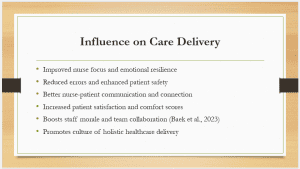
Establishing a healing environment for employees indirectly improves the quality of care being provided in the hospital. A peaceful environment where nurses can unwind increases focus and emotional resilience, allowing them to respond more effectively and wisely to patients’ needs. With less tension, mental performance is improved, medical errors are reduced, and safer care is improved. A more emotionally balanced nursing staff improves nurse-patient communication and strengthens intimate, trusting relationships. All these factors combined promote greater patient satisfaction and comfort, as patients sense they are more visible, heard, and cared for. Staff morale also benefits, as cooperative access to a restorative space fosters team bonding and support (Baek et al., 2023). Ultimately, this intervention creates a sustainable culture of whole-person, patient-centered care in which wellness is prioritized at every level, from patient experience to frontline staff. It redesigns care delivery by putting wellness, empathy, and human connection at the center.
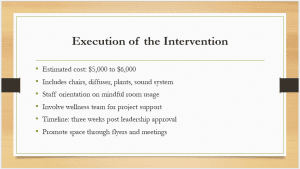
Implementation of the healing space intervention is an inexpensive, well-considered step that utilizes available hospital resources. The projected $5,000 to $6,000 budget includes comfortable seating chairs, an aromatherapy diffuser, calming plants, and a sound system to promote relaxation. Once funding and leadership are secured, transforming the space would only take about three weeks. Staff will receive a brief orientation about how to use the room respectfully and mindfully to continue reinforcing the room’s intention of being a place to relax and renew. A Wellness Team will implement and guide the room and ensure the staff’s needs are met. The intervention will be promoted through internal channels, such as meetings, visually appealing flyers and engagement to increase awareness and participation. Structure promotes smooth execution and maximizes impact and immediate and long-term usage of the space.
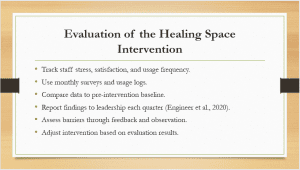
Three primary outcome objectives for the evaluation of the healing space intervention are staff stress levels, job satisfaction and occurrence of room usage. Perceived stress reduction and overall satisfaction with the intervention will be assessed monthly on anonymous survey forms. Moreover, usage logs of how the space will be used will also be kept. The impact will be measured by comparing these to baseline data taken before the intervention. Quarterly reports containing findings will be shared with hospital leadership to assist decision-making regarding the impact of program improvement (Engineer et al., 2020). Increased usage, positive survey responses, and reports of improved well-being will identify successes. Open-ended survey responses and observational feedback will be used to assess barriers, such as problems of low participation or scheduling. The findings of this evaluation will be used to inform appropriate modifications to the intervention to maintain relevance and effectiveness for staff needs.
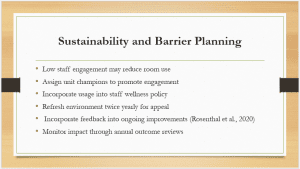
Maintaining the healing space intervention will necessitate continued attention to engagement, relevance, and integration into hospital culture. Low staff use, whether because of excessive workloads or lack of familiarity, is one of the barriers that may get in the way. To mitigate this, unit champions who will actively encourage use and model usage will be identified so the space continues to be visible and valued. Incorporating the healing room into the hospital’s wellness policy formalizes it as a normal support resource, not an optional amenity. Decor and sensory features will be updated biannually to keep the space appealing. Staff will be surveyed regularly to assess satisfaction, staff priorities, and areas for change. Feedback will be used to make incremental changes to align the space with staff needs (Rosenthal et al., 2020). Finally, an annual audit will assess usage patterns and well-being outcomes to ensure that the intervention continues to be effective, sustainable, and embedded in the general hospital culture of whole-person care.
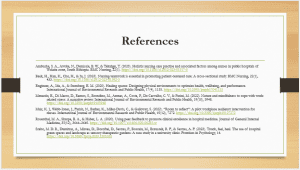
Ambushe, S. A., Awoke, N., Demissie, B. W., & Tekalign, T. (2023). Holistic nursing care practice and associated factors among nurses in public hospitals of Wolaita zone, South Ethiopia. BMC Nursing, 22(1). https://doi.org/10.1186/s12912-023-01517-0
Baek, H., Han, K., Cho, H., & Ju, J. (2023). Nursing teamwork is essential in promoting patient-centered care: A cross-sectional study. BMC Nursing, 22(1), 433. https://doi.org/10.1186/s12912-023-01592-3
Engineer, A., Ida, A., & Sternberg, E. M. (2020). Healing spaces: Designing physical environments to optimize health, wellbeing, and performance. International Journal of Environmental Research and Public Health, 17(4), 1155. https://doi.org/10.3390/ijerph17041155
Menardo, E., Di Marco, D., Ramos, S., Brondino, M., Arenas, A., Costa, P., De Carvalho, C. V., & Pasini, M. (2022). Nature and mindfulness to cope with work-related stress: A narrative review. International Journal of Environmental Research and Public Health, 19(10), 5948. https://doi.org/10.3390/ijerph19105948
Muir, K. J., Webb-Jones, J., Farish, N., Barker, K., Miller-Davis, C., & Galloway, S. (2022). “Room to reflect”: A pilot workplace resiliency intervention for nurses. International Journal of Environmental Research and Public Health, 19(12), 7272. https://doi.org/10.3390/ijerph19127272
Rosenthal, M. A., Sharpe, B. A., & Haber, L. A. (2020). Using peer feedback to promote clinical excellence in hospital medicine. Journal of General Internal Medicine, 35(12), 3644–3649. https://doi.org/10.1007/s11606-020-06235-w
Szabo, M. D. R., Dumitras, A., Mircea, D., Doroftei, D., Sestras, P., Boscaiu, M., Brzuszek, R. F., & Sestras, A. F. (2023). Touch, feel, heal. The use of hospital green spaces and landscape as sensory-therapeutic gardens: A case study in a university clinic. Frontiers in Psychology, 14. https://doi.org/10.3389/fpsyg.2023.1201030
ORDER A PLAGIARISM-FREE PAPER HERE
We’ll write everything from scratch
Question 
Create an Integrative, Holistic, Caring Environment
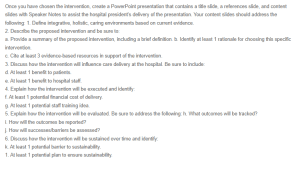
Once you have chosen the intervention, create a PowerPoint presentation that contains a title slide, a references slide, and content slides with Speaker Notes to assist the hospital president’s delivery of the presentation. Your content slides should address the following: 1. Define integrative, holistic, caring environments based on current evidence.
Create an Integrative, Holistic, Caring Environment
2. Describe the proposed intervention and be sure to:
a. Provide a summary of the proposed intervention, including a brief definition. b. Identify at least 1 rationale for choosing this specific intervention.
c. Cite at least 3 evidence-based resources in support of the intervention.
3. Discuss how the intervention will influence care delivery at the hospital. Be sure to include:
d. At least 1 benefit to patients.
e. At least 1 benefit to hospital staff.
4. Explain how the intervention will be executed and identify:
f. At least 1 potential financial cost of delivery.
g. At least 1 potential staff training idea.
5. Explain how the intervention will be evaluated. Be sure to address the following: h. What outcomes will be tracked?
i. How will the outcomes be reported?
j. How will successes/barriers be assessed?
6. Discuss how the intervention will be sustained over time and identify:
k. At least 1 potential barrier to sustainability.
1. At least 1 potential plan to ensure sustainability.
 Complete the order form and upload all of your files, including any instructions, rubrics, or other materials provided by your instructor.
  Complete the order payment after filling in the order form. We’ll receive your order and assign it to a writer.
 The assigned writer will complete your paper and forward it to our Editing Team for review and approval.
 Once approved by the editor, the completed paper will be uploaded to your account for you to download, review and approve.