
Counselling skills and Techniques in Session
Client ID: Anonymous Military Client
Session Number: 3
Session Duration: 15 minutes
Counselor: (Augusta Sherrod)
Client: Anonymous Military Client
| Speaker | Verbatim | Counselling skill or technique | Rationale |
| Counselor | So, you said you were in the reserves in active duty? | Open-ended questioning | This encourages the client to share more details about their military experience. It builds rapport and allows the counselor to explore contextual factors relevant to the client’s presenting concern (Butt, 2021). Open-ended questions also reduce the likelihood of the counselor leading the client. |
| Client | Well, I was in active duty and then we learned that they’re using the stop-loss policy to extend our active duties. We all have to return to Iraq for another tour.
|
||
| Counselor | Was that pretty upsetting? | Reflecting feeling | This validates the client’s potential emotional reaction to stop-loss orders. It also opens space for the client to discuss emotions they may otherwise suppress. Reflecting on emotions promotes a deeper exploration of the underlying affective state. |
| Client | I can’t begin to describe how I’m feeling. | ||
| Counselor | Tell me about why you decided to make an appointment with a psychiatrist. | Focused exploration | Redirects the conversation to the client’s purpose for seeking help (Falicov et al., 2020). This helps frame the session and elicit key concerns. It also promotes client-centered dialogue by giving the client control over topic disclosure. |
| Client | Well, some questions I can answer. Sadness, fear, I guess. But other questions I can’t find the answers to. | ||
| Counselor | Go ahead. | Encourager | This prompt encourages the client to keep speaking (Berg et al., 2022). It conveys openness and active listening. Simple encouragement supports a safe therapeutic environment. |
| Client | You know how they repealed the don’t ask, don’t tell policy? Well, I’m struggling if I should. You don’t have to report what I tell you?
|
||
| Counselor | Well, it’s similar to civilian life. The military is under the same HIPAA laws. So, if someone wants to look at your record, only medical personnel can look at your record and only with a medical reason. And no one else is allowed access. Any private personal issues you have which don’t break any law or military rule, those are not reported. Someone always could illegally access your medical record, but that person would be prosecuted. | Psychoeducation | Provides the client with factual information about confidentiality protections. This aims to reduce anxiety and build trust in the therapeutic alliance (Morgado et al., 2022). It also empowers the client to make informed decisions about disclosure. |
| Client | Good. I guess you can probably figure out. Well, I can’t figure out if I should tell people when I go back. | ||
| Counselor | Okay. So, have you been weighing the pros and cons of advantages and disadvantages about telling people about your sexuality?
|
Reframing | This rephrases the client’s internal conflict as a thoughtful decision-making process. It empowers the client by highlighting their ability to evaluate complex social dynamics. Reframing also helps reduce emotional intensity and foster problem-solving. |
| Client | Every day. | ||
| Counselor | What do you feel are the pressures for you to tell people?
|
Probing | This encourages the client to explore underlying motivations and external influences. It guides the session deeper into the emotional and social context of the dilemma. Probing questions helps the counselor gather specific information for further processing (Williams, 2023). |
| Client | It’s miserable enough being, just being a soldier. On top of that, you have to listen to all these gay comments. Oh, Johnston, you look like a fag when you wear your headgear like that. | ||
| Counselor | Who is Johnston? | Clarifying | This helps clarify who the client is referring to in the anecdote. It brings specificity to the discussion and invites elaboration on interpersonal relationships. Clarification prevents misinterpretation and supports accurate understanding. |
| Client | He’s one of my best friends.
|
||
| Counselor | Is he gay or someone who has homosexual type thoughts? | Reality testing | This question gently challenges the client’s assumptions without being confrontational. It helps the client explore their own thought process regarding identity perception. Reality testing can surface cognitive distortions or support clearer thinking. |
| Client | Johnston? No, never. | ||
| Counselor | Why do you say that? | Challenging assumptions | This encourages the client to reflect on the basis of their belief. It helps uncover potential cognitive distortions or biases influencing the client’s perception. |
| Client | I don’t know. I can just feel, sense that he’s not gay. | ||
| Counselor | Okay. So, if I play the, for me to play the devil’s advocate, maybe there are others who feel they know, can already feel whether you are gay or not. | Perspective shifting | This introduces a hypothetical angle to encourage the client to consider others’ viewpoints. It reduces defensiveness and invites the client to challenge their own certainty. |
| Client | No. I hide it. I’m careful.
|
||
| Counselor | I see. | Encourager | This short response signals active listening while allowing the client to lead the dialogue. It acknowledges the client’s response without interruption (Stefana et al., 2023). It maintains therapeutic flow and engagement. |
| Client | If I told the other people in my unit, the men and the women, they’d be surprised. I promise. | ||
| Counselor | So, you think that they all fell for the lies, as you call it, about your sexuality? | Reflecting content | This paraphrases the client’s earlier assertion in a way that invites clarification or affirmation (Kamp et al., 2024). It validates the internal conflict while helping the client assess the perceived success of concealment. Reflecting also helps clients feel understood. |
| Client | Absolutely. I think. Absolutely. I mean, they wouldn’t, they wouldn’t feel free to make all the, the comments like, like they do if they thought that I was. | ||
| Counselor | Have you ever talked with anyone in your unit about your private sexual thoughts, private sexual feelings? | Direct questioning | Direct questions help obtain essential information about the client’s communication patterns and boundaries. This also assists in evaluating levels of internalized stigma and isolation. It’s key in assessing social support and openness. |
| Client | No, never. | ||
| Counselor | Do others talk with you about their private sexual thoughts and feelings? | Contrast questioning | By comparing the client’s openness to others’, this technique explores social norms and peer dynamics. It helps the client recognize inconsistencies and their emotional impact. It can foster insight into feelings of alienation. |
| Client | Like fifty-nine minutes out of every hour, every day. | ||
| Counselor | Everyone? | Clarifying | A brief follow-up ensures an accurate interpretation of the client’s generalization. Clarifying strengthens the counselor’s understanding and encourages the client to reflect more precisely (Gómez Penedo et al., 2021). It also promotes honest dialogue. |
| Client | Well, almost everyone. I mean, some people are more private, standoffish | ||
| Counselor | So, what do you fear would happen if you did talk with them?
|
Anticipatory guidance | This prompts the client to examine possible outcomes and emotional readiness. It aids in processing hypothetical consequences, supporting proactive coping. It also surfaces underlying fears that may block authenticity. |
| Client | They wouldn’t feel comfortable around me. In the showers, patting me on the back, guy hugs, sleeping in close quarters.
|
||
| Counselor | So, some people, men and women, if they knew you were gay, they’d treat you differently. But it’s hard to know in advance what the, what the gains and losses are. All you can know is, it would be different. | Reality testing | This helps the client assess their assumptions in a broader, more objective context. It introduces ambiguity in a way that encourages deeper contemplation. |
| Client | They didn’t feel lousy for somebody to get up and move away from me because they thought that I’d do something with them. | ||
| Counselor | Some may very well feel that way. Do you ever have sexual thoughts about any of the men in your unit?
|
Exploratory questioning | This invites the client to consider and articulate the nature of their feelings. It helps distinguish between attraction, curiosity, and platonic closeness. This clarity is essential for addressing self-concept and anxiety. |
| Client | Mild curiosity, maybe, of what somebody looks like or something undressed. But not actually, you know, having sex kinds of thoughts. I have thoughts of wanting to be close. But that’s, that’s not sexual. I mean, with women too, you know, I enjoy close friendships. | ||
| Counselor | Sounds like, um, your feelings are still just a little bit confused about separating out friendship and sexual feelings. | Reflection feeling and reflection content | The counselor reflects both emotional tone and thematic content to promote clarity. This encourages the client to further differentiate emotional closeness from sexual desire. |
| Client | I’ve never been in an ongoing relationship. I mean, a few times fooling around a couple years back. | ||
| Counselor | Do you have any doubts about whether you prefer women or prefer men? | Clarifying | This helps the client define their sexual orientation with more precision. It also creates space for the client to explore internal certainty or unresolved doubts. It’s a necessary step toward self-acceptance. |
| Client | No, no doubts. I’ve known since I was eight what kind of nude photos, later internet pics, videos I like to look at. Just no real-life experiences. | ||
| Counselor | So, it sounds like you feel pretty confident about your sexuality. | Summarizing | Summarizing reinforces the client’s self-understanding and affirms their clarity (Prottay Kumar Adhikary et al., 2024). It encourages confidence in expressing identity while consolidating key session themes. It also confirms the counselor’s accurate interpretation. |
| Client | I’m gay. I know I’m gay. | ||
| Counselor | So, who else, other than me just now, have you ever said those words to? | Probing | This question explores the client’s level of disclosure and experience with identity expression. It gauges readiness for wider self-revelation and potential support networks. It also opens a window into the client’s internalized fears. |
| Client | I’m gay? | ||
| Counselor | Yes | Encourager | Encourages the client to continue expressing themselves. It conveys attentiveness without interrupting the client’s thought process. |
| Client | Just you, just now. | ||
| Counselor | So, you don’t have experience in telling people. You haven’t practiced that skill. | Normalizing | This reduces shame and pressure by making the task feel achievable. It validates the client’s current stage in identity development. |
| Client | I never thought of that as a skill. | ||
| Counselor | Well, you have the skill, it sounds like, of thinking about whether or not you are gay, which many people don’t even have that skill. But you are lacking in two skills. You have a little difficulty, a little confusion about thinking about separating friendships from sexual relations and then you’re lacking in that skill of telling people you are gay and not having those two skills, sometimes that scares people. | Psychoeducation | This approach affirms the client’s strengths while introducing areas for growth. It fosters hope through skill-building. |
| Client | Trying terrifies. | ||
| Counselor | Terrifies. Well, over the years, listening to people like I do with similar concerns, it’s clear to me that there are several skills in talking about one’s own sexuality. There are bad ways, bad timing for telling people about your sexuality and there are good ways, better timing. | Psychoeducation | This informs the client that timing and method of disclosure can be strategic. It reduces fear by positioning identity expression as a process that can be planned. Psychoeducation empowers the client with tools for safer communication. |
| Client | I guess that makes sense. | ||
| Counselor | And then another skill is recognizing that there are people who won’t want to learn directly from you about your sexuality and then there are people who do not want to learn about it directly from you. Maybe because of their religious beliefs or their cultural backgrounds or even their lack of experience. They’re just thinking about sexuality. So, it’s a skill to learn to look at people, talk to people, and sense their attitudes. So, you don’t confront them and surprise them or alarm them. | Cognitive restructuring | This helps the client view others’ reactions through a more empathetic, less personal way. It introduces a skill of social evaluation to reduce emotional harm (Ezawa & Hollon, 2023). Cognitive restructuring reduces negative assumptions about rejection. |
| Client | But these people, they’re supposed to be learning about sexuality in workshops and all, right? | ||
| Counselor | How many times have you gone to a class, learning, only to discover later it was more difficult to apply what you learned? | Reality testing | Encourages the client to consider the difference between theoretical knowledge and lived behavior. This helps recalibrate the expectations of others. |
| Client | Lots of times. | ||
| Counselor | Yeah. So, maybe one day people will come into the military and talk open about sexuality and early when they’re meeting people, but not now. We’re not there now. We have to be realistic. You look confused. Maybe confusion is okay. It’s a confusing topic at this point in our history. | Validation | Acknowledges the difficulty of navigating identity in a restrictive military system. It validates the client’s confusion as an appropriate response to societal ambiguity. |
| Client | What other skills am I missing? | ||
| Counselor | Well, what about dealing with rejection? | Probing | This introduces an overlooked but vital emotional skill in identity disclosure. It prepares the client for real-world reactions while framing it as something learnable. Naming it as a skill reduces stigma and fear. |
| Client | Rejection? | ||
| Counselor | Yep, that’s a skill. Think about it. Lots of celebrities and politicians, they have to be really superb at dealing with rejection. That’s a skill. If you tell people, you are gay, there are people who will walk away from it. Those people may need time to go think about it. Not what you shared with them. You’ve had lots of times to think about sexuality. Maybe they have not. You can expect that some of those people will come around and later be accepting. Other people who walk away from you may feel deceived, and they may never, ever come back to your side. | Psychoeducation and anticipatory guidance | This prepares the client for a range of possible responses and outcomes. It promotes resilience by setting realistic expectations. By providing examples, it also models cognitive flexibility and perspective-taking (Mhango et al., 2023). |
| Client | That’s what scares me. | ||
| Counselor | And you have to plan ahead for that. Rehearse it in your head. Maybe rehearse with accepting friends or counselors, professional people, about how you are going to deal with those moments. That’s a skill. You look sad about that. | Anticipatory guidance | Encourages practical strategies to reduce anticipatory anxiety and increase confidence. Rehearsal is a proven technique for emotion regulation. This intervention acknowledges emotion while empowering the client to prepare. |
| Client | I used to worry about rejection and it just made me want to die. | ||
| Counselor | Kill yourself? Any thoughts like that now? | Suicide risk assessment | This is a direct but essential safety check based on the client’s statement. It prioritizes client welfare and opens the door to necessary intervention if risk is present (Ryan & Oquendo, 2020). It models clinical responsibility and ethical care. |
| Client | You know, for years, I’ve seen too many people come out of the closet and do fine. I mean, not so much people I know, but from TV, internet, hearing their stories. | ||
| Counselor | In your unit, if you tell people, you feel people may threaten your safety, would they not watch your back when you were in danger? | Risk and safety evaluation | This checks for environmental threats while fostering reflection on existing trust within the unit. It’s essential in a military context where physical danger and unit cohesion are vital. This technique gauges protective and risk factors (Peart et al., 2023). |
| Client | No, the people in my unit are amazing. It’s more the small, the subtle looks, the feeling like I wasn’t with them. I mean, I don’t want to sound like a pussy, but these men are all I have, day after day. They’re right there, and I don’t, I don’t want to feel like I’m on the outside. | ||
| Counselor | So back when you were with the unit, did you feel like they were with you when you were not being truthful with them? | Reflective questioning | Promotes insight into authenticity and emotional connection. Helps the client evaluate the cost of inauthenticity on relational bonds. This technique supports exploration without imposing judgment (Mösler et al., 2022). |
| Client | I guess not. I couldn’t be with me. I wasn’t being real. I used to dream that what I had was real. I want that to end, not being real. | ||
| Counselor | What are you thinking? | Prompting | Encourages deeper cognitive processing and personal accountability in decision-making. The open nature of the question respects the client’s autonomy. |
| Client | I still don’t have my answer. I have a lot more weighing of pros and cons to do. Maybe that’s okay. Brush up on the skills, as you call them, while I prepare to tell them. How do I start? I wish I could use Stop Loss and take you with me. | ||
| Counselor | I mean, thank you for inviting me. You’re welcome. I tell you what, let me talk to a few people, see if I can identify someone with whom you can talk overseas. But in the meantime, let’s, you and me, at least have a session or two before you leave. Okay? | Support planning and continuity of care | Provides the client with support and continuity, increasing safety and trust (Khatri et al., 2023). Planning ahead also reduces abandonment anxiety and reinforces therapeutic commitment.
|
| Client | Sure. |
References
Berg, I., Hovne, V., Carlbring, P., Bernhard-Oettel, C., Oscarsson, M., Mechler, J., Lindqvist, K., Topooco, N., Andersson, G., & Philips, B. (2022). “Good job!”: Therapists’ encouragement, affirmation, and personal address in internet-based cognitive behavior therapy for adolescents with depression. Internet Interventions, 30(1), 100592. https://doi.org/10.1016/j.invent.2022.100592
Butt, M. (2021). Approaches to building rapport with patients. Clinical Medicine, 21(6), 662–663. https://doi.org/10.7861/clinmed.2021-0264
Ezawa, I. D., & Hollon, S. D. (2023). Cognitive restructuring and psychotherapy outcome: A meta-analytic review. Psychotherapy, 60(3), 396–406. https://doi.org/10.1037/pst0000474
Falicov, C., Nakash, O., & Alegría, M. (2020). Centering the Voice of the Client: On Becoming a Collaborative Practitioner with Low‐Income Individuals and Families. Family Process, 60(2), 670–687. https://doi.org/10.1111/famp.12558
Gómez Penedo, J. M., Schwartz, B., Deisenhofer, A.-K., Rubel, J., Babl, A. M., & Lutz, W. (2021). Interpersonal clarification effects in Cognitive-Behavioral Therapy for depression and how they are moderated by the therapeutic alliance. Journal of Affective Disorders, 279, 662–670. https://doi.org/10.1016/j.jad.2020.10.043
Kamp, D., Blanker, C., Hafkenscheid, A., & Os, J. van. (2024). The additional value of self-reflection and feedback on therapy outcome: a pilot study. Frontiers in Psychology, 15. https://doi.org/10.3389/fpsyg.2024.1451251
Khatri, R., Endalamaw, A., Erku, D., Wolka, E., Nigatu, F., Zewdie, A., & Assefa, Y. (2023). Continuity and care coordination of primary health care: A scoping review. BioMed Central Health Services Research, 23(1). https://doi.org/10.1186/s12913-023-09718-8
Mhango, W., Crowter, L., Michelson, D., & Gaysina, D. (2023). Psychoeducation as an active ingredient for interventions for perinatal depression and anxiety in youth: a mixed-method systematic literature review and lived experience synthesis. BJPsych Open, 10(1). https://doi.org/10.1192/bjo.2023.614
Morgado, T., Lopes, V., Carvalho, D., & Santos, E. (2022). The Effectiveness of Psychoeducational Interventions in Adolescents’ Anxiety: A Systematic Review Protocol. Nursing Reports, 12(1), 217–225. https://doi.org/10.3390/nursrep12010022
Mösler, T., Poppek, S., Leonhard, C., & Collet, W. (2022). Reflective Skills, Empathy, Wellbeing, and Resilience in Cognitive-Behavior Therapy Trainees Participating in Mindfulness-Based Self-Practice/Self-Reflection. Psychological Reports, 126(6), 003329412210944. https://doi.org/10.1177/00332941221094482
Peart, N., Hetrick, S., Gibson, K., & Stasiak, K. (2023). Exploring Counselor Practices and Risk Assessment in a Proactive Digital Intervention Through Instagram in Young People: Qualitative Study. JMIR Formative Research, 7(1), e46579. https://doi.org/10.2196/46579
Prottay Kumar Adhikary, Srivastava, A., Kumar, S., Salam Michael Singh, Puneet Manuja, Gopinath, J. K., Krishnan, V., Swati Kedia Gupta, Koushik Sinha Deb, & Chakraborty, T. (2024). Exploring the Efficacy of Large Language Models in Summarizing Mental Health Counseling Sessions: Benchmark Study. JMIR Mental Health, 11, e57306–e57306. https://doi.org/10.2196/57306
Ryan, E. P., & Oquendo, M. A. (2020). Suicide Risk Assessment and Prevention: Challenges and Opportunities. FOCUS, 18(2), 88–99. https://doi.org/10.1176/appi.focus.20200011
Stefana, A., Vieta, E., Paolo Fusar-Poli, & Youngstrom, E. (2023). Enhance psychotherapy outcomes by encouraging patients to regularly self-monitor, reflect on, and share their affective responses toward their therapist: Protocol for a randomized controlled trial (Preprint). JMIR Research Protocols. https://doi.org/10.2196/55369
Williams, E. N. (2023). The use of questions in psychotherapy: A review of research on immediate outcomes. Psychotherapy, 60(3), 246–254. https://doi.org/10.1037/pst0000471
ORDER A PLAGIARISM-FREE PAPER HERE
We’ll write everything from scratch
Question 
Counselling skills and Techniques in Session
Overview:
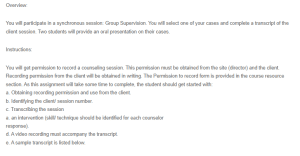
You will participate in a synchronous session: Group Supervision. You will select one of your cases and complete a transcript of the client session. Two students will provide an oral presentation on their cases.
Counselling skills and Techniques in Session
Instructions:
You will get permission to record a counseling session. This permission must be obtained from the site (director) and the client. Recording permission from the client will be obtained in writing. The Permission to record form is provided in the course resource
section. As this assignment will take some time to complete, the student should get started with:
a. Obtaining recording permission and use from the client.
b. Identifying the client/ session number.
c. Transcribing the session
a. an intervention (skill/ technique should be identified for each counselor
response).
d. A video recording must accompany the transcript.
e. A sample transcript is listed below.
 Complete the order form and upload all of your files, including any instructions, rubrics, or other materials provided by your instructor.
  Complete the order payment after filling in the order form. We’ll receive your order and assign it to a writer.
 The assigned writer will complete your paper and forward it to our Editing Team for review and approval.
 Once approved by the editor, the completed paper will be uploaded to your account for you to download, review and approve.