
Contraception Options
Condoms
Condoms are the widely used form of contraceptives worn to cover the erect penis or inserted into the vagina. For condoms to be effective, they must be worn before engaging in sex (Mahdy et al., 2022).
Pros
Condoms provide effective contraception and protection against sexually transmitted infections (STIs) (Mahdy et al., 2022). Condoms require no prescription, are convenient to carry, and are worn on demand. They are also non-hormonal (Mahdy et al., 2022).
Cons
They carry a risk of tearing during sex, and oil-based lubrication to reduce friction.
Indications and Contraindications
Condoms are used for birth control and protection against STIs. However, people with latex allergies may be affected by latex condoms.
Oral Contraceptive Pills
Oral contraceptive pills include combined estrogen-progesterone and progesterone-only pills (Cooper et al., 2022).
Pros
Pills are highly effective and do not disrupt sex life. They also act on painful menstruation, acne, and other related disorders such as fibroids and migraines (Cooper et al., 2022).
Cons
The cons of oral contraceptive pills include a high risk of non-adherence, lack of protection against STIs, and risk of exacerbation of blood pressure and hyperglycemia.
Indications and Contraindications
Oral contraceptive pills are indicated for birth control and contraindicated for hypertension and hyperglycemia (Cooper et al., 2022).
Contraceptive Implants
Contraceptive implants are tiny, flexible rods that periodically release progesterone hormone placed under the skin of a woman’s upper arm.
Pros
Implants are highly effective contraceptives. They last for an extended period of three years, are easy to reverse their effects, and have no impact on sexual desires or experiences.
Cons
Related side effects may include irregular menstrual bleeds, weight gain, and risk of insulin resistance and depression (Rocca et al., 2021). They also do not offer protection against STIs.
Indications and Contraindications
Contraceptive implants are indicated for effective birth control and may be contraindicated for people with diabetes, hypertension, epilepsy, and high cholesterol.
References
Cooper, D. B., Patel, P., & Mahdy, H. (2022). Oral Contraceptive Pills. A History of Intellectual Property in 50 Objects, 224–231. https://doi.org/10.5005/jp/books/12894_19
Mahdy, H., Shaeffer, A. D., & McNabb, D. M. (2022). Condoms. BMJ, 322(7296), 1253. https://doi.org/10.1136/bmj.322.7296.1253/a
Rocca, M. L., Palumbo, A. R., Visconti, F., & di Carlo, C. (2021). Safety and Benefits of Contraceptives Implants: A Systematic Review. Pharmaceuticals 2021, Vol. 14, Page 548, 14(6), 548. https://doi.org/10.3390/PH14060548
ORDER A PLAGIARISM-FREE PAPER HERE
We’ll write everything from scratch
Question 
Contraception Options
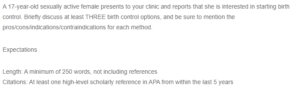
A 17-year-old sexually active female presents to your clinic and reports that she is interested in starting birth control. Briefly discuss at least THREE birth control options, and be sure to mention the pros/cons/indications/contraindications for each method.
Expectations
Length: A minimum of 250 words, not including references
Citations: At least one high-level scholarly reference in APA from within the last 5 years
 Complete the order form and upload all of your files, including any instructions, rubrics, or other materials provided by your instructor.
 Complete the order payment after filling in the order form. We’ll receive your order and assign it to a writer.
 The assigned writer will complete your paper and forward it to our Editing Team for review and approval.
 Once approved by the editor, the completed paper will be uploaded to your account for you to download, review and approve.