
Contemporary Nursing Practice
Evolution of Nursing Practice over time
There have been massive changes in the nursing field since its introduction by Florence Nightingale. During the early years of its introduction, nursing entailed caring for patients in their homes, which women mainly did. No education was required for one to provide nursing services. Early nursing practices involved simple tasks such as caring for the sick, which did not require professional skills and knowledge. However, with time, nursing evolved and became a profession. There have also been massive changes in nursing due to innovations and an increased need for advanced nursing care services.
Innovation, the use of technology, and the need for quality care led to drastic changes in nursing. The need for quality care resulted in nurses being trained in various fields. Nurses undergo general education but later specialize in multiple areas, such as ICU. Specialized nurses provide the highest quality of care to patients suffering from specific conditions since they are highly trained. The introduction of modern technology in healthcare improved the quality of care (Kowalski & Anthony, 2017). Nurses have to be prepared to use current technology in care. Today, information technology is incorporated into nursing education (Kowalski & Anthony, 2017). Nurses are also encouraged to conduct research that improves the quality of care and patient outcomes. Government and non-governmental organizations have supported nursing by funding their research and education. The changes in the use of technology and education have resulted in changes in nursing scope to fit the modern healthcare system (Kowalski & Anthony, 2017). The current nursing scope requires nurses to use the nursing process to care for the patients where they should assess the patient, develop a nursing diagnosis and a plan of action, develop nursing intervention together with their rationale, and finally implement the interventions. Nurses today are also required to use evidence-based practice, which improves patient outcomes.
Differentiated practice competencies between an associate and baccalaureate education in nursing
After completing their programs, both ADNs and BSNs become registered nurses. The duties and tasks for registered nurses include the provision of nursing care services such as assessing patients, performing physical examinations, taking vitals, and educating patients, among other simple nursing tasks (Loveridge et al., 2018). Although the programs for ADN take three years and BSN 4 years, their duties as registered nurses are similar. However, there are differences based on their level of education. BSNs undergo an advanced education compared to ADNs (Loveridge et al., 2018). Therefore, BSNs have more complex and sensitive responsibilities and leadership duties (Loveridge et al., 2018). The education of BSNs is more detailed and complex, where they are taught in areas such as research. Unlike ADNs, BSNs are managers and can advance their education to high levels, such as having a doctorate.
A patient care situation to show the difference between the BSN‐prepared nurse and the ADN nurse.
The difference between a BSN-prepared nurse and an ADN nurse can be seen when caring for a patient with stage four cancer who is in palliative care. In this case, unlike the ADN nurse, the BSN-prepared nurse will use critical thinking and evidence-based practice in caring for the patient. Any intervention performed by the BSN will have a rationale (Loveridge et al., 2018). The BSN, in this situation, will assess the patient and come up with a nursing diagnosis and relevant nursing interventions based on the assessment findings. A BSN, for example, will determine the spiritual and psychosocial needs of the patient and come up with an evidence-based intervention through critical thinking in caring for the patient (Loveridge et al., 2018). On the other hand, the ADN nurse will perform simple tasks in caring for the patient, such as giving the patient medication and turning the patient, among others. The ADN does simple tasks and interventions that do not require critical thinking.
Significance of applying evidence‐based practice to nursing care
Evidence-based practice (EBP) improves the quality of care since the nurse is confident and sure with the intervention being implemented. The patient outcomes are enhanced since the EBP nurse has more knowledge and skills (Grove & Gray, 2018). Evidence-based practice reduces medical errors and ensures the nurse works within the required scope of practice. The academic preparation of the registered BSN nurse supports EBP by incorporating more research in teaching (Grove & Gray, 2018). BSN student nurses must research articles and journals during their education to answer questions. Highly educated people, such as professors, educate nurses who encourage using evidence in nursing. The students also perform their research before they are allowed to graduate and practice. Any intervention that a nurse performs should have evidence from peer-reviewed articles.
How nurses today communicate and collaborate with interdisciplinary teams
Interdisciplinary collaboration involves various healthcare professionals, such as nurses, physicians, nutritionists, pharmacists, physiotherapists, social workers, and psychiatrists, working together to manage patients. Some people suffer from multiple conditions, which require different specialized professionals to manage all of the requirements (Mertens et al., 2019). The rise of lifestyle diseases such as hypertension and diabetes has increased the need for Interdisciplinary collaboration. Effective communication is essential in Interdisciplinary collaboration to prevent role confusion (Mertens et al., 2019). Nurses exchange information with team members through meetings they hold, where they come up with the best interventions. Education held by team members on certain days helps in communication, where the team members share knowledge and skills to improve care. The use of Electronic Health Records and systems also ensures effective communication among the team members (Mertens et al., 2019). Modern methods such as MHealth help nurses communicate with team members. Interdisciplinary collaboration reduces medical errors, hence improving the quality of care. Effective communication among the team members ensures efficiency when managing the patient.
Reference
Grove, S. K., & Gray, J. R. (2018). Understanding Nursing Research E-Book: Building an Evidence-Based Practice. Elsevier Health Sciences.
Kowalski, S. L., & Anthony, M. (2017). CE: Nursing’s evolving role in patient safety. AJN The American Journal of Nursing, 117(2), 34-48.
Loveridge, J., Yen, P. Y., Chipps, E., Gallagher-Ford, L., Genter, L., & Buck, J. (2018). Top-of-license nursing practice, part 2: Differentiating BSN and ADN perceptions of top-of-license activities. JONA: The Journal of Nursing Administration, 48(6), 329-334.
Mertens, F., De Gendt, A., Deveugele, M., Van Hecke, A., & Pype, P. (2019). Interprofessional collaboration within fluid teams: Community nurses’ experiences with palliative home care. Journal of Clinical Nursing, 28(19-20), 3680-3690.
ORDER A PLAGIARISM-FREE PAPER HERE
We’ll write everything from scratch
Question 
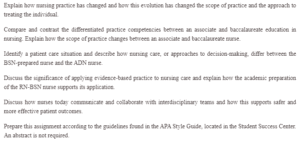
Explain how nursing practice has changed and how this evolution has changed the scope of practice and the approach to treating the individual.
Contemporary Nursing Practice
Compare and contrast the differentiated practice competencies between an associate and baccalaureate education in nursing. Explain how the scope of practice changes between an associate and baccalaureate nurse.
Identify a patient care situation and describe how nursing care, or approaches to decision‐making, differ between the BSN‐prepared nurse and the ADN nurse.
Discuss the significance of applying evidence‐based practice to nursing care and explain how the academic preparation of the RN‐BSN nurse supports its application.
Discuss how nurses today communicate and collaborate with interdisciplinary teams and how this supports safer and more effective patient outcomes.
Prepare this assignment according to the guidelines found in the APA Style Guide, located in the Student Success Center. An abstract is not required.
 Complete the order form and upload all of your files, including any instructions, rubrics, or other materials provided by your instructor.
 Complete the order payment after filling in the order form. We’ll receive your order and assign it to a writer.
 The assigned writer will complete your paper and forward it to our Editing Team for review and approval.
 Once approved by the editor, the completed paper will be uploaded to your account for you to download, review and approve.