
Constitutional Criminal Procedure
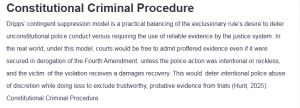
Dripps’ contingent suppression model is a practical balancing of the exclusionary rule’s desire to deter unconstitutional police conduct versus requiring the use of reliable evidence by the justice system. In the real world, under this model, courts would be free to admit proffered evidence even if it were secured in derogation of the Fourth Amendment, unless the police action was intentional or reckless, and the victim of the violation receives a damages recovery. This would deter intentional police abuse of discretion while doing less to exclude trustworthy, probative evidence from trials (Hunt, 2025): Constitutional Criminal Procedure.
Dripps (2001 ) comments that exclusion also serves the valuation problem because it comes very close to settling the sanction equal to the government’s illegal gain. The contingent model seeks to maintain a more equitable balance between public safety and constitutional rights. Police departments would, therefore, have greater motivation to strengthen training, supervision, and internal accountability to prevent constitutional violations.
Dripps’s model has already partially addressed restorative concerns but does not fully incorporate the principles of restorative justice. Restorative justice addresses the harm of crime or wrongdoing through dialogue, accountability and healing among offenders, victims and communities (Wood & Suzuki, 2024). Though compensating victims is one way to recognize harm, Dripps’ theory conceptualizes the offence as a legal wrong rather than a moral or relational wrong. Restorative justice would require officers or agencies to enter into direct dialogue with the people harmed, take responsibility and actively work to restore trust.
Galatians 6:2 states, “Carry each other’s burdens, and in this way, you will fulfil the law of Christ” (New International Version, 2011). This reminds us that true justice involves not only financial remedies but also shared empathy, responsibility, and healing. To render the contingent suppression model more compatible, it could encompass restorative conferences in which individuals who have committed misconduct and those they wronged have the opportunity to discuss. This would allow for acknowledgement of harm, repentance, and mutual understanding, thus deepening accountability beyond financial remedies.
References
Dripps, D. (2001). The case for the contingent exclusionary rule. Am. Crim. L. Rev., 38,1.
Hunt, L. W. (2025). Police interrogation and fraudulent epistemic environments. Journal of Public Policy, 45(2), 201–223. https://doi.org/10.1017/s0143814x25000030
New International Version. (2011). NIV Bible. Biblica.
Wood, W. R., & Suzuki, M. (2024). Getting to Accountability in Restorative Justice. Victims & Offenders, 19(7), 1–24. https://doi.org/10.1080/15564886.2024.2333304
ORDER A PLAGIARISM-FREE PAPER HERE
We’ll write everything from scratch
Question 
After completing Read: The Case for the Contingent Exclusionary Rule, respond to the following:
Based on the article and your current level of exposure to the topic of constitutional criminal procedure, outline your position as to how Dripps’ model would work in the real world.
Refer to Watch: Introduction to Criminal Procedure found in Module 1: Week 1. State whether Dripps’ Model of “Contingent Suppression” is in any way compatible with restorative justice. If not, how could it be made more compatible?
Constitutional Criminal Procedure
Please review the Discussion Assignment Instructions (ATTACHED) prior to posting. You may also click the three dots in the upper corner to Show Rubric.
Post-First: This course utilizes the Post-First feature in all Discussions. This means you will only be able to read and interact with your classmates’ threads after you have submitted your thread in response to the provided prompt.
 Complete the order form and upload all of your files, including any instructions, rubrics, or other materials provided by your instructor.
  Complete the order payment after filling in the order form. We’ll receive your order and assign it to a writer.
 The assigned writer will complete your paper and forward it to our Editing Team for review and approval.
 Once approved by the editor, the completed paper will be uploaded to your account for you to download, review and approve.