
Comparison Table on Types of Shock
| Hypovolemic | Cardiogenic | Neurogenic | Anaphylactic | Septic | |
| Pathophysiology | Excessive blood loss activates neuroendocrine, hematologic, renal, and cardiovascular systems (Taghavi et al., 2022). The neuroendocrine system responds by increasing the circulation of antidiuretic hormones, leading to increased salt and water reabsorption. The hematologic system responds by activating the coagulation cascade, which leads to contracting the bleeding blood vessels. The renal system increases renin secretion, which leads to the conversion of large amounts of angiotensin Ⅰ to form angiotensin Ⅱ that stimulates the release of aldosterone that, in turn, causes water conservation and sodium reabsorption. | Low cardiac output leads to left or right ventricular infarction (Kosaraju et al., 2020). | Primary and secondary injuries on the spinal cord cause loss of sympathetic tone (Dave & Cho, 2022). | Exposure to an allergen causes antigen and antibody reactions (McLendon & Sternard, 2022). | The infection causes a systemic response and organ damage (Mahapatra & Heffner, 2022). |
| Causes | Vascular disorders, such as arteriovenous malformations, aneurysms, and dissections.
Pregnancy-related disorders such as placenta previa, ectopic pregnancy, and placenta abruption. Traumatic causes include abdominal organ injury (Taghavi et al., 2022).
|
Coronary artery disease.
Diastolic dysfunction. Cardiac arrhythmias. Systolic dysfunction. Mechanical complications. Valvular dysfunction. |
Spinal cord injury.
Spinal anesthesia. Autonomic nervous system toxins. |
Exposure to allergens (McLendon & Sternard, 2022). | Microorganisms such as E. coli (Mahapatra & Heffner, 2022).
|
| Signs/Symptoms
|
Changes in mental status, such as confusion.
Lightheadedness. Lethargy and weakness. Abdominal, back, or chest pain in vascular disorders. Pain radiating towards the back in the thoracic aneurysm. Melena and hematemesis in gastrointestinal bleeding (Taghavi et al., 2022).
|
Signs of poor tissue perfusion include altered mental status, oliguria, and cool extremities.
Hypovolemia. Cyanotic, ashen, or cool skin. Absence of hypovolemia. Systemic hypotension. Distant heart sounds (Kosaraju et al., 2020). |
Hypotension.
Loss of consciousness. Pale or blueish skin. Flushing and increased sweating. Slow heart rhythm. Nausea and vomiting. Warm skin (Dave & Cho, 2022). |
Respiratory signs/symptoms include dyspnea, cough, shortness of breath, nasal congestion, and rhinorrhea.
Gastrointestinal signs/symptoms include cramps, dysphagia, diarrhoea, and vomiting. Cardiovascular signs/symptoms include chest pains, dizziness, and palpitations. Neurologic signs/symptoms include seizure, blurred vision, and headache. Dermatologic signs/symptoms include pruritis, swelling, and urticarial (McLendon & Sternard, 2022). |
Confusion.
Fever. Nausea and vomiting. Difficulty in breathing. Anxiety. Fatigue.
|
| Nursing Diagnosis | Decreased cardiac output is related to altered heart rate, rhythm, and preload (Taghavi et al., 2022).
|
Excess fluid volume is related to increased sodium and water retention and decreased renal organ perfusion (Kosaraju et al., 2020). | Risk for trauma related to spinal column instability at or above C-5 secondary to neurogenic shock (Dave & Cho, 2022). | Impaired gas exchange (McLendon & Sternard, 2022). | Risk for infection related to a compromised immune system secondary to septic shock (Mahapatra & Heffner, 2022). |
| Interventions:
|
Monitor the patient’s heart rate, blood pressure, arterial blood gases, oxygen saturation, and respiratory rate.
Prescribe and administer fluid, electrolyte, and blood replacement therapy. Monitor the patient’s ECG for dysrhythmias. Monitor the patient’s pulmonary capillary wedge pressure, central venous pressure, cardiac output, and pulmonary artery diastolic pressure (Taghavi et al., 2022).
|
Monitor the patient’s fluid intake, urine colour, and urine output.
Examine the patient weight, height, BMI, chest X-ray, electrolyte levels, and fluid balance. Examine the patient for distended jugular veins and oedema. Auscultate the lungs for orthopnea, dyspnea, and breath sounds. Position the patient in a Fowler’s position and turn the patient every two hours to improve breathing (Kosaraju et al., 2020). |
Maintain patient comfort and bed rest.
Maintain skeletal tractions using vests, tongs, and callipers. Assess the need for spinal stabilization through internal stabilization surgery (Dave & Cho, 2022). |
Monitor the patient’s arterial blood gases, oxygen saturation, ease of breathing, and respiratory rate.
Maintain airway patency and auscultate breath sounds. Administer oxygen therapy and corticosteroid medications (McLendon & Sternard, 2022). |
Maintain aseptic, hygiene, and handwashing techniques before interacting with the patient. Use of protective equipment such as gloves.
Pain management and limiting the use of invasive devices. Monitor the patient’s white blood cell count and visible signs of septic shock and infection (Mahapatra & Heffner, 2022).
|
| Patient Teaching
(for prevention)
|
Advise the patient on keeping warm and comfortable.
Educate patients and families on early detection (Taghavi et al., 2022).
|
Smoking cessation.
Limited intake of alcohol. Physical activity, exercising, and weight loss. Dietary adjustment with less saturated fat and cholesterol (Kosaraju et al., 2020). |
Prevent spinal cord injury by using a seatbelt and driving when sober (Dave & Cho, 2022). | Avoidance patient education that focuses on proper food labelling to prevent food anaphylaxis.
Patients are educated against self-medication to prevent drug allergies. Patients who are hypersensitive to insect stings are educated on avoiding brightly coloured clothes and scented perfumes that attract insects. Patients are advised to keep an epinephrine autoinjector (McLendon & Sternard, 2022). |
Educate the patient’s family and caregivers on hand hygiene and proper handwashing techniques.
Educate patients and their families on the effects and complications of infectious diseases (Mahapatra & Heffner, 2022).
|
References
Dave S, & Cho J.J. (2022). Neurogenic Shock. StatPearls Publishing. https://www.ncbi.nlm.nih.gov/books/NBK459361/.
Kosaraju, A., Pendela, V.S., & Hai, O. (2020). Cardiogenic Shock. StatPearls Publishing. https://www.ncbi.nlm.nih.gov/books/NBK482255/.
Mahapatra, S., & Heffner, A.C. (2022). Septic Shock. StatPearls Publishing. https://www.ncbi.nlm.nih.gov/books/NBK430939/.
McLendon, K., & Stannard, B.T. (2022). Anaphylaxis. StatPearls Publishing. https://www.ncbi.nlm.nih.gov/books/NBK482124/.
Taghavi, S., Nassar, A.K., & Askari, R. (2022). Hypovolemic Shock. StatPearls Publishing. https://www.ncbi.nlm.nih.gov/books/NBK513297/.
ORDER A PLAGIARISM-FREE PAPER HERE
We’ll write everything from scratch
Question 
Comparison Table on Types of Shock
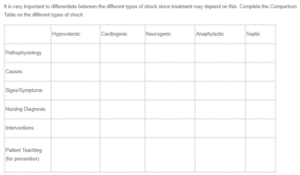
It is very important to differentiate between the different types of shock since treatment may depend on this. Complete the Comparison Table on the different types of shock.
| Hypovolemic | Cardiogenic | Neurogenic | Anaphylactic | Septic | |
| Pathophysiology | |||||
| Causes | |||||
| Signs/Symptoms | |||||
| Nursing Diagnosis | |||||
| Interventions | |||||
| Patient Teaching (for prevention) |
 Complete the order form and upload all of your files, including any instructions, rubrics, or other materials provided by your instructor.
  Complete the order payment after filling in the order form. We’ll receive your order and assign it to a writer.
 The assigned writer will complete your paper and forward it to our Editing Team for review and approval.
 Once approved by the editor, the completed paper will be uploaded to your account for you to download, review and approve.