
Comparison of Fluid Electrolyte Exemplars
Get in touch with us at eminencepapers.com for any assistance. We offer excellent Services.
| SIADH | Diabetes Insipidus | Acute Renal Failure | Chronic Renal Failure | |
| Pathophysiology | ADH plays the role of osmoregulation. ADH release is stimulated by increased plasma osmolality, reduced blood volume and pressure, stress, and the use of certain drugs. Lowered plasma osmolality prevents ADH release, leading to the production of highly diluted urine. Underlying factors may influence the release of ADH in the presence of normal or low plasma osmolality and blood volume and pressure. This may cause kidneys to retain water, leading to hyponatremia and increased body water volume. | Diabetes insipidus (DI) is an endocrine disorder that develops due to abnormalities in ADH secretion (Mutter et al., 2021). Based on the mechanism of disease development, DI can be presented as central (neurogenic) DI (CDI) and nephrogenic DI (NDI). CDI results from deficient secretion of ADH. Low ADH volumes allow the kidney to pass dilute urine, leading to excessive water loss and continuous thirst. NDI develops when the terminal distal convoluted tubule and the collecting duct are insensitive to ADH in circulation. | Acute renal failure (ARF) is the sudden impairment of renal function. The mechanism of ARF includes vascular and tubular factors. The impairment and loss of renal function can result from prerenal, intrarenal, postrenal, and unilateral injuries (Gaut & Liapis, 2021). This impairment causes insufficient waste elimination, increasing nitrogenous waste retention. ARF develops in 4 stages: initiation, oligo-anuria, polyuria, and restitution. However, ARF is only manifested during the oliguria stage. | Chronic renal failure is an end-stage renal disease. The loss of renal tissue function leads to renal functional adaptation. This can mask the abnormalities within the renal tissue structure and the progression of the disease unnoticed. The increased renal dysfunction impairs fluid and electrolyte homeostasis. This leads to the excessive excretion of phosphates, acid, and potassium (Malkina, 2022). CRF progresses over six stages, with the final stage leading to total renal failure and total loss of kidney function. |
| Etiology | SIADH can be hereditary or occur as a secondary disease complication. Common factors include central nervous system (CNS) abnormalities, drugs affecting ADH secretion and sensitivity to ADH, such as carbamazepine, oxcarbazepine, methylenedioxymethamphetamine, and oxcarbazepine, hormone impairments and hormone therapies (Yasir & Mechanic, 2022). | Significant forms of DI are CDI and NDI. CDI is the most common DI. CDI results from acquired brain injuries (TBI), infections, and blood loss in the posterior pituitary and the hypothalamus (Mutter et al., 2021). Surgical procedures such as neurosurgery and the development of tumours can lead to CDI. NDI development can be influenced by age, medications, and therapies such as Lithium therapy, protein malnutrition, hypokalemia, and ureteral obstruction. | ARF, currently known as acute kidney injury (AKI), results from ischemic injury, leading to a drop in renal blood supply. It is also a result of intrinsic renal parenchymal diseases and other processes leading to the obstruction of urine flow (Gaut & Liapis, 2021). | CRF can result from various factors leading to central renal dysfunction. The significant factors contributing to CRF are Diabetic nephropathy, Hypertensive nephrosclerosis, and other metabolic syndromes leading to renal damage. |
| Clinical Manifestations, including Laboratory data | SIADH manifestations are related to those of hyponatremia. These include CNS dysfunction, mental status changes, confusion, stupor, hyperreflexia, and other mental-related symptoms. Subtle symptoms show when the effective plasma osmolality falls below 240 mmol/kg, with extreme outcomes experienced when serum sodium falls below 115 mmol/L (Yasir & Mechanic, 2022). | Regardless of the form of DI, the disease’s main symptom is passing high amounts of dilute urine. DI is diagnosed as passing blood volumes over 3-3.5 litres within 24 hours and a urine osmolality below 300 mOsmol/kg (Mutter et al., 2021). DI can also manifest as unusual bed wetting, sleeping problems, vomiting, and feverishness. Some people with DI may experience constipation and retarded growth. | ARF is manifested by reduced urine output, chest pressure, irregular heartbeats, fatigue, nausea, and increased fluid retention. In severe instances, ARF can be manifested by seizures and even coma. | Disease progress is majorly asymptomatic. Manifestations are in the later stages of advancement. It is diagnosed when the estimated glomerular filtration rate (eGFR) is above 60 mL/min/1.73m2 or when the urinary albumin to creatinine ratio (ACR) is above 30 mg/g among adults (Malkina, 2022).
The primary symptoms include anorexia, nausea, vomiting, and stomatitis. Patients also manifest instances of dysgeusia, increased fatigue, pruritus, and mental issues. Patients may also experience muscle spasms, twi,tching, and seizures. |
| Interventions | The choice of intervention depends on the severity of the manifested SIADH symptoms. Interventions focus on managing the underlying factors of SIADH. Both pharmacological and non-pharmacological interventions are advised. The major interventions include severe restriction of fluid intake, use of hypertonic saline fluids, and vasopressin receptor antagonists. | Synthetic ADH can be administered to patients. Patients can also be provided with behavioural therapy to manage the mental outcomes of the condition as well as manage water intake.
Patient education is another intervention for DI focused on helping the patient understand their condition and how to manage it best. |
Patient education is the best intervention to manage current patients and at-risk populations. Education can focus on drugs to avoid and promote an active, healthy lifestyle. Renal replacement therapy for ARF can be considered a treatment plan for ARF. | Interventions for chronic renal failure focus on managing the underlying factors and comorbid diseases. Dietary restriction focused on proteins, phosphates, and potassium. Water intake is also restricted during recovery. Vitamin D supplements may also be provided as a treatment. |
| Possible Complications | Complications depend on levels of sodium in the blood. Some common complications due to lowered levels of sodium include occasional headaches and memory loss, depressive symptoms, and incidents of tremors and cramping (Yasir & Mechanic, 2022). Severe cases may lead to respiratory failures, seizures, hallucinations, and an increased risk of death. | DI due to excessive water loss leads to dehydration, which impacts skin elasticity and fatigue. DI is also a risk factor for electrolyte imbalance. This can lead to nausea, confusion, muscle cramping, and loss of appetite. | ARF leads to increased water retention, electrolyte imbalances and the need for hemodialysis. It also risks permanent kidney damage requiring transplantation. | The disease risks heart failure, anaemia, coagulation disorders, and the need for transplantation. |
References
Gaut, J. P., & Liapis, H. (2021). Acute kidney injury pathology and pathophysiology: a retrospective review. Clinical Kidney Journal, 14(2), 526–536. https://doi.org/10.1093/CKJ/SFAA142.
Malkina, A. (2022, October). Chronic Kidney Disease – Genitourinary Disorders. Merck Manuals Professional Edition. https://www.merckmanuals.com/professional/genitourinary-disorders/chronic-kidney-disease/chronic-kidney-disease.
Mutter, C. M., Smith, T., Menze, O., Zakharia, M., & Nguyen, H. (2021). Diabetes Insipidus: Pathogenesis, Diagnosis, and Clinical Management. Cureus, 13(2). https://doi.org/10.7759/CUREUS.13523.
Yasir, M., & Mechanic, O. J. (2022). Syndrome of Inappropriate Antidiuretic Hormone Secretion. Complications in Neuroanesthesia, 273–279. https://www.ncbi.nlm.nih.gov/books/NBK507777/.
ORDER A PLAGIARISM-FREE PAPER HERE
We’ll write everything from scratch
Question 
Comparison of Fluid Electrolyte Exemplars
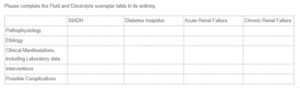
Please complete the Fluid and Electrolyte exemplar table in its entirety.
| SIADH | Diabetes Insipidus | Acute Renal Failure | Chronic Renal Failure | |
| Pathophysiology | ||||
| Etiology | ||||
| Clinical Manifestations, including Laboratory data | ||||
| Interventions | ||||
| Possible Complications |
 Complete the order form and upload all of your files, including any instructions, rubrics, or other materials provided by your instructor.
 Complete the order payment after filling in the order form. We’ll receive your order and assign it to a writer.
 The assigned writer will complete your paper and forward it to our Editing Team for review and approval.
 Once approved by the editor, the completed paper will be uploaded to your account for you to download, review and approve.