
Chronic Pain Syndrome
Evidence-based approaches in nursing seek to translate theory and available evidence into practice and improve nurse-related outcomes (Melnyk et al., 2021). However, searching for credible and relevant evidence for evidence-based practice (EBP) nursing is the most challenging task. Nurses should have excellent skills in searching for credible evidence from the available resources to aid in the implementation of EBP. Various frameworks assist nurses in designing their research and developing evidence for practice. The Population, Intervention, Comparison, Outcome, and Time (PICO(T)) framework is the primary framework for developing questions to guide nursing research. This paper will apply the PICO(T) framework to develop a research question to develop evidence around the diagnosis of chronic pain syndrome.
Use of the PICO(T) Approach to Diagnose Chronic Pain Syndrome
There are varied types and causes of chronic pain syndrome. This makes it a challenge for nurses to conclusively diagnose chronic pain syndrome and develop an appropriate treatment plan. Therefore, nurses end up trying out various tests. This may take time and hurt the experiences of the patient. Consequently, it is essential to research to collect evidence on the best applicable diagnosis approach to pinpoint the actual causes and type of chronic pain the patient experiences for effective treatment.
Hire our assignment writing services if your assignment is devastating you.
Applying the PICO(T) approach is essential in this situation. In this case, the population is the people from surgery with persistent pain, and the intervention is the imaging and nerve tests. At the same time, the control is physical and neurological exams, and the outcome is the differential diagnosis of chronic pain syndrome. Therefore, the PICO(T) formatted question is: In patients with persistent pain, are imaging and nerve tests more accurate than physical and neurological exams in the differential diagnosis of chronic pain syndrome?
Identification of Sources of Evidence to Answer PICO(T) Question
The primary sources of evidence are various types of articles published in peer-reviewed journals. The search for the sources of evidence to answer the PICO(T) question was conducted in PubMed and ScienceDirect databases. Various articles were returned based on the search. A CRAAP (Currency, Relevance, Authority, Accuracy, and Purpose) test was applied to identify more credible and relevant articles. Four of the identified articles to provide evidence to inform the differential diagnosis of chronic pain in patients were articles by Bourgaize et al. (2018), Pott et al. (2018), Treede et al. (2019), and van Straalen et al. (2020).
Findings from Sources of Evidence
The article by Bourgaize et al. (2018) compared the clinical manifestations and pathophysiology of fibromyalgia (FM) and myofascial pain syndrome (MPS) as the most prevalent significant types of chronic musculoskeletal pain syndromes. The authors found inconsistencies in the diagnosis of the primary forms of chronic musculoskeletal pain, making it difficult to carry out a differential diagnosis of FM and MPS. The authors suggest focusing on myofascial trigger points (MTP) as a differentiating factor between FM and MPS during diagnosis.
Pott et al. (2018) focused on diagnosing Myofascial Pain Syndrome in patients with chronic pain. The authors found that it contributed to the development of chronic pain. The findings of the article note focusing on myofascial trigger points (MTP) acted as a good criterion for diagnosing MPS.
In their article, Treede et al. (2019) focus on developing an updated diagnosis of chronic pain from the current International Classification of Diseases (ICD). The article is created on whether chronic pain is a disease or a symptom of an underlying disease. Based on a systematic review, the authors found that chronic pain could be primary or secondary: immediate anatomical pain that could not be defined by another condition and secondary as a symptom of an underlying disease.
Van Straalen et al. (2020) aimed to develop a diagnostic prediction model that utilizes patient-reported outcomes to differentiate between chronic pain disorders with overlapping and heterogeneous symptoms. With a focus on juvenile idiopathic arthritis (JIA) and chronic musculoskeletal pain syndrome (CMPS), the authors found that various factors before the onset of symptoms of the JIA and CMPS, such as age, sex, health condition, and locality of the pain could be used for differential diagnosis.
Relevance of Findings from the Chosen Articles in Making Decisions on a PICO(T) Question
The findings in the selected articles are relevant in making decisions on the differential diagnosis of chronic pain syndrome. However, no specific method has yet been identified to provide a complete diagnosis of chronic pain syndrome. Despite this, the articles provide evidence on how a differential diagnosis can be made. For instance, the findings by Treede et al. (2019) provide substantial details on how chronic pain can be differentiated as a disease or a symptom of an underlying health condition. Bourgaize et al. (2018) and Pott et al. (2018) focus on Myofascial pain syndrome as a joint chronic pain that can affect any part of the body and how myofascial trigger points (MTP) can be used as a differentiating factor between MSP and other chronic pain syndromes with heterogenous symptoms. Therefore, the evidence from the articles can provide a reference base when diagnosing patients to pinpoint the type of CPS and decide on the treatment plan for specific patients.
Conclusion
Chronic pain syndrome can be challenging to diagnose. However, implementing EBP in diagnosis can help achieve positive patient nursing outcomes. Applying the PICO(T) approach can guide nurses in developing credible evidence to utilize in the evidence-based diagnosis of chronic pain. However, despite the application of the PICO(T) framework, it is still challenging to settle on a single method for differential diagnosis of chronic pain syndrome.
References
Bourgaize, S., Newton, G., Kumbhare, D., & Srbely, J. (2018). A comparison of the clinical manifestation and pathophysiology of myofascial pain syndrome and fibromyalgia: implications for differential diagnosis and management. The Journal of the Canadian Chiropractic Association, 62(1), 26. /pmc/articles/PMC6160895/
Melnyk, B. M., Tan, A., Hsieh, A. P., & Gallagher-Ford, L. (2021). Evidence-Based Practice Culture and Mentorship Predict EBP Implementation, Nurse Job Satisfaction, and Intent to Stay: Support for the ARCC© Model. Worldviews on Evidence-Based Nursing, 18(4), 272–281. https://doi.org/10.1111/WVN.12524
Pott, H., Baeumler, P., & Irnich, D. (2018). Diagnosis of Myofascial Pain Syndrome in Chronic Pain Patients in Daily Clinical Practice. Journal of Acupuncture and Meridian Studies, 11(4), 259–260. https://doi.org/10.1016/J.JAMS.2018.08.193
Treede, R. D., Rief, W., Barke, A., Aziz, Q., Bennett, M. I., Benoliel, R., Cohen, M., Evers, S., Finnerup, N. B., First, M. B., Giamberardino, M. A., Kaasa, S., Korwisi, B., Kosek, E., Lavand’Homme, P., Nicholas, M., Perrot, S., Scholz, J., Schug, S., Wang, S. J. (2019). Chronic pain as a symptom or a disease: The IASP Classification of Chronic Pain for the International Classification of Diseases (ICD-11). Pain, 160(1), 19–27. https://doi.org/10.1097/J.PAIN.0000000000001384
van Straalen, J. W., van Stigt Thans, M., Wulffraat, N. M., de Roock, S., & Swart, J. F. (2022). A Diagnostic Prediction Model for Separating Juvenile Idiopathic Arthritis and Chronic Musculoskeletal Pain Syndrome. The Journal of Pediatrics. https://doi.org/10.1016/J.JPEDS.2022.04.029
ORDER A PLAGIARISM-FREE PAPER HERE
We’ll write everything from scratch
Question 
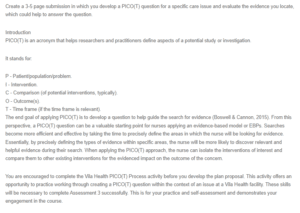
Create a 3-5 page submission in which you develop a PICO(T) question for a specific care issue and evaluate the evidence you locate, which could help to answer the question.
Chronic Pain Syndrome
Introduction
PICO(T) is an acronym that helps researchers and practitioners define aspects of a potential study or investigation.
It stands for:
P – Patient/population/problem.
I – Intervention.
C – Comparison (of potential interventions, typically).
O – Outcome(s).
T – Time frame (if the time frame is relevant).
The end goal of applying PICO(T) is to develop a question to help guide the search for evidence (Boswell & Cannon, 2015). From this perspective, a PICO(T) question can be a valuable starting point for nurses applying an evidence-based model or EBPs. Searches become more efficient and effective by taking the time to precisely define the areas in which the nurse will be looking for evidence. Essentially, by precisely defining the types of evidence within specific areas, the nurse will be more likely to discover relevant and helpful evidence during their search. When applying the PICO(T) approach, the nurse can isolate the interventions of interest and compare them to other existing interventions for the evidenced impact on the outcome of the concern.
You are encouraged to complete the Vila Health PICO(T) Process activity before you develop the plan proposal. This activity offers an opportunity to practice working through creating a PICO(T) question within the context of an issue at a Vila Health facility. These skills will be necessary to complete Assessment 3 successfully. This is for your practice and self-assessment and demonstrates your engagement in the course.
Reference
Boswell, C., & Cannon, S. (2015). Introduction to nursing research. Jones & Bartlett Learning.
Professional Context
As a baccalaureate-prepared nurse, you will locate and identify credible and scholarly resources to incorporate the best available evidence to enhance clinical reasoning and judgment skills. When reliable and relevant evidence-based findings are utilized, patients, healthcare systems, and nursing practice outcomes are positively impacted.
PICO(T) is a framework that can help you structure your definition of the issue, a potential approach that you will use, and your predictions related to the issue. Word choice is essential in the PICO(T) process because different word choices for similar concepts will lead you to additional existing evidence and research studies to help develop your initial question. When writing a PICO(T)-formatted research question, you want to focus on the intervention’s impact and compare the desired outcome.
Scenario
For this assessment, please use a healthcare issue of interest from your current or past nursing practice.
If you do not have an issue of interest in your nursing practice, review the optional Case Studies presented in the resources and select one of those as the basis for your assessment.
Instructions
Select a healthcare issue of interest for this assessment and apply the PICO(T) process to develop and research the research question.
Your initial goal is to define the population, intervention, comparison, and outcome. In some cases, a time frame is relevant, and you should include that when writing a question, you can research related to your issue of interest. After you define your question, analyze it, and organize your initial findings, select the two sources of evidence that seem the most relevant to your question and explore them more deeply. Interpret each source’s specific findings and best practices related to your issues and explain how the evidence would help you plan and decide on your question.
If you need some structure to organize your initial thoughts and research, the PICOT Question and Research Template document (accessible from the “Create PICO(T) Questions” https://capellauniversity.libguides.com/EBP/picot page in the Capella library’s Evidence-Based Practice guide) might be helpful.
In your submission, make sure you address the following grading criteria:
Define a practice issue to be explored via a PICO(T) approach. Create a PICO(T)-formatted research question
Identify sources of evidence that could be potentially effective in answering a PICO(T) question (databases, journals, websites, etc.).
Explain the findings from articles or other sources of evidence related to the identified healthcare issue.
Explain the relevance of the findings from chosen sources of evidence to deciding a PICO(T) question.
Communicate using the current APA style using clear, logical, and professional writing with correct grammar and spelling.
Example Assessment: You may use the following to give you an idea of what a Proficient or higher rating on the scoring guide would look like:
 Complete the order form and upload all of your files, including any instructions, rubrics, or other materials provided by your instructor.
 Complete the order payment after filling in the order form. We’ll receive your order and assign it to a writer.
 The assigned writer will complete your paper and forward it to our Editing Team for review and approval.
 Once approved by the editor, the completed paper will be uploaded to your account for you to download, review and approve.