
Case Study of Major Depressive Disorder With Peripartum Onset
This paper presents a strengths-based diagnostic assessment of Yvonne Perez, a 23-year-old Hispanic woman who presented for outpatient psychiatric evaluation three weeks after giving birth to her second child. Through a clinical lens grounded in DSM-5-TR and a culturally responsive approach, the paper analyzes Yvonne’s symptom presentation, contextualizes her experience within social and cultural dimensions, and formulates an appropriate diagnosis with differential considerations. It also lays the groundwork for evaluating these areas and presents comprehensive dual-pathway treatment objectives that encompass a medical-scientific and decolonized perspective.
Strengths, Resources, and Competencies
Yvonne does have potential internal strengths and competencies despite her present psychological condition. This is seen when she tried to breastfeed and attend to her children under conditions that must have been physically and emotionally unbearable at some point. The fact that she should be able to speak out and seek assistance also points to insight and survival. She also acted responsibly throughout, for instance, quitting smoking during pregnancy and bearing the responsibility of running a house. Her bonding with her extended family is limited. However, the positive family environments she experienced during her childhood and her belief in religion can be employed as assets in prospecting future treatment. These areas of strength should, therefore, be identified and/or included in the subsequent treatment plan.
Contextual and Cultural Considerations
Yvonne’s representation of mental illness is couched in cultural and environmental factors. She might have internalized the ideal Hispanic woman stereotype, the model of a submissive wife and an affectionate mother, and Christian morality principles. She was moved to another city due to her husband’s job, which deprived her of the essential social support system, thus making her susceptible to experiencing emotional distress. The added psychological load arising from her husband’s lack of support for the pregnancy, together with the lack of paid employment outside the home, detracts from personal autonomy. Also, this feeling of ‘punishment’ to bear a child when she never wanted one in the first place indicates a sense of sinfulness or sin within her religious belief system. These aspects form a more intricate psychosocial context that should guide diagnosis and treatment interventions.
DSM-5-TR Diagnosis and Justification
Based on Yvonne’s description of her symptoms, she meets the criteria for Major Depressive Disorder, Recurrent Episode, Moderate, With Peripartum Onset (ICD-10 code F33.1). The diagnosis requires five or more symptoms over at least two weeks, with at least one being a depressed mood or loss of interest (American Psychiatric Association, 2022). Yvonne reports persistent sadness, loss of pleasure, insomnia, psychomotor retardation, chronic fatigue, guilt, and cognitive impairment, all contributing to a significant functional decline. Her belief that she is being punished, coupled with withdrawal and lack of enthusiasm since pregnancy, suggests an enduring depressive episode rather than a brief mood fluctuation. The peripartum specifier is appropriate, as symptoms began during pregnancy and worsened postpartum. The moderate severity is supported by her level of impairment, though she denies suicidal ideation or psychotic symptoms.
Differential Diagnosis and DSM-5-TR Codes
The first differential diagnosis is Adjustment Disorder with Depressed Mood (F43.21). This condition presents with emotional or behavioral symptoms in response to identifiable stressors—such as unplanned pregnancy, lack of familial support, and role strain (Geer, 2023). While Yvonne clearly faces these stressors, her symptoms, including cognitive dysfunction and psychomotor slowing, exceed the scope of an adjustment reaction. Additionally, the pervasiveness and functional impairment she displays are more consistent with a mood disorder, making Adjustment Disorder less appropriate.
The second differential diagnosis is Persistent Depressive Disorder (Dysthymia) (F34.1). This disorder requires a depressed mood most of the day, more days than not, for at least two years (Patel et al., 2024). Though Yvonne’s symptoms are severe, they have only been present since her most recent pregnancy and postpartum period. There is no evidence of a prolonged low mood history predating this episode. Therefore, the duration criteria are not met, and this diagnosis is ruled out.
Notably, the third consideration is Generalized Anxiety Disorder (F41.1). Yvonne reports constant worry about daily functioning, disrupted sleep, fatigue, and difficulty concentrating. These symptoms could align with GAD; however, her predominant affect is sadness, not worry, and her core experience revolves around depressive thoughts and low mood rather than pervasive anxiety (Munir & Takov, 2022). Furthermore, she does not describe restlessness, muscle tension, or irritability, which are central to GAD. Thus, while anxiety is a feature, it appears secondary to depression and insufficient to meet diagnostic criteria for GAD. These considerations reinforce Major Depressive Disorder with peripartum onset as the most accurate diagnosis.
Additional Assessment Questions
Several critical questions must be addressed to refine the diagnostic picture and provide holistic care. It is important to explore how Yvonne’s religious beliefs influence her interpretation of suffering, motherhood, and guilt, as this may uncover spiritual distress (Shea, 2016). Inquiry into her previous postpartum experiences is also vital—did she experience similar symptoms after her first child? If so, this would strengthen the justification for a recurrent depressive disorder. Clarifying her coping strategies during previous stressful periods may help identify culturally appropriate resources that can be re-integrated into care. Additional questions should address potential intergenerational trauma, the impact of relocation on her cultural identity, and her access to social support networks. These explorations are essential not just diagnostically but also to inform healing interventions that honor her lived experience.
Treatment Goals
The first goal, within a traditional medical model, is to reduce depressive symptoms interfering with Yvonne’s maternal functioning, particularly her fatigue and poor sleep. A culturally adapted objective would be for Yvonne to engage in a structured nighttime routine, incorporating relaxation practices that resonate with her—such as prayer, music, or warm baths—at least three times per week (Shea, 2016). The therapist’s intervention would include introducing psychoeducation on sleep hygiene, helping her identify culturally congruent methods, and checking in on their effects throughout treatment.
The second goal is informed by a decolonizing framework of care and pertains to Yvonne regaining her sense of cultural well-being or spirituality and support systems. One might set a therapeutic goal that maybe in the next four weeks, she is to engage in a community resource or group, such as a Latina mothers support group or an online faith-based group. The above options would be researched, and the provider would facilitate her participation in any of them. It could also help re-establish a place, a social ground, and redemption and relevance to belief systems of childbirth and mother for hearing.
Conclusion
Yvonne Perez’s case proves how complex is the process of evaluating mental health in various aspects of individual, cultural, and structural settings. Whereas most may argue that she has major depressive disorder peripartum onset to explain her suffering and pain, there is more to her suffering than diagnosis. Thus, there should be proper utilization of the strengths-based cultural approach to support her and assist in her recovery process. In the light of high diagnosability and elimination of the colonial approach to care, this case affirms the relevance of respect, partnership, and humility in mental health care delivery.
References
American Psychiatric Association. (2022). Diagnostic and statistical manual of mental disorders (DSM-5-TR). Psychiatry.org; American Psychiatric Association. https://www.psychiatry.org/psychiatrists/practice/dsm
Shea, S., C. (2016). Psychiatric interviewing: The art of understanding: A practical guide for psychiatrists, psychologists, counselors, social workers, nurses, and other mental health professionals (3rd ed.). Elsevier.
Geer, K. (2023). Adjustment disorder. Primary Care: Clinics in Office Practice, 50(1), 83–88. https://doi.org/10.1016/j.pop.2022.10.006
Munir, S., & Takov, V. (2022, October 17). Generalized anxiety disorder. StatPearls – NCBI Bookshelf. https://www.ncbi.nlm.nih.gov/books/NBK441870/
Patel, R. K., Aslam, S. P., & Rose, G. M. (2024, August 11). Persistent depressive disorder. StatPearls – NCBI Bookshelf. https://www.ncbi.nlm.nih.gov/books/NBK541052/
ORDER A PLAGIARISM-FREE PAPER HERE
We’ll write everything from scratch
Question 
Case Study of Major Depressive Disorder With Peripartum Onset
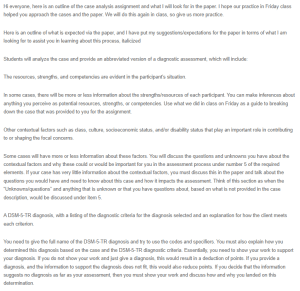
Hi everyone, here is an outline of the case analysis assignment and what I will look for in the paper. I hope our practice in Friday class helped you approach the cases and the paper. We will do this again in class, so give us more practice.
Case Study of Major Depressive Disorder With Peripartum Onset
Here is an outline of what is expected via the paper, and I have put my suggestions/expectations for the paper in terms of what I am looking for to assist you in learning about this process, italicized
Students will analyze the case and provide an abbreviated version of a diagnostic assessment, which will include:
The resources, strengths, and competencies are evident in the participant’s situation.
In some cases, there will be more or less information about the strengths/resources of each participant. You can make inferences about anything you perceive as potential resources, strengths, or competencies. Use what we did in class on Friday as a guide to breaking down the case that was provided to you for the assignment.
Other contextual factors such as class, culture, socioeconomic status, and/or disability status that play an important role in contributing to or shaping the focal concerns.
Some cases will have more or less information about these factors. You will discuss the questions and unknowns you have about the contextual factors and why these could or would be important for you in the assessment process under number 5 of the required elements. If your case has very little information about the contextual factors, you must discuss this in the paper and talk about the questions you would have and need to know about this case and how it impacts the assessment. Think of this section as when the “Unknowns/questions” and anything that is unknown or that you have questions about, based on what is not provided in the case description, would be discussed under item 5.
A DSM-5-TR diagnosis, with a listing of the diagnostic criteria for the diagnosis selected and an explanation for how the client meets each criterion.
You need to give the full name of the DSM-5-TR diagnosis and try to use the codes and specifiers. You must also explain how you determined this diagnosis based on the case and the DSM-5-TR diagnostic criteria. Essentially, you need to show your work to support your diagnosis. If you do not show your work and just give a diagnosis, this would result in a deduction of points. If you provide a diagnosis, and the information to support the diagnosis does not fit, this would also reduce points. If you decide that the information suggests no diagnosis as far as your assessment, then you must show your work and discuss how and why you landed on this determination.
A description of which other disorders were considered in the differential diagnosis, and why those ultimately were not selected.
This is an essential element, and if you skip this or say that you didn’t consider any other diagnosis, then. You will have points deducted as well. This section of the paper is focused on discussing what other diagnoses, you must have at least ONE, that you had considered in the assessment and diagnosis process, and talk about why you considered it and why you eventually ruled it out as a diagnosis. Again, showing your work and your thought process is key in this section. Use what we did in class as an example of how you list a potential diagnosis and then rule it out by talking about why the expressions/symptoms do not meet the criteria.
A list of additional questions the assessor would like to ask the client to develop a more comprehensive understanding of the client’s diagnosis.
In this section, you would focus on all the questions you need answered and what is missing from the case to help you understand the participant, their lived experiences, and the presenting problem/concern. Here, you will utilize what you learned from the Decolonizing Therapy book and other readings/discussions to consider the effects of colonization, oppression, and historical and intergenerational trauma. You would also discuss questions you would want to know about the unknown cultural contextual factors, and need to know more about them to understand the person and their experience. When writing out your questions, you need to provide some context as to why you would ask the questions regarding understanding the individual and their experiences, with the purpose of assessment and diagnosis.
A list of treatment goals consistent with the client assessment.
We will assume that all of these goals were achieved in collaboration with the participants and that the goals are not what “we tell them” they need to do.
For this section, you must include two treatment goals, at least one objective for each goal, and at least one intervention for each goal. Remember, the objectives are what the participant will do as an action step toward the goal, and the intervention is what you, as the worker/provider/healer, will do to help the participant work on the objective(s) toward meeting their goal.
Goal 1 – needs to be a medical model goal, meaning it needs to focus on reducing a symptom or symptoms of the diagnosis that is creating “impairments in functioning” for the individual. The one objective (what action the participant will take toward the goal), and one intervention (what are you as the worker/provider/healer) going to do. While this is a medical model of treatment planning, we must do what we can to incorporate and use anti-oppressive and decolonizing practices in any way we can, which is the constant challenge and tension, as we discussed working in medicalized models of care.
Example: Participant’s diagnosis based on the expressions/symptoms is Generalized Anxiety Disorder, and the expression/symptom of excessive worry is making falling asleep difficult, and they report feeling tired and panicky the next day.
Goal: Reduce symptoms of anxiety so that daily functioning in the area of sleep is not impaired.
Objective: The participant will use at least one relaxation technique before bedtime at least three times a week and measure it by keeping a log of the nights they used it and the amount of time it took to fall asleep each night.
Intervention: I/We (if you are writing the paper with a group) will teach and practice relaxation exercises that align with the participant’s values and lifestyle and support them in finding a sleep routine that works for them.
Goal 2: Imagine there are no requirements from insurance or licensing boards, and all forms of healing and care are accessible to everyone. Ground yourself in a decolonized approach to care, and envision what healing could look like if practiced within a decolonized system. Write a goal for the individual, in your case, from this perspective. Be sure to include at least one objective and one intervention for this goal.
FORMAT of PAPER
There is no required page count for this paper. Your paper will be graded based on whether you include all the required elements and follow the guidelines.Please aim for depth, clarity, and thoughtful engagement with the material.
Your paper must follow APA format. This includes:
A title page with the academic honesty statement/pledge
A narrative format (do not use bullet points to respond to questions)
You can use the in-class practice from Friday to help organize your thoughts and structure your writing.
Citations and References
Include in-text citations where appropriate, and provide a full reference page at the end of your paper. You must cite the DSM-5-TR and other course readings or resources you use for the paper.
CASE ANALYSIS MENTION ABOVE.
The case analysis assignment is intended to improve students’ capacity to apply elements of a strengths- based assessment of client concerns in the context of the DSM-5-TR diagnostic model. The instructor will present students with a case. Students may choose to work in groups of 3 or individually. Students will analyze the case and provide an abbreviated version of a diagnostic assessment, which will include:
1.The resources, strengths and or competencies that are evident in the client situation.
2. Other contextual factors such as class, culture, socioeconomic status, and/or disability status that play an important role in contributing to or shaping the focal concerns.
3. A DSM-5-TR diagnosis, with a listing of the diagnostic criteria for the diagnosis selected and an explanation for how the client meets each criterion.
4. A description of which other disorders considered in the differential diagnosis, and why those ultimately were not selected.
5. A list of additional questions the assessor would like to ask the client to develop a more comprehensive understanding of the client’s diagnosis.
6. A list of treatment goals consistent with the client assessment.
7. If you are referring to a specific article, please be sure to cite the source using APA format.
 Complete the order form and upload all of your files, including any instructions, rubrics, or other materials provided by your instructor.
  Complete the order payment after filling in the order form. We’ll receive your order and assign it to a writer.
 The assigned writer will complete your paper and forward it to our Editing Team for review and approval.
 Once approved by the editor, the completed paper will be uploaded to your account for you to download, review and approve.