
Case Study – Concept Map and Plan of Care for Mrs Y, an 84-year-old Client
Concept Map

Nursing Plan of Care
| Prioritized Nursing Diagnoses | Goal | Nursing Interventions |
| Risk for infection | Patients maintain freedom from infection. | 1. Provide appropriate wound care to the patients. This may hasten the healing process and prevent reinfection (Rodrigues et al., 2019).
2. Help the patients clean their environment to eliminate environmental pathogens that may increase their likelihood of being reinfected. 3. Ensure all equipment used for catheterization is properly disinfected prior to use to guarantee freedom from external pathogens. |
| Impaired skin integrity | The goal is for the patient to demonstrate proper foot care to prevent further ulcer formation or reinfection of the already-developed ulcers. | 1. Assess the wound for necrotic tissues and an unusual odor to determine its responsiveness to medications. Necrotic tissues may hinder the healing process and must, therefore, be removed for healing to occur. Necrotic tissue debridement eliminates conditions that favor optimal bacterial growth and is, therefore, important in wound care (Thomas et al., 2021). Odor signifies infection progression and may inform the need to revise the medication.
2. Educate the patients on foot protection and the need to avoid walking on bare feet. Walking on her feet may increase her chances of her wound being reinfected. 3. Educate the patients on the likely causes of foot ulcers. This may enhance the patient’s ability to care for themselves. |
| Ineffective health management | The patient should verbalize factors that are contributing to their health and how they can address these factors. | 1. Assess the patient’s and her daughter’s skills and wound care knowledge. This determines their capacity to provide local wound care without a caregiver.
2. Educate the patients on local wound care and instruct her daughter to clean the house and walkways frequently. This will enhance their accountability in lessening environmental pathogens that may precipitate the infection. 3. Educate the patient on the significance of nutrition in lessening their symptom severity. Appropriate nutrition may optimize diabetes management and lower the patient’s chances of developing complications. |
References
Rodrigues, M., Kosaric, N., Bonham, C. A., & Gurtner, G. C. (2019). Wound healing: A cellular perspective. Physiological Reviews, 99(1), 665–706. https://doi.org/10.1152/physrev.00067.2017.
Thomas, D. C., Tsu, C. L., Nain, R. A., Arsat, N., Fun, S. S., & Sahid Nik Lah, N. A. (2021). The role of debridement in wound bed preparation in chronic wound: A narrative review. Annals of Medicine and Surgery, 71, 102876. https://doi.org/10.1016/j.amsu.2021.102876.
ORDER A PLAGIARISM-FREE PAPER HERE
We’ll write everything from scratch
Question 
Concept Map and Plan of Care for Mrs Y, an 84-year-old Client
Consider the scenario below, then follow the instructions to complete the assignment.
Mrs. Y
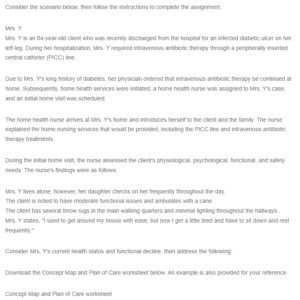
Mrs. Y is an 84-year-old client who was recently discharged from the hospital for an infected diabetic ulcer on her left leg. During her hospitalization, Mrs. Y required intravenous antibiotic therapy through a peripherally inserted central catheter (PICC) line.
Due to Mrs. Y’s long history of diabetes, her physician ordered that intravenous antibiotic therapy be continued at home. Subsequently, home health services were initiated, a home health nurse was assigned to Mrs. Y’s case, and an initial home visit was scheduled.
The home health nurse arrives at Mrs. Y’s home and introduces herself to the client and the family. The nurse explained the home nursing services that would be provided, including the PICC line and intravenous antibiotic therapy treatments.
During the initial home visit, the nurse assessed the client’s physiological, psychological, functional, and safety needs. The nurse’s findings were as follows:
Mrs. Y lives alone; however, her daughter checks on her frequently throughout the day.
The client is noted to have moderate functional issues and ambulates with a cane.
The client has several throw rugs in the main walking quarters and minimal lighting throughout the hallways.
Mrs. Y states, “I used to get around my house with ease, but now I get a little tired and have to sit down and rest frequently.”
Consider Mrs. Y’s current health status and functional decline, then address the following:
Download the Concept Map and Plan of Care worksheet below. An example is also provided for your reference.
Concept Map and Plan of Care worksheet
Concept Map and Plan of Care Example
Identify three (3) priority nursing diagnoses for Mrs. Y. Visit the School of Nursing Guide Nursing Reference eBooks section for resources to assist with nursing diagnoses.
Create a visual representation of the three (3) priority nursing diagnoses by incorporating them into the Concept Map (template in the worksheet). Be sure each nursing diagnosis includes the following elements:
“related to (r/t)” — description of the client’s problem
“as evidenced by” — description of the client’s symptoms
Complete the Nursing Plan of Care (table in the worksheet) describing what should be implemented for Mrs. Y.
Goals: Establish at least one (1) goal for each nursing diagnosis you identified (for a total of 3 goals). Goals should be patient-specific, measurable, actionable, realistic, and time-limited.
Nursing Interventions: Describe at least three (3) nursing interventions for each of the goals (for a total of 9 nursing interventions). Each intervention should be in alignment with the goal it is supporting.
Complete the assignment using proper spelling, grammar, and APA.
 Complete the order form and upload all of your files, including any instructions, rubrics, or other materials provided by your instructor.
 Complete the order payment after filling in the order form. We’ll receive your order and assign it to a writer.
 The assigned writer will complete your paper and forward it to our Editing Team for review and approval.
 Once approved by the editor, the completed paper will be uploaded to your account for you to download, review and approve.