
Case Study – Access to Global Healthcare
Access to healthcare is a major determinant of community and public health. Current approaches to enhancing access to healthcare services have been centered on expanding insurance coverage to vulnerable and low-income earners, healthcare technological innovations such as telehealth, cultural responsiveness in healthcare delivery, public education on care provisions, and others. Despite their effectiveness, poor access to healthcare is still a challenge in some American societies, with physical, social, economic, and cultural barriers still being implicated as causal factors for poor access to care. This paper explores variables affecting access to global healthcare through the lens of a case study on HIV.
Case Study
Mr. Kendricks is a 37-year-old African American male referred to the clinic from a remote village clinic in the Eastern part of Alaska for the management of pneumonia. He was diagnosed with HIV a year earlier but has been in denial. He claims that his miseries are because of a familial curse from his late grandmother and has been seeking divine interventions from the sorceress. The patient is a school dropout. He is unemployed, has no insurance coverage, and is late on his immunizations. He is a heavy alcohol drinker and an active cigarette smoker. During the assessment, he lamented alcohol as a causal factor for his disease. He also noted that his family has a low belief in the American healthcare system and has been against health initiatives such as immunizations and disease screening. During the physical assessment, the patient was found to be alert and oriented to space and time. He was diagnosed with opportunistic pneumonia and is set to begin antiretroviral therapy.
Variables Affecting Access to Healthcare Evident in the Case
The case study reveals some of the variables affecting access to global healthcare. This case study shows how poverty, race and ethnicity, access to healthcare facilities accustomed to geographical location, behavior, culture, and literacy/educational status affect access to healthcare. The patient, in this case, was unemployed and lacked insurance coverage. The patient was from an ethnic minority group. Ethnic minority groups in the U.S. are disproportionately affected by traditional problems of poor access to healthcare and healthcare disparity. This is because of specific factors within these groups, such as language barriers, misconceptions about the American healthcare system, or poor healthcare practices and behavior (Dawkins et al., 2021). This may be the case in the patient in the case presented.
Poor access to healthcare accustomed to a geographical location is also evident in the case. The patient is from a remote village in Alaska. The fact that he was referred to receive healthcare is another demonstration of poor access to healthcare facilities and services. Poor educational status and culture were other variables affecting access to care in the case. The patient was a school dropout. His culture was also against various healthcare practices and had low belief in the American healthcare system. The patient also attributed his suffering to a familial curse, which reveals cultural imprints in their definition of illness and disease.
How Culture and Other Variables Impact Global Healthcare Access
Culture remains an important variable affecting access to global healthcare. A question, in this case, is: How does culture affect access to global healthcare? Culture has an impact on access to healthcare. It has been linked to individuals’ perceptions and definitions of illness and disease. In addition, it affects healthcare-seeking and overall behavior toward health and wellness. The definition and perception of illness vary across cultures and have a bearing on the modalities to be used to offset them (Hernandez & Gibb, 2019). Ethnic groups that perceive illnesses and diseases as natural phenomena recommend spiritual and divine interventions to remedy the presumed disfavor from these powerful forces. The patient in the case linked his illness to a familial curse and sought sorcerer intervention to cure his illnesses.
Another aspect of culture is behavior and health-seeking. Health-seeking behavior varies across cultures and is highly dependent on the perception of the healthcare systems. Ethnic groups with poor belief in the conventional healthcare systems are unlikely to have good healthcare-seeking behavior (Hernandez & Gibb, 2019). The patient in the case expressed his family’s disbelief in the American healthcare system and lagged in community screening programs and immunizations. All these are an affirmation of cultural influences on access to healthcare.
How Health Disparities Affect Global Health Populations
How do healthcare disparities affect access to global healthcare? Healthcare disparity is still a problem in many societies. Ethnic minority groups are disproportionately affected by this problem. Social discrimination, inadequate legal protections, poverty, geographical location, and availability of community resources and healthcare services that constitute healthcare disparities have been implicated in worse healthcare outcomes and poor access to healthcare. Lavizzo-Mourey et al. (2021) report that social discrimination witnessed across many ethnic minority communities directly affects the behavior of individuals in these communities. Low literacy levels, for instance, that are conspicuous in communities affected by health disparities lower their uptake and adoption of health promotion and preservation information such as screening and immunization. The lack of community resources and healthcare facilities also diminishes individuals’ willingness to pursue health preservation measures. These factors demonstrate how healthcare disparity affects access to healthcare.
Summary
Poor access to healthcare remains a global healthcare issue. Low literacy levels, poverty, culture, behavior, and others have been implicated as causal factors. Culture influences the definition of illnesses and shapes an individual’s healthcare-seeking behavior. Health disparity across some societies across the globe also denies some communities access to healthcare. The case presented is a representation of how these factors can jeopardize an individual’s access to care.
References
Dawkins, B., Renwick, C., Ensor, T., Shinkins, B., Jayne, D., & Meads, D. (2021). What factors affect patients’ ability to access healthcare? An overview of systematic reviews. Tropical Medicine & International Health, 26(10), 1177–1188. https://doi.org/10.1111/tmi.13651.
Hernandez, M., & Gibb, J. K. (2019). Culture, behavior, and health. Evolution, Medicine, and Public Health, 2020(1), 12–13. https://doi.org/10.1093/emph/eoz036.
Lavizzo-Mourey, R. J., Besser, R. E., & Williams, D. R. (2021). Understanding and mitigating health inequities — past, current, and Future Directions. New England Journal of Medicine, 384(18), 1681–1684. https://doi.org/10.1056/nejmp2008628.
ORDER A PLAGIARISM-FREE PAPER HERE
We’ll write everything from scratch
Question 
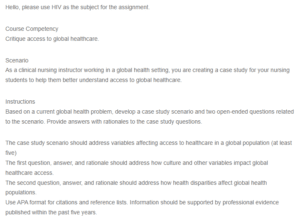
Case Study – Access to Global Healthcare
Hello, please use HIV as the subject for the assignment.
Course Competency
Critique access to global healthcare.
Scenario
As a clinical nursing instructor working in a global health setting, you are creating a case study for your nursing students to help them better understand access to global healthcare.
Instructions
Based on a current global health problem, develop a case study scenario and two open-ended questions related to the scenario. Provide answers with rationales to the case study questions.
The case study scenario should address variables affecting access to healthcare in a global population (at least five)
The first question, answer, and rationale should address how culture and other variables impact global healthcare access.
The second question, answer, and rationale should address how health disparities affect global health populations.
Use APA format for citations and reference lists. Information should be supported by professional evidence published within the past five years.
 Complete the order form and upload all of your files, including any instructions, rubrics, or other materials provided by your instructor.
 Complete the order payment after filling in the order form. We’ll receive your order and assign it to a writer.
 The assigned writer will complete your paper and forward it to our Editing Team for review and approval.
 Once approved by the editor, the completed paper will be uploaded to your account for you to download, review and approve.