
Case Analysis – Mr. Hector
Additional Health History Questions
In evaluating Mr. Hector’s chief complaint of memory loss and forgetfulness at times, it is essential to gather a complete and detailed health history. I would begin with thorough questioning regarding the onset, frequency, and pattern of his memory loss. I would ask questions like, “When did the symptoms first start?” and “Are they constant or do they come and go?” I would like to know whether there is a sequence of symptoms over time, which could be suggestive of a neurodegenerative disorder. I would also inquire whether he can perform activities of daily living such as cooking, managing finances, driving, and medication use, as changes in functional status are the primary predictors of cognitive impairment. Inquiries about sleeping habits, mood alteration, recent stressors, alcohol or substance use, and head trauma are important to identify reversible causes. There should be a careful review of all medications, since polypharmacy and adverse drug interactions can frequently be the cause of confusion in the elderly (Feast et al., 2020). I would also ask about any family history of Alzheimer’s disease or other dementias to establish genetic risk.
Assessment Techniques and Screening Tools
For Mr. Hector, a complete physical and neurological examination is necessary to assess any signs of underlying systemic illness or neurological deficit. I would employ standardized cognitive screening tools such as the Montreal Cognitive Assessment (MoCA), which is highly effective in screening for mild cognitive impairment and early dementia (Serrano et al., 2020). Although the Mini-Mental State Examination (MMSE) may also be used, MoCA is the test of choice because of its sensitivity. Further, functional assessment using the Instrumental Activities of Daily Living (IADL) scale may reveal difficulties in managing everyday activities. Additionally, screening for depression using the Geriatric Depression Scale (GDS) would be valuable since depression can simulate cognitive impairment. Blood work like CBC, B12, TSH, and a metabolic panel, as well as possible neuroimaging, may be indicated to eliminate reversible etiologies and to guide treatment.
References
Feast, A. R., White, N., Candy, B., Kupeli, N., & Sampson, E. L. (2020). The effectiveness of interventions to improve the care and management of people with dementia in general hospitals: A systematic review. International Journal of Geriatric Psychiatry, 35(5), 463–488. https://doi.org/10.1002/gps.5280
Serrano, C. M., Sorbara, M., Minond, A., Finlay, J. B., Arizaga, R. L., Iturry, M., Martinez, P., Heinemann, G., Gagliardi, C., Serra, A., Magliano, F. C., Yacovino, D., Rojas, M. M. E. Y., Ruiz, A. S., & Graviotto, H. G. (2020). Validation of the Argentine version of the Montreal Cognitive Assessment Test (MOCA): A screening tool for mild cognitive impairment and mild dementia in elderly. Dementia & Neuropsychologia, 14(2), 145–152. https://doi.org/10.1590/1980-57642020dn14-020007
ORDER A PLAGIARISM-FREE PAPER HERE
We’ll write everything from scratch
Question 
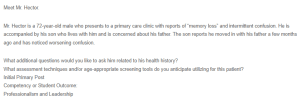
Meet Mr. Hector.
Mr. Hector is a 72-year-old male who presents to a primary care clinic with reports of “memory loss” and intermittent confusion. He is accompanied by his son who lives with him and is concerned about his father. The son reports he moved in with his father a few months ago and has noticed worsening confusion.
Case Analysis – Mr. Hector
What additional questions would you like to ask him related to his health history?
What assessment techniques and/or age-appropriate screening tools do you anticipate utilizing for this patient?
Initial Primary Post
Competency or Student Outcome:
Professionalism and Leadership
 Complete the order form and upload all of your files, including any instructions, rubrics, or other materials provided by your instructor.
  Complete the order payment after filling in the order form. We’ll receive your order and assign it to a writer.
 The assigned writer will complete your paper and forward it to our Editing Team for review and approval.
 Once approved by the editor, the completed paper will be uploaded to your account for you to download, review and approve.