
Care Models for Nursing Practice to The Older Adult Bibliography
Chaising, S., & Temdee, P. (2020). Determining Significant Risk Factors for Preventing Elderly People with Hypertension from Cardiovascular Disease Complication Using Maximum Objective Distance. Wireless Personal Communications, 115(4), 3099–3122. https://doi.org/10.1007/s11277-020-07195-4
This article aims at identifying key risk factors that predispose elderly hypertensive patients to cardiovascular complications. According to the authors, chronic and inadequately managed hypertension predisposes the patient to high morbidity and mortality rates associated with cardiovascular complications. According to the authors, the key risk factors include elevated total cholesterol levels, elevated low-density lipoproteins and low high-density lipoproteins levels, lack of physical activity, and cigarette smoking.
This article is relevant and credible. This is because it fulfills the provisions of the CRAAP (currency, relevance, accuracy, authority, and purpose) criteria. Furthermore, the authors are objective and unbiased. This source is relevant because it provides key information about the risk factors of cardiovascular disease complications in elderly hypertensive patients. This information forms the basis for patient education and initiating pertinent measures to avert complications.
Delhey, L., Shoults, C., Johnson, K., Orloff, M., Faramawi, M. F., & Delongchamp, R. (2021). The Difference between Hypertension Determined by Self-Report Versus Examination in the Adult Population of the USA: Continuous NHANES 1999-2016. Journal of Public Health (Oxford, England), 43(2), 316–324. https://doi.org/10.1093/pubmed/fdz132
This article aims to evaluate the validity of self-reported hypertension versus screened hypertension. The respondents were Hispanics, non-Hispanic whites, and non-Hispanic blacks. The article identifies an age of more than or equal to 45 years and lack of annual checkups increased the risk of hypertension. According to the article, individuals aged 65 years and above have the highest prevalence of hypertension, as evidenced by self-reports and examination results.
This article is relevant and credible. This is because it fulfills the provisions of the CRAAP criteria. Furthermore, the authors are objective and unbiased. This source is relevant because it identifies the importance of hypertension to the target population. This is evidenced by the highest prevalence of the disease among those aged 65 years and above.
Hari, T. S., Sudha, T. S., Varghese, A. M., Sasanka, K. K., & Thangaraju, P. (2021). A Study of Risk Factors and Complications in Elderly Hypertensive Subjects. Journal of Family Medicine and Primary Care, 10(6), 2230. https://doi.org/10.4103/jfmpc.jfmpc_1959_20
This article aims at identifying the risk factors for high blood pressure among the elderly population living in an urban area. The authors conducted a cross-sectional observational study in which respondents aged above 60 years were included in the study. Findings indicate that major risk factors are smoking, alcohol intake, family history of hypertension, and diabetes. Furthermore, myocardial infarction, heart failure, and cerebrovascular accidents are the most common complications of hypertension.
This article is relevant and credible because it fulfills the provisions of the CRAAP criteria. Furthermore, the authors are objective and unbiased. This source is relevant because it identifies the risk factors and common complications associated with hypertension among the elderly.
References
Chaising, S., & Temdee, P. (2020). Determining Significant Risk Factors for Preventing Elderly People with Hypertension from Cardiovascular Disease Complication Using Maximum Objective Distance. Wireless Personal Communications, 115(4), 3099–3122. https://doi.org/10.1007/s11277-020-07195-4
Delhey, L., Shoults, C., Johnson, K., Orloff, M., Faramawi, M. F., & Delongchamp, R. (2021). The Difference between Hypertension Determined by Self-Report Versus Examination in the Adult Population of the USA: Continuous NHANES 1999-2016. Journal of Public Health (Oxford, England), 43(2), 316–324. https://doi.org/10.1093/pubmed/fdz132
Hari, T. S., Sudha, T. S., Varghese, A. M., Sasanka, K. K., & Thangaraju, P. (2021). A Study of Risk Factors and Complications in Elderly Hypertensive Subjects. Journal of Family Medicine and Primary Care, 10(6), 2230. https://doi.org/10.4103/jfmpc.jfmpc_1959_20
ORDER A PLAGIARISM-FREE PAPER HERE
We’ll write everything from scratch
Question 
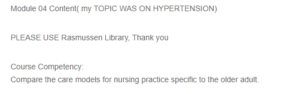
Module 04 Content( my TOPIC WAS ON HYPERTENSION)
PLEASE USE Rasmussen Library, Thank you
Course Competency:
Compare the care models for nursing practice specific to the older adult.
Care Models for Nursing Practice to The Older Adult Bibliography
Transferable Skill:
Information Literacy: Discovering information reflectively, understanding how information is produced and valued, and using information to create new knowledge and participate ethically in communities of learning.
Your nursing supervisor likes the topic you chose for the in-service presentation and wants you to start researching! To make sure you get the project on the right track, your supervisor has asked you to do the following:
Using the Rasmussen Library, identify at least 2 resources pertaining to your topic.
Prepare an annotated bibliography for the resources you identified. Each entry will include:
the full APA formatted reference
an annotation consisting of the following elements:
2 to 4 sentences to summarize the main idea(s) of the source
1 or 2 sentences to assess and evaluate the source
1 or 2 sentences to reflect on the source
For information about making a research appointment with a Rasmussen librarian, evaluating the credibility of a source, or creating an annotated bibliography, consult the resources below.
What is an annotated bibliography and how do I do one? Do you have a sample I can see?
How can I make a research appointment with a Rasmussen College Librarian?
How do I know if a source is credible?
Once you receive your graded submission, be sure to review the supervisor’s feedback. You want to make sure that your next submission shows that you made appropriate improvements based on the feedback.
Rubric Details
Maximum Score
20 points
APA Style and Annotations
90% of total grade
Mastery: Advanced or exceeds achievement
APA citations are free of style and formatting errors. Provided thorough annotation for each source.
18
Proficiency: Clear/effective achievement
Errors in APA citations are less noticeable and do not detract from the ability to locate the original source (for example, a missing or misused comma or period, missing parentheses, author name not properly abbreviated, indentation is misaligned). Provided complete annotation for each source.
16.74
Competence: Adequate/basic achievement
Errors in APA citations are noticeable and may detract from the ability to locate the original source (for example, no title provided, year of publication is missing, no punctuation). Provided reasonable annotation for each source.
15.12
Emerging: Limited or growing achievement
Citations do not follow the APA Style. Quotations, paraphrases, and summaries are not cited, or there is no attempt to cite them using APA style. Provided partial annotation for at least one source.
11.7
Spelling and Grammar
10% of total grade
Mastery: Advanced or exceeds achievement
Demonstrates an exemplary application of spelling and grammar.
2
Proficiency: Clear/effective achievement
Displays proper grammar application and writing contains minimal to no spelling errors. May contain rare improper uses of words (ex., their vs. there), a misplaced modifier, or a run-on sentence, but does not detract from the overall understanding of the sentence and/or paragraph.
1.86
Competence: Adequate/basic achievement
Spelling and grammar errors occur but are inconsistent. Paragraphs and sentences are coherent but may exhibit spelling errors, run-ons or fragments, and/or improper verb tense usage.
1.68
Emerging: Limited or growing achievement
Spelling and grammar contain substantial errors that make sentences and/or paragraphs incoherent.
 Complete the order form and upload all of your files, including any instructions, rubrics, or other materials provided by your instructor.
 Complete the order payment after filling in the order form. We’ll receive your order and assign it to a writer.
 The assigned writer will complete your paper and forward it to our Editing Team for review and approval.
 Once approved by the editor, the completed paper will be uploaded to your account for you to download, review and approve.