
Cardiovascular Disorders – Heart failure (HF)
Heart failure (HF) is a complex clinical syndrome characterized by the heart’s inability to pump blood efficiently to meet the body’s metabolic demands. The pathophysiology of HF comprises reduced contractility of the myocardium, increased pre-load and after-load, and activation of a neurohormonal system that consequently results in edema, low cardiac output, and organ failure. Symptomatic manifestations of HF include dyspnoea, fatigue, peripheral edema, and orthopnoea, which are associated with pulmonary and systemic congestion. According to Hajouli and Ludhwani (2024), diagnosis is made based on the clinical history and physical examination, elevated B-type natriuretic peptide (BNP) levels, and echocardiogram to assess ejection fraction and structural changes. The options for treatment include medications, which include ACE inhibitors, beta-blockers, and diuretics and non-pharmacologic treatments, which include diet, limitation of fluids, alcohol restriction, exercise, and weight management to enhance heart function and reduce the manifestations of symptoms (Schwinger, 2021).
Nurse practitioners (NPs) play a crucial role in ensuring that evidence-based practice (EBP) systematically guides decision-making when managing cardiovascular conditions. This entails the concern with the utilization of new research, clinical practice, and patient preference. Implementing clinical protocols, diagnosing diseases, performing evidence-based evaluation of the literature, and using evidence-based assessment tools will help improve the ability to diagnose diseases and select the most effective treatments. Integration of multidisciplinary teams will enhance the care of patients as they address diverse aspects that embrace best practices. Thus, with the use of EBP, NPs enhance patients’ knowledge, improve dosage schedules that the patients undergo, and ensure compliance with the set treatment plans (Brunt & Morris, 2023).
The American College of Cardiology (ACC)/American Heart Association (AHA) guidelines provide a structured approach to HF management by outlining classification, staging, and recommended interventions. These guidelines are focused on pharmacological approaches, lifestyle changes, and client-centered approaches that may slow down the disease progression. Adhering to these guidelines as an NP means that the right treatment options will be chosen while considering the disease severity and possible complications that may arise. Comprehensive use of guideline-directed medical therapy contributes to the formulation of knowledgeable decisions and the enhancement of patient care, thus reducing hospitalizations (Heidenreich et al., 2022).
References
Brunt, B. A., & Morris, M. M. (2023, March 4). Nursing professional development evidence-based practice. National Library of Medicine. https://www.ncbi.nlm.nih.gov/books/NBK589676/
Hajouli, S., & Ludhwani, D. (2024, May 5). Heart failure and ejection fraction. National Library of Medicine; StatPearls Publishing. https://www.ncbi.nlm.nih.gov/books/NBK553115/
Heidenreich, P. A., Bozkurt, B., Aguilar, D., Allen, L. A., Byun, J. J., Colvin, M. M., Deswal, A., Drazner, M. H., Dunlay, S. M., Evers, L. R., Fang, J. C., Fedson, S. E., Fonarow, G. C., Hayek, S. S., Hernandez, A. F., Khazanie, P., Kittleson, M. M., Lee, C. S., Link, M. S., . . . Yancy, C. W. (2022). 2022 AHA/ACC/HFSA guideline for the management of heart failure: A report of the American College of Cardiology/American Heart Association Joint Committee on Clinical Practice Guidelines. Circulation, 145(18). https://doi.org/10.1161/cir.0000000000001063
Schwinger, R. H. G. (2021). Pathophysiology of heart failure. Cardiovascular Diagnosis and Therapy, 11(1), 263–276. https://doi.org/10.21037/cdt-20-302
ORDER A PLAGIARISM-FREE PAPER HERE
We’ll write everything from scratch
Question 
Cardiovascular Disorders – Heart failure (HF)
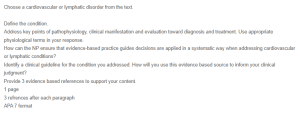
Choose a cardiovascular or lymphatic disorder from the text.
Define the condition.
Cardiovascular Disorders – Heart Failure
Address key points of pathophysiology, clinical manifestation and evaluation toward diagnosis and treatment. Use appropriate physiological terms in your response.
How can the NP ensure that evidence-based practice guides decisions are applied in a systematic way when addressing cardiovascular or lymphatic conditions?
Identify a clinical guideline for the condition you addressed. How will you use this evidence based source to inform your clinical judgment?
Provide 3 evidence based references to support your content.
1 page
3 refrences after each paragraph
APA 7 format
 Complete the order form and upload all of your files, including any instructions, rubrics, or other materials provided by your instructor.
  Complete the order payment after filling in the order form. We’ll receive your order and assign it to a writer.
 The assigned writer will complete your paper and forward it to our Editing Team for review and approval.
 Once approved by the editor, the completed paper will be uploaded to your account for you to download, review and approve.