
Business Case for a New Economic Opportunity
Currently, the healthcare facility uses the traditional paperwork system. The management is planning an upgrade to the Electronic Health Records (EHR) System. The EHR system is desirable because it will enhance patient service delivery and create additional economic benefits for the health facility. This paper aims at developing a business case for the EHR system. It also examines the feasibility and cost-benefit considerations of implementing the EHR system over the next five years. Furthermore, the paper analyzes ways to mitigate risks and performs a cost-benefit analysis.
Potential Economic Opportunities Associated with EHR.
The healthcare facility receives approximately 1,000 patients per day. The delays associated with the traditional paperwork system lead to long patient queues. The delays make the facility’s healthcare providers serve about 750 patients daily. Approximately 250 patients must wait until the next day for health care services. This creates a supply-demand gap. Furthermore, the prognosis of patients’ diseases is likely worsened by the delays in accessing care.
Implementation of EHR will have various economic opportunities that will benefit the healthcare facility. EHR presents an opportunity to increase the rate of service delivery to the patients. It is projected that approximately 300 more patients will be served per day after the implementation of EHR. This will provide an opportunity for economic advantage because the patients will pay for consultation services, medications, and services such as laboratory tests. In addition to serving approximately 300 more patients daily, EHR will enable the facility to avoid delays in the referral process. The use of paperwork in the facility usually impedes the patient referral process. This is because the patients’ treatment progress is not shared freely among healthcare providers between the two institutions. EHR will solve this problem and increase the number of referrals in the health care facility. This will have a positive financial impact on the facility.
EHR will enable the health facility to increase the accuracy of the billing process. The traditional paperwork system is associated with numerous errors during billing capture. EHR contains fields to ensure accuracy during billing (Adler-Milstein & Jha, 2017). The fields have the identity of medications, medical equipment, and services provided at the facility. The cost of each drug and assistance is provided in the areas. This will lead to an accurate billing procedure and minimize losses incurred by the institution.
EHR will lead to a reduction in the costs incurred in the management of adverse drug reactions and allergies. The traditional paperwork system doesn’t facilitate easy access to patients’ personal health information. EHR provides health caregivers with this critical information. It serves as the basis for selecting the most appropriate treatment regimen for the patient. Careful selection of treatment plans helps to avert the possibility of side effects and allergies (Kharrazi et al., 2018). The patients benefit maximum from the treatment plan provided. Therefore, EHR is beneficial to health facilities and the patient. The resources the institution and patients would have used to manage such allergies and side effects can be channeled to other developmental projects.
Potential Risks to the Financial Security of the Health Facility.
The potential risks associated with the introduction of EHR at the health facility were identified. During the competitor analysis, it was observed that two more healthcare facilities are found within a three-mile radius of the health facility. The two facilities receive approximately 300 patients per day each compared to the 1000-patient population in this facility. Furthermore, the two healthcare facilities have already implemented the EHR systems. The two healthcare facilities deliver their patient care services faster, and patient queues are not witnessed. The costs of treatment at the two healthcare facilities are slightly lower. The two healthcare facilities have the same operating hours as the health facility. The existence of the two facilities with shorter patient queues, similar operation hours, lower treatment costs, and already established EHR systems is most likely to attract patients. This puts the financial security of the health facility at risk.
The potential economic opportunities outweigh the potential financial risks. EHR will lead to an improvement in the billing process, an increase in the service delivery rate, and a reduction in drug side effects and allergy cases. This will lead to financial gain for the healthcare facility. The potential economic risk emanates from the competition from the other two healthcare facilities. The risk can be mitigated effectively by adopting various strategies. Therefore, the potential economic opportunities outweigh the potential financial risks.
Ethical and Culturally Sensitive Solutions that Address the Risks
Competition between the two facilities is handled using various strategies. Staff training will take place weekly. The training will aim at equipping staff with the appropriate skills needed to serve the patients effectively using the EHR. This training is expected to minimize potential delays caused by the inability to use EHR. Regular exercise is expected to expedite the adaptation to the new system. This will lead to the fulfillment of the expected increase in service delivery by EHR. Patient queues are expected to decrease significantly to the extent of serving 300 more patients per day. In addition to regular staff training, hardware and software maintenance will be done quarterly. This maintenance will help to avoid the possibility of breakdowns and the associated timewasting and slow service delivery. The two strategies will give the healthcare facility a competitive advantage.
Healthcare providers at the facility will be expected to uphold evidence-based practice while using the EHR. Evidence-based practice enables healthcare providers to select the best treatment plans to improve patient outcomes (Horntvedt et al., 2018). Evidence-based practice while using EHR will lead to patients’ satisfaction with the healthcare services offered by the facility. This will give the facility a competitive advantage.
The healthcare providers using the EHR will be expected to uphold the principles of healthcare ethics. They include patient autonomy, justice, non-maleficence, and beneficence (Gillon, 2015). Keeping healthcare ethics will make the patients feel appreciated and part of the Treatment Process. Therefore, during the implementation of EHR, continuous education on the importance of healthcare ethics will occur. Healthcare ethics and the increase in the rate of service delivery will give the healthcare facility a competitive advantage.
These solutions will give the healthcare facility a competitive advantage and improve community healthcare delivery outcomes. Proper training on the use and regular maintenance of EHR will help to solve the problem of delays in service delivery. This will lead to better treatment outcomes due to the early initiation of treatment. Evidence-based practice and continuous education on the importance of health ethics will be necessary during the implementation of EHR. Health ethics will make patients from all ethnicities and socio-demographic backgrounds feel appreciated. Caution should be exercised to avoid medication errors during service delivery. The need to serve many patients can lead to medication errors and put healthcare workers at risk of legal implications.
Cost-Benefit Analysis of the Proposed Economic Initiative
A cost-benefit analysis of the project is necessary to determine the benefits resulting from implementing the EHR System. In deciding the cost-benefit research, future and present values are used (Posner & Sunstein, 2017). A current value discount rate of 2 percent is used in the calculations. The net worth of the analysis is determined by subtracting the Total Costs Present Value from the Total Benefits Present Value. The costs in the current year of the introduction of EHR emanate from software, hardware, implementation costs, maintenance costs, and staff training. The prices are approximated to $ 360,000.
It is approximated that software costs for each healthcare provider are $ 1,500. Software cost estimation for all health care providers at the health facility is $ 100,000. EHR hardware costs are approximately $ 6,500 per office with three healthcare providers (Reis et al., 2017). Hardware costs for the entire healthcare facility are roughly $ 120,000. The approximated implementation costs of the EHR are $ 3,300 per healthcare provider (Reis et al., 2017). The total estimate of the implementation cost is $ 80,000. The other costs incurred in the current year are maintenance and staff training. It is estimated that the prices are $ 30,000 each. In calculating future value, it was estimated that maintenance costs will increase by $ 10,000, staff training will increase by $ 6,000, and other operating expenses will increase by $ 11,000 yearly.
An increase in the revenue in the benefits section was calculated based on the fees collected from patients. The EHR will increase the number of patients served daily by approximately 300. The patients will receive consultation services, during which they must pay a service fee. The fee ranges from $ 90 to $ 120 based on the service being sought. However, there is uncertainty about whether all of these patients will pay for medications, medical equipment, and laboratory services. Furthermore, there is uncertainty on whether the estimated increase in the number of patients will be achieved daily. Therefore, an approximation to the rise in revenue is set at $ 200,000, $ 400,000, $650,000, $ 900,000, and $ 1,100,000, respectively, for the five years.
The net benefit is approximately $ 1,914,013.09 (see Appendix for more information on the cost-benefit analysis). This suggests that the implementation of EHR is viable for the healthcare facility. These findings should be used to identify ways to optimize the benefits. This can be accomplished by modifying the maintenance costs and staff training costs.
Ways to Control Costs and Maximize Benefits.
The management of the healthcare facility should control costs to achieve maximum benefits from the EHR system. The expenses that can be controlled include maintenance, staff training, and other operation costs. A collaborative effort among all staff minimizes maintenance costs. The team should handle both hardware and software with care. They should seek assistance when they are uncertain about the usage of EHR. This will minimize breakdowns that necessitate regular maintenance.
Furthermore, the maintenance can be conducted after six months rather than quarterly. Care after six months is possible if staff carefully handle hardware and software. The collaborative effort will be implemented while respecting the staff’s beliefs and ensuring that their suggestions on the strategy are considered (Henderson et al., 2018). This will ensure that the measures are ethical and culturally equitable.
Staff training can be performed monthly rather than weekly to control costs. The training should be rigorous to ensure staff has the skills and knowledge needed to use EHR. After that, the training can be done after every two months, then quarterly. This will be achieved easily if the healthcare facility retains its staff for as long as possible. Furthermore, healthcare workers should uphold health ethics and evidence-based practice and adopt good patient communication skills (Henderson et al., 2018). This will lead to referrals because the patients will be content with the services. In addition to referrals, the patients will always visit the facility when they need medical attention.
Conclusion
Implementation of EHR will lead to an increase in the rate of service delivery to the patients. Long patient queues will be reduced significantly, and the prognosis of patients’ diseases will improve because prompt interventions will be taken. EHR will lead to an increase in the number of patients served per day. This will have an economic advantage for the health facility. A cost-benefit analysis reveals that EHR is a viable economic initiative. Costs that can be controlled to maximize benefits include staff training, maintenance, and operating costs.
References
Adler-Milstein, J., & Jha, A. K. (2017). The Hitech Act drove large gains in hospital electronic health record adoption. Health Affairs, 36(8), 1416–1422. https://doi.org/10.1377/hlthaff.2016.1651
Gillon, R. (2015). Defending the four principles approach as a good basis for good medical practice and, therefore, for good medical ethics. Journal of Medical Ethics, 41(1), 111–116. https://doi.org/10.1136/medethics-2014-102282
Henderson, S., Horne, M., Hills, R., & Kendall, E. (2018). Cultural competence in healthcare in the community: A concept analysis. Health and Social Care in the Community, 26(4), 590–603. https://doi.org/10.1111/hsc.12556
Horntvedt, M. E. T., Nordsteien, A., Fermann, T., & Severinsson, E. (2018). Strategies for teaching evidence-based practice in nursing education: A thematic literature review. BMC Medical Education, 18(1), 1–11. https://doi.org/10.1186/s12909-018-1278-z
Kharrazi, H., Gonzalez, C. P., Lowe, K. B., Huerta, T. R., & Ford, E. W. (2018). Forecasting the maturation of electronic health record functions among US hospitals: Retrospective analysis and predictive model. Journal of Medical Internet Research, 20(8), 1–11. https://doi.org/10.2196/10458
Posner, E. A., & Sunstein, C. R. (2017). Moral commitments in cost-benefit analysis. Virginia Law Review, 103(8), 1809–1860. https://doi.org/10.2139/ssrn.2930450
Reis, Z. S. N., Maia, T. A., Marcolino, M. S., Becerra-Posada, F., Novillo-Ortiz, D., & Ribeiro, A. L. P. (2017). Is there evidence of cost benefits of electronic medical records, standards, or interoperability in hospital information systems? Overview of systematic reviews. JMIR Medical Informatics, 5(3). https://doi.org/10.2196/medinform.7400
ORDER A PLAGIARISM-FREE PAPER HERE
We’ll write everything from scratch
Question 
Develop a business case for the economic initiative you proposed in Assessment 1. Examine the feasibility and cost-benefit considerations of implementing your proposed initiative over the next five years. Analyze ways to mitigate risks and complete a cost-benefit analysis.
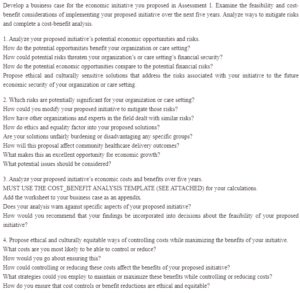
Business Case for a New Economic Opportunity
1. Analyze your proposed initiative’s potential economic opportunities and risks.
How do the potential opportunities benefit your organization or care setting?
How could potential risks threaten your organization’s or care setting’s financial security?
How do the potential economic opportunities compare to the potential financial risks?
Propose ethical and culturally sensitive solutions that address the risks associated with your initiative to the future economic security of your organization or care setting.
2. Which risks are potentially significant for your organization or care setting?
How could you modify your proposed initiative to mitigate those risks?
How have other organizations and experts in the field dealt with similar risks?
How do ethics and equality factor into your proposed solutions?
Are your solutions unfairly burdening or disadvantaging any specific groups?
How will this proposal affect community healthcare delivery outcomes?
What makes this an excellent opportunity for economic growth?
What potential issues should be considered?
3. Analyze your proposed initiative’s economic costs and benefits over five years.
MUST USE THE COST_BENEFIT ANALYSIS TEMPLATE (SEE ATTACHED) for your calculations.
Add the worksheet to your business case as an appendix.
Does your analysis warn against specific aspects of your proposed initiative?
How would you recommend that your findings be incorporated into decisions about the feasibility of your proposed initiative?
4. Propose ethical and culturally equitable ways of controlling costs while maximizing the benefits of your initiative.
What costs are you most likely to be able to control or reduce?
How would you go about ensuring this?
How could controlling or reducing these costs affect the benefits of your proposed initiative?
What strategies could you employ to maintain or maximize these benefits while controlling or reducing costs?
How do you ensure that cost controls or benefit reductions are ethical and equitable?
5. Justify the relevance and significance of the quantitative and qualitative economic, financial, and scholarly evidence you used to support your business case.
This criterion applies to any evidence you cited throughout your business case. Your evidence should be persuasive and relevant to your findings, proposals, and recommendations. Consider one or more of the following questions when citing support evidence:
How is the evidence relevant to your organization or care setting?
How is the evidence relevant to your proposed economic initiative?
How does the proof illustrate a solution that has been successful in the past?
How does the defense show that an industry or solution will benefit the organization or care setting?
 Complete the order form and upload all of your files, including any instructions, rubrics, or other materials provided by your instructor.
  Complete the order payment after filling in the order form. We’ll receive your order and assign it to a writer.
 The assigned writer will complete your paper and forward it to our Editing Team for review and approval.
 Once approved by the editor, the completed paper will be uploaded to your account for you to download, review and approve.