
Becoming a Lifelong Advocate
My recently completed Social Change Project on housing insecurity supports the social work mission by addressing the basic human need for safe, affordable housing, particularly for the underrepresented demographics, like people of color, LGBTQ+ youth, and persons with disabilities. The project promotes a long-term, considerate, and lasting change by recommending the National Housing Trust Fund over the limited SHIP program. This aligns with the social work mission to promote well-being and combat poverty and oppression (National Association of Social Workers, 2021). The practical experiences in my professional life with clients who have the issue of eviction and overcrowding anchored the project in the real-world needs and client-centered advocacy.
The core value that is less apparent to my Social Change Project is the importance of human relationships. Although I was able to pay attention to policy analysis and structural change, I did not fully incorporate the voices of people who are the most affected. In the TED Talk by Derrick Jackson, the sheriff’s office established trust, and individuals got connected to the services and community members became part of the solutions (TEDx Talks, 2016). As such, partnership with the community, client stories, and testimonies will become a part of my advocacy in the future to make sure that policies embrace the real experiences of the population.
To make my advocacy congruent with the mission of social work and the NASW values, I will place a priority on constant learning, collaboration in the community, and reflective supervision. I will also promote through storytelling to bring the linkage of policy to real lives. As Jansson (2017) emphasizes, effective advocates build up policy arguments using knowledge about issues. I can enhance my advocacy by basing it on evidence and ethical values, which will help me to foster dignity and justice in every policy work, and especially those related to housing insecurity and its structural causes.
References
Jansson, B. S. (2017). Empowerment series: Becoming an effective policy advocate (8th ed.). Cengage Learning. https://bookshelf.vitalsource.com/books/9798214338224
National Association of Social Workers. (2021). Code of ethics. National Association of Social Workers. https://www.socialworkers.org/About/Ethics/Code-of-Ethics/Code-of-Ethics-English
TEDx Talks. (2016, May 12). Problem-oriented policing: Where social work meets law enforcement | Derrick Jackson | TEDxYDL [Video]. YouTube. https://www.youtube.com/watch?v=wK8glFZuQw8
ORDER A PLAGIARISM-FREE PAPER HERE
We’ll write everything from scratch
Question 
Textbook link: https://login.vitalsource.com/?redirect_uri=https%3A%2F%2Fbookshelf.vitalsource.com%2Freader%2Fbooks%2F9798214338224%2Fepubcfi%2F6%2F320%5B%253Bvnd.vst.idref%253Dbd-CZHR10A3ZY8U4ZVDD206%5D%21%2F4%2F2%5BCZHR10A3ZY8U4ZVDD206%5D&brand=bookshelf.vitalsource.com
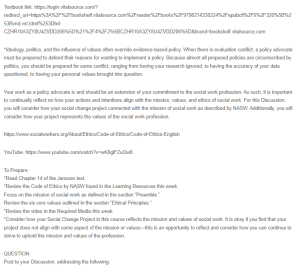
Becoming a Lifelong Advocate
*Ideology, politics, and the influence of values often override evidence-based policy. When there is evaluation conflict, a policy advocate must be prepared to defend their reasons for wanting to implement a policy. Because almost all proposed policies are circumscribed by politics, you should be prepared for some conflict, ranging from having your research ignored, to having the accuracy of your data questioned, to having your personal values brought into question.
Your work as a policy advocate is and should be an extension of your commitment to the social work profession. As such, it is important to continually reflect on how your actions and intentions align with the mission, values, and ethics of social work. For this Discussion, you will consider how your social change project connected with the mission of social work as described by NASW. Additionally, you will consider how your project represents the values of the social work profession.
https://www.socialworkers.org/About/Ethics/Code-of-Ethics/Code-of-Ethics-English
YouTube. https://www.youtube.com/watch?v=wK8glFZuQw8
To Prepare:
*Read Chapter 14 of the Jansson text.
*Review the Code of Ethics by NASW found in the Learning Resources this week.
Focus on the mission of social work as defined in the section “Preamble.”
Review the six core values outlined in the section “Ethical Principles.”
*Review the video in the Required Media this week.
*Consider how your Social Change Project in this course reflects the mission and values of social work. It is okay if you find that your project does not align with some aspect of the mission or values—this is an opportunity to reflect and consider how you can continue to strive to uphold the mission and values of the profession.
QUESTION:
Post to your Discussion, addressing the following:
*Explain how your Social Change Project upholds the mission of the social work profession. Cite 2–3 specific examples from your project in your explanation.
*Select one core value from the NASW resource that you think is least evident in your Social Change Project. Explain your selection. Include actions you will take to better represent the value in your future advocacy work.
*Describe additional steps you will take as a social change and policy advocate to ensure your advocacy work continues to be guided by your social work mission and values as defined by NASW.
 Complete the order form and upload all of your files, including any instructions, rubrics, or other materials provided by your instructor.
  Complete the order payment after filling in the order form. We’ll receive your order and assign it to a writer.
 The assigned writer will complete your paper and forward it to our Editing Team for review and approval.
 Once approved by the editor, the completed paper will be uploaded to your account for you to download, review and approve.