
BarkBox Target Market & Customer Journey
Segmentation Analysis
BarkBox has positioned itself as a provider of subscription-based toys, treats, and goodies for dogs as the pet industry thrives. The company focuses on engaging content and personalized offerings to cater to the needs of a target audience that seeks convenience and quality. With the knowledge that most of its customers seek to surprise their furry friends, BarkBox has to understand specific customer preferences. BarkBox is a perfect choice for most dog lovers because it spans different demographics, from young professionals interested in pampering their pets to families that keep them for interactive playtime.
Demographic Segmentation
BarkBox primarily targets millennials who treat their dogs as part of their family. This demographic is partly made up of individuals who do not have enough time to visit a store and purchase dog food and treats. Additionally, most of the target audience is made up of women aged between 25-34 years who value their dogs highly. This segment is largely made up of married ladies who likely live alone or with a small family (Bhakat, 2019). Therefore, they would be willing to allocate significant resources to make their dogs feel special.
Another notable characteristic of BarkBox’s target audience is that they are predominantly educated, tech-savvy, and live in an urban area. A typical BarkBox customer is described as a woman who works full time, is married or committed to a long-term relationship, and has a household income of $75,000. Therefore, BarkBox targets middle-to-high-income customers because they can afford subscription services (Bhakat, 2019). The company is interested in an audience that is obsessed with their dogs and has a fairly significant income; hence can commit to purchasing toys and treats for their dogs on a monthly basis.
Geographic Segmentation
BarkBox mostly targets customers who live in large urban areas. One of the reasons the company targets individuals living in urban areas is that they are more likely to accept that their dogs have special nutritional needs compared to their rural counterparts (Bhakat, 2019). Besides, urban pet owners are more likely than their rural counterparts to acknowledge that organic food offers better nutritional value than standard national brands, even though there is no scientific evidence to support this. Another reason why BarkBox targets pet owners in urban areas is that they believe in the product safety services offered by renowned brands like BarkBox. Given the exposure and attitudes of urban dog owners, BarkBox mostly focuses on marketing to audiences in urban geographic locations.
Psychographic Segmentation
Regardless of age, BarkBox targets individuals who see dogs as part of their family. Based on psychographic factors, dog owners are classified into strongly attached owners, moderately attached owners, and basic owners. As the primary target audience, strongly attached owners spend a lot of money on their dogs’ special products and select their vehicles with dog ownership in mind (Bhakat, 2019). Also, moderately attached dog owners agree with most variables that influence strongly attached owners, although they may not purchase vehicles to suit their dogs’ needs. By targeting strongly and moderately attached owners, BarkBox is assured of regular customers who can subscribe to monthly offerings, hence business sustainability.
Behavioral Segmentation
BarkBox customers show signs of the global trend of pet parenting. According to research on pet ownership, pet parenting behavior is exhibited by owners who attach significant value to their dogs. The declining birth rate due to the preference for small families, work, and educational commitments means that some households end up with few or no children. Members of such households have shown significant interest in owning pets for interactive play and company (Boya et al., 2012). The emotional attachment between dog owners and their dogs makes such owners offer their dogs the best treatment, an equivalent of what loving parents give their children.
Benefits Sought
One key benefit sought by BarkBox’s primary target audience is the convenience associated with the company’s shopping experience. Pet food customers live busy lifestyles and would appreciate the convenience of having dog products delivered to their doorstep (Bhakat, 2019). The company’s subscription model makes it possible for customers to receive curated product selections without having to constantly shop for new items. The company takes the responsibility to diversify the offers delivered to customers to save them from repeatedly searching for new offers. Besides, BarkBox balances between wet dog food and dry dog food delivered to customers to prevent the food from going bad and to ensure customers have sufficient supplies to save them from regular shopping.
Buyer Persona
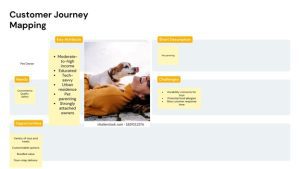
The buyer persona illustrated above highlights the primary needs of a BarkBox customer as convenience, quality, and safety. As stated earlier, the company’s primary target audience lives busy lives. By implementing a subscription service that enables them to receive dog food at their doorstep every month, the customers do not have to worry about making time to shop. Also, the company invests resources to create high-quality products specially curated to suit individual pet needs. Finally, given that the company takes pet safety seriously, customers do not have to worry about purchasing products that may cause health complications for their furry friends.
The specific opportunities BarkBox’s buyers enjoy include access to diverse toys and treats, customizable options, bundled value, and doorstep delivery. When customers buy products from BarkBox, they benefit from bundled value as the company includes multiple options based on their preferences. If pet owners were to purchase such products separately, they may incur higher costs. Also, the company offers customizable options depending on a customer’s needs and their pet type. It is worth noting that the company has nutritional experts who determine what type of products are best for a given type of pet; hence, the customer does not have to conduct much research on their own.
However, there are a few pain points or challenges customers may encounter after purchasing their pet offerings from BarkBox. One such challenge is a concern about the durability of toys. Some dogs are aggressive chewers, something that hastens wear and tear for the toys. Besides, without prior examination, it may be impossible to figure out if pets have an allergy, thus exposing them to health hazards.
Conclusion
BarkBox’s primary target is customers who live in large urban areas. These customers live busy lives; hence, BarkBox solves their problem by providing doorstep delivery of customizable pet offerings. Besides, the company targets middle-to-high-income customers who can afford to subscribe to monthly offerings. Another notable customer attribute that influences customer segmentation at BarkBox is the level of a customer’s obsession with their dogs. Typical BarkBox customers exhibit moderate to high attachment to their pets. Such customers are willing to sacrifice their resources to purchase quality products for their dogs.
References
Bhakat, R. S. (2019). Emerging products and demographic transition:A case of pet foods. Jaipuria International Journal of Management Research, 5(2), 48–52. https://doi.org/10.22552/jijmr/2019/v5/i2/189061
Boya, U. O., Dotson, M. J., & Hyatt, E. M. (2012). Dimensions of the dog–human relationship: A segmentation approach. Journal of Targeting Measurement and Analysis for Marketing, 20(2), 133–143. https://doi.org/10.1057/jt.2012.8
ORDER A PLAGIARISM-FREE PAPER HERE
We’ll write everything from scratch
Question 
BarkBox Target Market & Customer Journey
Topic: Barkbox
Task
Write a 3–5-page paper addressing the following sections. Include headings, sub-headings, and references.
Continue with the same product or service chosen in Unit 1.
BarkBox Target Market & Customer Journey
Segmentation Analysis:
Conduct segmentation analysis using the following five segmentation categories:
Demographic/Firmographic: Group consumers by categorical descriptive characteristics.
Geographic: Group consumers using location variables.
Psychographic: Group consumers using psychological, sociological, and anthropological variables.
Behavioral: Group consumers based on past or predicted behavior.
Benefits Sought: Group consumers based on the utility or need driving decisions.
Evaluate each category thoroughly and provide reasoning for your segmentation choices.
Buyer Persona Creation:
Based on your segmentation analysis, create a detailed buyer persona for your chosen product or service.
Include demographic details, geographic location, psychographic traits, behavioral patterns, and benefits sought.
Provide a narrative description of your buyer persona, including their background, goals, challenges, preferences, and buying behavior.
Include a photo representative of your buyer persona.
Use research and data to support your persona creation process.
Format:
This assignment should be double spaced, 12-point Arial or Times New Roman Font
Include references and in-text citations
Assignment will be 3-5 pages not including the title page or reference list
 Complete the order form and upload all of your files, including any instructions, rubrics, or other materials provided by your instructor.
  Complete the order payment after filling in the order form. We’ll receive your order and assign it to a writer.
 The assigned writer will complete your paper and forward it to our Editing Team for review and approval.
 Once approved by the editor, the completed paper will be uploaded to your account for you to download, review and approve.