
Assignment 1
Impact of Evidence-Based Practice on Patient Experience
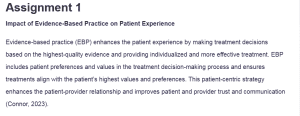
Evidence-based practice (EBP) enhances the patient experience by making treatment decisions based on the highest-quality evidence and providing individualized and more effective treatment. EBP includes patient preferences and values in the treatment decision-making process and ensures treatments align with the patient’s highest values and preferences. This patient-centric strategy enhances the patient-provider relationship and improves patient and provider trust and communication (Connor, 2023): Assignment 1.
Through the removal of ineffective and outdated methods of treatment, EBP reduces the risk of patient injury and enhances patient outcomes. EBP also improves patient and provider communication about the patient’s disease and treatment options and includes the patient in making an educated treatment decision (Melnyk & Fineout-Overholt, 2023). This not only leads to better patient outcomes but also improves patient satisfaction because the patient becomes an active participant in the treatment and is esteemed and respected by the provider.
Impact of EBPs on Population Health
EBP has a critical role in population health in that it ensures that interventions used are proven at the population level. Preventative methods against common chronic diseases such as diabetes and hypertension will be used based on evidence that they reduce disease burden at the population level. Standardization of treatment through evidence-informed guides ensures that everyone receives the same top-quality treatment regardless of the individual’s background, and this diminishes disparities.
Through the use of proven interventions, EBP also prevents the spread of infectious disease and enhances the management of chronic disease in the long term, and this results in overall good results for the population’s health (Kennedy et al., 2020). The use of EBP systematically results in lower variation of the treatment and higher consistency of the provision of treatment, which results in the enhancement of the population’s health and the reduction of the general burden of the healthcare system.
Impact of Evidence-Based Practice on Costs
EBP reduces the cost of healthcare by prioritizing proven and cost-efficient treatments (Walewska-Zielecka, et al., 2021). Through the elimination of non-essential procedures and prioritization of interventions that have been proven with solid evidence, the healthcare system avoids squandering resources on ineffective treatment. EBP reduces errors with the use of evidence-supported guidelines and subsequently results in a lower occurrence of complications and the necessity of expensive follow-up treatments (Mohamed et al., 2024).
Furthermore, through the elimination of avoidable emergency room visits and hospital readmissions with the use of proven treatments and preventative interventions, EBP reduces the overall expenditure of healthcare. The standardization of interventions and treatments with the use of EBP also ensures that interventions and treatments are not only efficient but also supported with the best evidence (Melnyk & Fineout-Overholt, 2023). They utilize the existing resources effectively and minimize wasteful spending. In the long run, implementation of EBP in clinical settings enhances the development of sustainable models that enhance the right care at the right time.
Impact of Evidence-Based Practice on the Work of Healthcare Providers
In the work setting, EBP contributes to the improvement of job satisfaction, which in turn enhances the provider’s productivity by reducing burnout. By using the applicable guidelines in practice, the healthcare providers feel more confident and sure in their clinical decisions with less stress and confusion. EBP also contributes to the improvement of patients’ outcomes, which can be rewarding to healthcare professionals as they perceive their labour as beneficial to patients (Shibabaw et al., 2023). Thus, EBP fosters staff development since providers are inspired to familiarize themselves with the most recent literature.
This can help to foster engagement and development of the personnel, hence working to lower the levels of dissatisfaction with their jobs (Shibabaw et al., 2023). Additionally, EBP assists in enhancing the quality of care and communication among different healthcare personnel. As such, it could eliminate a lot of unnecessary conflict and make the workplace environment better. Promoting a culture of learning and respect, EBP contributes to enhancing the quality of the work life of healthcare professionals.
References
Connor, L. (2023). Evidence-based practice improves patient outcomes and healthcare system return on investment: Findings from a scoping review. Worldviews on Evidence-Based Nursing, 20(1), 6–15. https://doi.org/10.1111/wvn.12621
Kennedy, M., Carbone, E. G., Siegfried, A. L., Backman, D., Henson, J. D., Sheridan, J., Meit, M. B., & Thomas, E. V. (2020). Factors Affecting Implementation of Evidence-Based Practices in Public Health Preparedness and Response. Journal of Public Health Management and Practice, 26(5), 434–442. https://doi.org/10.1097/phh.0000000000001178
Melnyk, B. M., & Fineout-Overholt, E. (2023). Evidence-based practice in nursing & healthcare: A guide to best practice (5th ed.). Evidence-based practice in nursing & healthcare: A guide to best practice (4th ed.).
Mohamed, R. A., Alhujaily, M., Ahmed, F. A., Nouh, W. G., & Almowafy, A. A. (2024). Nurses’ experiences and perspectives regarding evidence‐based practice implementation in healthcare context: A qualitative study. Nursing Open, 11(1), e2080. https://doi.org/10.1002/nop2.2080
Shibabaw, A. A., Chereka, A. A., Walle, A. D., Demsash, A. W., Kebede, S. D., Gebeyehu, A. S., Tizie, S. B., Mamo, D. N., & Kassie, S. Y. (2023). Evidence-Based Practice and Its Associated Factors among Health Professionals Working at Public Hospitals in Southwest Ethiopia. BioMed Research International, 1–10. https://doi.org/10.1155/2023/4083442
Walewska-Zielecka, B., Religioni, U., Soszyński, P., & Wojtkowski, K. (2021). Evidence-Based Care Reduces Unnecessary Medical Procedures and Healthcare Costs in the Outpatient Setting. Value in health regional issues, 25, 23–28. https://doi.org/10.1016/j.vhri.2020.07.577
ORDER A PLAGIARISM-FREE PAPER HERE
We’ll write everything from scratch
Question 
Healthcare organizations continually seek to optimize healthcare performance. For years, this approach was a three-pronged one known as the Triple Aim, with efforts focused on improved population health, enhanced patient experience, and lower healthcare costs.
More recently, this approach has evolved to a Quadruple Aim by including a focus on improving the work life of healthcare providers. Each of these measures are impacted by decisions made at the organizational level, and organizations have increasingly turned to EBP to inform and justify these decisions.
Resources
Be sure to review the Learning Resources before completing this activity.
Click the weekly resources link to access the resources.
To Prepare:
- Read the articles by Sikka, Morath, & Leape (2015); Crabtree, Brennan, Davis, & Coyle (2016); and Kim et al. (2016) provided in the Resources.
- Reflect on how EBP might impact (or not impact) the Quadruple Aim in healthcare.
- Consider the impact that EBP may have on factors impacting these quadruple aim elements, such as preventable medical errors or healthcare delivery.

Assignment 1
To Complete:
Write a brief analysis (no longer than 2 pages) of the connection between EBP and the Quadruple Aim.
Your analysis should address how EBP might (or might not) help reach the Quadruple Aim, including each of the four measures of:
- Patient experience
- Population health
- Costs
- Work life of healthcare providers
Readings:
- Melnyk, B. M., & Fineout-Overholt, E. (2023). Evidence-based practice in nursing & healthcare: A guide to best practice (5th ed.).
- Boller, J. (2017). Nurse educators: Leading health care to the quadruple aim sweet spot.Links to an external site. Journal of Nursing Education, 56(12), 707–708. doi:10.3928/01484834-20171120-01
- Sikka, R., Morath, J. M., & Leape, L. (2015). The Quadruple Aim: Care, health, cost and meaning in workLinks to an external site.. BMJ Quality & Safety, 24, 608–610. doi:10.1136/bmjqs-2015-004160
- Crabtree, E., Brennan, E., Davis, A., & Coyle, A. (2016). Improving patient care through nursing engagement in evidence-based practiceLinks to an external site.. Worldviews on Evidence-Based Nursing, 13(2), 172–175. doi:10.1111/wvn.12126
- Kim, S. C., Stichler, J. F., Ecoff, L., Brown, C. E., Gallo, A.-M., & Davidson, J. E. (2016). Predictors of evidence-based practice implementation, job satisfaction, and group cohesion among regional fellowship program participantsLinks to an external site.. Worldviews on Evidence-Based Nursing, 13(5), 340–348. doi:10.1111/wvn.12171
- Melnyk, B.M., Fineout-Overhold, E., Stillwell, S.B., & Williamson, K.M. (2010). Evidence-based practice step-by-step: The seven steps of evidence-based practiceLinks to an external site.. American Journal of Nursing, 110(1), 51-53.
- Melnyk, B. M., Gallagher-Ford, L., Long, L. E., & Fineout-Overholt, E. (2014). The establishment of evidence-based practice competencies for practicing registered nurses and advanced practice nurses in real-world clinical settings: Proficiencies to improve healthcare quality, reliability, patient outcomes, and costsLinks to an external site.. Worldviews on Evidence-Based Nursing, 11(1), 5–15. doi:10.1111/wvn.12021
 Complete the order form and upload all of your files, including any instructions, rubrics, or other materials provided by your instructor.
  Complete the order payment after filling in the order form. We’ll receive your order and assign it to a writer.
 The assigned writer will complete your paper and forward it to our Editing Team for review and approval.
 Once approved by the editor, the completed paper will be uploaded to your account for you to download, review and approve.