
Assessment of Nose, Mouth, Throat, and Neck
Subjective
The client is a 71-year-old African-American female who presents to the clinic complaining of a “sore throat and stuffy nose.” The symptoms started four days ago and have only gotten worse. The patient has not taken any medications to relieve the symptoms. The presenting symptoms do not have any associating symptoms. She denies any relieving or exacerbating symptoms. The patient is currently taking antihypertensives for her high blood pressure. She has allergies to penicillin-based drugs and animal dander. She reports nasal discharge and congestion. She denies nasal trauma is,nus pain, or changes in smell. She refuses any mouth sores or ulcers. She says she has a sore throat. She denies toothache. She denies polyphagia. She prohibits alcohol, tobacco, or recreational drug use. She flossed daily and visited her dentist twice a year. She refuses any swelling on the neck or neck pains. Our assignment writing help is at affordable prices to students of all academic levels and academic disciplines.
Objective
Vital signs: Oral Temp 37 C, HR: 88 bpm, RR 20, BP 183/72
Her nose is symmetrical and atraumatic. She has a thick, green,, crusty nasal discharge—red turbinates with internal swelling. Nares are not patent. The nasal mucosa is pink with no polyps or lesions. No nasal deformities were noted. Nasal septum deviation is negative. Maxillary sinuses are non-tender on palpation. Lips are intact with no lesions. She has no missing teeth. Oral mucosa is pink with no discoloration, redness, or bleeding. The tongue is moist and pink with an even appearance. No lesions were noted on the language.
Her mucous membranes are moist and pink with no lesions. The uvula hangs in the midline and rises with phonation. No masses on the neck on palpation. Her channel is symmetrical, with a complete range of movements. The posterior oral pharynx is red. The tonsillar lymph nodes are tender and enlarged on both sides. There were no enlargements on the occipital, postauricular, submandibular, submental, or preauricular nodes.
Risk Factors
The risk factors that this patient has are the allergies she has. The patient has allergies to animal dander. This can predispose the patient to a pet allergy. Pet allergy occurs due to a reaction to proteins in an animal’s skin, urine, or saliva (Chan & Leung, 2018). The common signs of a pet allergy are similar to hay fever, including runny nose and sneezing. The patient presented with symptoms of a stuffy nose and sore throat. These are symptoms related to pet allergy. The most common causes of pet allergies are cats and dogs. To reduce this risk, the client should minimize exposure to animals.
The second risk factor is the non-patent nares. Individuals exhale through occluded nares (Freeman et al., 2020). If the nares are not patent, the patient will not be able to exhale through the nares. The non-patent is the reason why the patient has a stuffy nose. This makes her unable to exhale properly.
In conclusion, patient subjective and objective assessment is essential to determine a diagnosis. Healthcare professionals must thus have the relevant skills and knowledge to conduct a patient assessment and use this information to make a clinical diagnosis. The data from the evaluation can help determine patient risk factors and develop patient-centered care.
References
Chan, S. K., & Leung, D. Y. (2018). Dog and cat allergies: Current state of diagnostic approaches and challenges. Allergy, Asthma & Immunology Research, 10(2), 97. https://doi.org/10.4168/aair.2018.10.2.97
Freeman, S. C., Karp, d. A., & Kahwaji, C. 1. (2020, July 10). Physiology, nasal. National Center for Biotechnology Information. https://www.ncbi.nlm.nih.gov/books/NBK526086/
ORDER A PLAGIARISM-FREE PAPER HERE
We’ll write everything from scratch
Question 
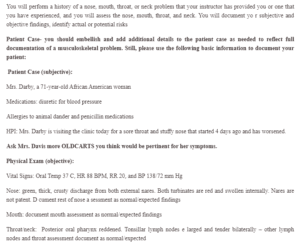
You will perform a history of a nose, mouth, throat, or neck problem that your instructor has provided you or one that you have experienced, and you will assess the nose, mouth, throat, and neck. You will document your subjective and objective findings and identify actual or potential risks.
Assessment of Nose, Mouth, Throat, and Neck
Patient Case- you should embellish and add additional details to the patient case as needed to reflect full documentation of a musculoskeletal problem. Still, please use the following basic information to document your patient:
Patient Case (subjective):
Mrs. Darby, a 71-year-old African American woman
Medications: diuretic for blood pressure
Allergies to animal dander and penicillin medications
HPI: Mrs. Darby is visiting the clinic today for a sore throat and stuffy nose that started four days ago and has worsened.
Ask Mrs. Davis more OLDCARTS you think would be pertinent for her symptoms.
Physical Exam (objective):
Vital Signs: Oral Temp 37 C, HR 88 BPM, RR 20, and BP 138/72 mm Hg
Nose: green, thick, crusty discharge from both external nares. Both turbinates are red and swollen internally. Nares are not patent. D cument rest of nose a sessment as normal/expected findings
Mouth: document mouth assessment as normal/expected findings
Throat/neck: Posterior oral pharynx reddened. Tonsillar lymph nodes are larged and tender bilaterally – other lymph nodes and throat assessment document as normal/expected
 Complete the order form and upload all of your files, including any instructions, rubrics, or other materials provided by your instructor.
 Complete the order payment after filling in the order form. We’ll receive your order and assign it to a writer.
 The assigned writer will complete your paper and forward it to our Editing Team for review and approval.
 Once approved by the editor, the completed paper will be uploaded to your account for you to download, review and approve.