
Assessing and Planning Care for an Elderly Person
Elderly persons are usually incarcerated by factors other than their age. Such factors as underlying pathologies, the decline in functionality due to reduced physical strength, and mental decline have been associated with these incarcerations. It is for these reasons that necessitate special considerations when handling these patients. It is fundamental to note that despite their age and health status, they reserve the right to humane treatment and that their incarcerations should not be used as an element of isolating them. Healthcare providers, being better poised at handling these individuals because of the higher propensity of older adults to seek healthcare, should always exhibit alertness when taking these patients. This paper aims to assess a care plan for older adults based on an interview with a 75-year-old male individual.
The elderly adult chosen was a 75-year-old male American of African descent. This individual is a known hypertensive and diabetic who is currently on medication. On assessment with Tinetti Balance and Gait Evaluation, this individual scored 26. This indicated that the individual is independent and able to do balance and gait-related activities, as evident in his usual morning and evening walks and general activity pattern (Tinetti & Kumar, 2017). On assessment with the Katz Index of Activities of Daily Living, this individual scored 5 (Ibrahim et al., 2018). This indicates total independence, requiring no supervision in executing activities such as bathing, feeding, continence, toileting, and dressing.
The individual was generally found to be safe at home. His ability to establish and follow home safety protocols in his homestead informed this. The presence of fire alarms, fire extinguishers, ramps instead of staircases, and door locks, among others, as components of an integrated security system installed at his homestead all indicated a safe environment. On assessment using the Barthel index, the individual scored 90. This meant his independence in executing most activities, such as mobility, grooming, feeding, bathing, defecating, toilet use, and transfers to bed. He, however, experienced occasional urine leakage and had difficulty climbing stairs (Yi et al., 2020). These assessment tools reveal that this individual exhibits independence in most of his routine activities. He also expresses good physical strength and is generally healthy. This is particularly remarkable considering his age and the comorbidities that he currently has.
Old age presents several physiologic and functional alterations that, in most instances, lead to the individual’s incarceration. The various attributes of old age include reduced mobility due to reduced physical strength and pathological conditions attributable to altered physiologic functionalities (An et al., 2018). The older adult interviewed exhibited great freedom from most incarcerations, as would have been expected for persons of his age and health status. The individual had excellent mobility, as evident in the logs he indulged in, and his ability to carry out a routine task requiring physical functionality and strength.
However, comorbidities in the interviewed individual show consistencies with most older adults. The interviewed individual had diabetes and hypertension and was on active medications for these pathologies. Additionally, from his accounts, the interviewed individual noted a reduction in physical strength and inability to execute exercises demanding more power, such as running, lifting heavy objects, and doing many daily activities. This also indicates old age and is consistent with most older adults. Features of old age are usually evident in older people. However, variations in the range of activities differ among individuals and depend on several factors, such as lifestyle and background.
Several preliminary issues were evident in the interviewed individuals, consistent with older persons. Such issues include chronic health conditions, drug use, physical injuries, and cognitive impairments. Chronic health conditions in older patients may be attributed to altered physiologic functionality, as seen in declining organ functionalities. Such disorders affecting the cardiovascular, renal, and respiratory systems have been implicated in old age (An et al., 2018). Physical injuries are also every day. This is attributable to falls due to mobility restrictions. Another apparent issue in old age is cognitive impairments, as seen in dementia.
Various health alterations are apparent in old age. These include cognitive impairments, chronic disease conditions, and inadequate bladder control. Cognitive impairments in older people are characterized by impairment in thinking, learning new skills, and ability to remember. These are evident in dementia, which exhibits a greater propensity for existence in old age than the younger generation. Chronic diseases are often observable in the aged. Clinical presentation of older persons reveals many persons with comorbidities with disorders of the cardiovascular systems, renal and respiratory systems being the most implicated. These diseases are associated with the declining physiological functionality of organs in these systems due to age and other factors related to the individual’s behavior and environment. Inadequate bladder control and constipation are also common occurrences in older males.
Inadequate bladder control manifests as urinary incontinence that has been implicated in wet pants for some elderly persons and other disease states. Inadequate bladder control is a consequence of weakened control of the sphincter muscles of the bladder and is a particularly concerning issue in the aged groups. However, as described below, effective interventions could be applied to manage these issues.
Cognitive impairments evident in old age can be managed by an integrative approach that utilizes pharmacological and non-pharmacological interventions. Cognitive-behavioral therapy has been used as a psychosocial treatment approach to dementia. Enhancing physical activity also confers significant benefits in preventing dementia and other cognitive impairment diseases in old age. Various medications can be utilized to slow the progression of these diseases. Such medicines as donepezil and rivastigmine have been used in this course and have shown considerable benefits.
Chronic disease conditions evident in old age can be managed by several interventions aimed at reducing risk, eliminating the disease, and symptomatic management of the disease. Healthy behaviors have been associated with a reduction in the development of comorbidities. Such behaviors as smoking cessation, a healthy diet, and reduced alcohol use reduce the effect of various chronic conditions. It is also fundamental that already developed diseases be managed efficiently to eliminate the disorders and manage the symptoms. Depending on the disease, various pharmacological interventions can be made, such as using antidiabetics and antihypertensive agents in the case of the interviewed individual. The utilization of alternative treatment modalities that may be influenced by culture may be necessary for managing these diseases. Such culturally related treatment modalities as herbs and diet therapy have shown significant benefits.
Urinary incontinence can also be managed in several ways. Adequacy in exercise, lifestyle changes, and proper nutrition have all shown positive effects. Exercises that strengthen the pelvic floor, such as Pilates, are essential in managing incontinence. Adequate nutrition to exclude acidic fruits that are potential bladder irritants also produces positive results in managing urinary leakages. Behavioral changes such as reduction of alcohol use and smoking cessation are also beneficial.
Old age presents several changes that may pose considerable challenges to individuals and their caregivers. Functional and physiologic alterations are evident in old age. Such alterations are apparent in decreased mobility and a decline in physiologic functionalities. The consequences of these alterations are seen in various diseases and incarcerations characteristic of old age. Comprehensive management of these conditions is necessary to improve their quality of life and alleviate their suffering.
References
An, R., Wilms, E., Masclee, A., Smidt, H., Zoetendal, E., & Jonkers, D. (2018). Age-dependent changes in GI physiology and microbiota: time to reconsider? Gut, 67(12), 2213-2222. https://doi.org/10.1136/gutjnl-2017-315542
Ibrahim, N., Ahmad, M., Zulfarina, M., Zaris, S., Mohamed, I., & Mohamed, N. et al. (2018). Activities of Daily Living and Determinant Factors among Older Adult Subjects with Lower Body Fracture after Discharge from Hospital: A Prospective Study. International Journal Of Environmental Research And Public Health, 15(5), 1002. https://doi.org/10.3390/ijerph15051002
Tinetti, M., & Kumar, C. (2017). The Patient Who Falls. JAMA, 303(3), 258. doi: 10.1001/jama.2009.2024
Yi, Y., Ding, L., Wen, H., Wu, J., Makimoto, K., & Liao, X. (2020). Is the Barthel Index Suitable for Assessing Activities of Daily Living in Patients With Dementia? Frontiers In Psychiatry, 11. doi: 10.3389/fpsyt.2020.00282
ORDER A PLAGIARISM-FREE PAPER HERE
We’ll write everything from scratch
Question 
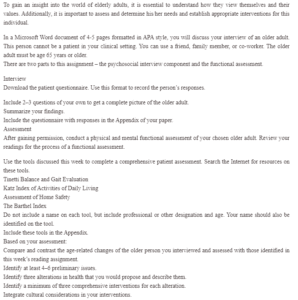
To gain an insight into the world of elderly adults, it is essential to understand how they view themselves and their values. Additionally, assessing and determining his/her needs and establishing appropriate interventions for this individual.
Assessing and Planning Care for an Elderly Person
is important a Microsoft Word document of 4-5 pages formatted in APA style, you will discuss your interview with an older adult. This person cannot be a patient in your clinical setting. You can use a friend, family member, or co-worker. The older adult must be age 65 years or older.
This assignment has two parts – the psychosocial interview component and the functional assessment.
Interview
Download the patient questionnaire. Use this format to record the person’s responses.
Include 2–3 questions to get a complete picture of the older adult.
Summarize your findings.
Include the questionnaire with responses in the Appendix of your paper.
Assessment
After gaining permission, conduct a physical and mental functional assessment of your chosen older adult. Review your readings for the process of a practical evaluation.
Use the tools discussed this week to complete a comprehensive patient assessment. Search the Internet for resources on these tools.
Tinetti Balance and Gait Evaluation
Katz Index of Activities of Daily Living
Assessment of Home Safety
The Barthel Index
Do not include a name on each tool, but include professional or other designation and age. Your title should also be identified on the tool.
Include these tools in the Appendix.
Based on your assessment:
Compare and contrast the age-related changes of the older person you interviewed and assessed with those identified in this week’s reading assignment.
Identify at least 4–6 preliminary issues.
Identify three alterations in health that you would propose and describe them.
Identify a minimum of three comprehensive interventions for each alteration.
Integrate cultural considerations in your interventions.
 Complete the order form and upload all of your files, including any instructions, rubrics, or other materials provided by your instructor.
 Complete the order payment after filling in the order form. We’ll receive your order and assign it to a writer.
 The assigned writer will complete your paper and forward it to our Editing Team for review and approval.
 Once approved by the editor, the completed paper will be uploaded to your account for you to download, review and approve.