
Artwork
Part 1: Art and Future Career Plans as a Social Worker
In my future career as a social worker, art can help me develop intense observation and analytical skills that will enable me to be sensitive and responsive to client needs. It also fosters empathy by connecting me with different cultural and emotional worlds to understand others better. Art fosters analytical thinking, enhancing my capacity to understand complex human interactions: Artwork.
The analysis of symbolism in the work of art helps me see the hidden message or the unspoken problem to understand better clients who have difficulty expressing themselves in words. These analytical tools are essential for adequate, compassionate, and insightful practice in social work.
My goal is to become a licensed social worker who supports individuals and families who are dealing with mental health, trauma, and social injustice. I can also further my cultural knowledge by studying art and being sensitive and respectful toward people of different cultures. Social work also provides me with creative therapeutic tools, including art therapy, which can help clients express unspoken emotions.
Art’s ability to reflect on societal issues aligns with my mission to advocate for social justice. Exploring art strengthens my professional observations and understanding, helping me apply empathizing, innovating, and critically reflecting to my future as a social worker.
Part 2: Rio Delle Torreselle Chandelier
The art I selected is Dale Chihuly’s Rio delle Torreselle Chandelier, which is composed of hand-blown glass and was installed in Venice, Italy, in 1996. What drew my attention was the chandelier’s surprising installation over a Venetian canal and its wild, organic glass shapes that appear to float in defiance of gravity. It is interesting because it contradicts traditional notions of art and function and encourages viewers to experience everyday spaces in new ways.
The work is a vast, elaborate cluster of twisted, brightly colored glass pieces that capture and reflect natural light (Fichner-Rathus 216). Its tangles of bright tendrils spill outwards like sea creatures or budding flowers in a profuse suggestion of motion and vitality. The chandelier does not produce any light but conditions the surrounding light, creating an environment in which the environment itself is part of the work.
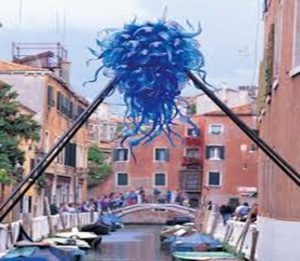
Artwork Title: Rio delle Torreselle Chandelier
Artist: Dale Chihuly
Date: 1996
Medium: Hand-blown glass chandelier installation, approximately 7 × 8 feet
The subject is established by the chandelier’s location in a public place, over a canal in Venice, and by its association with traditional chandeliers, though reimagined as a decorative sculpture. According to its name, Rio Delle Torreselle Chandelier, and its connection to the Chihuly Over Venice project, it has been a way to brighten up common public spaces with art. The work’s form is defined by the twisting and turning of the curved shapes of the blown glass pieces, their vibrant colors, and how they cluster together and cling as a single form.
The translucent, reflective quality of glass responds to changing light conditions, accentuating motion, depth, and texture. This work is abstract because even as it alludes to a chandelier shape, the exaggerated, non-literal shapes and the bold colors offer expressionist emphasis rather than a realistic portrayal.
The purpose that best describes Dale Chihuly’s Delle Torreselle Chandelier is beauty. Dale Chihuly’s Rio delle Torreselle Chandelier may serve this purpose best as it is specifically created to modify the visuals of a public place to be elegant, colorful, and filled with light. The chandelier is not for utility like ordinary lighting but for sensation and for provoking wonder. Its complex glass figures and brilliant reflections are hypnotic and demonstrate how the arts can make the environment more appealing for pure visual enjoyment.
Works Cited
Fichner-Rathus, Lois. Understanding Art. 11th ed., Cengage Learning, 2016.
ORDER A PLAGIARISM-FREE PAPER HERE
We’ll write everything from scratch
Question 
Part 1: How might art help you analyze in your future career or plans? What are your plans and how might studying art support that?
Part 2: Find a new-to-you artwork from the textbook that interests you. Feel free to look through upcoming chapters. NOTE: the following artworks are not allowed: Starry Night by Van Gogh, The Persistence of Memory by Dali, Mona Lisa by da Vinci.
Include identifying info on the artwork (title, artist, date, medium).
Describe what drew your attention, and why it interests you.
Describe the work, making as many observations as you can. Be specific and descriptive
Artwork
Which details establish the work’s subject?
Which details contribute to the work’s form?
Is this work abstract, realistic, or nonobjective?
What theme or purpose from the “Themes and Purposes of Art” section in Understanding Art would best suit this work? Justify your response. Please note this section is towards the back, in the ‘visual glossary’
- My career will be in Social Work and the Name of the textbook is: Understanding Art
 Complete the order form and upload all of your files, including any instructions, rubrics, or other materials provided by your instructor.
  Complete the order payment after filling in the order form. We’ll receive your order and assign it to a writer.
 The assigned writer will complete your paper and forward it to our Editing Team for review and approval.
 Once approved by the editor, the completed paper will be uploaded to your account for you to download, review and approve.