
Article Summary: Emerging Technologies
The area of practice I want to specialize in is Family Nurse Practitioner (FNP), which involves giving direct primary care across the lifespan. FNPs treat and diagnose acute and chronic illnesses, provide health screenings, administer medications, and provide preventive care management strategies (Melo et al., 2023). The role also involves educating, counseling patients, and working with interprofessional teams to provide holistic and evidence-based care. In the future, as an FNP, I should be able to keep up with fast-changing technologies to improve patient outcomes, simplify clinical processes, and facilitate continuity of care within outpatient and community settings.
As a future FNP, I would integrate into my practice a digital competency management platform to achieve ongoing clinical development and competency validation. In this case, the system will monitor my proficiency in performing tasks like suturing, women’s health screenings, or chronic disease management protocols. It would enable my supervisors to trace the improvement of skills, discover the learning requirements, and ensure competence in the provision of evidence-based interventions. The tool can also aid in continuous training updates in other practices such as vaccination protocols, telehealth procedures, or even emergency care, which makes the FNP practice consistent with the changing standards and regulatory needs.
Ethical, Legal, and Safety Issues
Legally, the main risk is privacy, security, and records retention requirements to store competency data associated with the staff and, indirectly, patient care operations associated with personnel. Protected information may be breached, or inadequate controls over the access to information may break the regulatory requirements and subject the organization to disciplinary action, and a lack of faith by the workforce (Seh et al., 2020). Other issues of concern are the accuracy of records on which the privileging decisions are made and defensibility in case of a survey or litigation. Data governance, role-based access, and auditable trails are necessary to maintain compliance. In the absence of such safeguards, administrative convenience within the technology may end up causing legal vulnerability.
Ethically, equity and fairness in evaluation need a consideration of how the competencies should be defined, observed, and validated across units. Provided that expectations are not the same or the documentation thoroughness differs by department, employees will have unequal access to promotion up the clinical ladder. Feelings of bias or actual bias during sign-offs will lower morale and destroy the just culture (Paradiso, 2022). Procedural justice is focused on transparency regarding the criteria, the calibration of the appraisers, and the possibility to appeal discriminatory assessments.
In terms of client safety, partial or early validation may allow clinicians to conduct procedures without a proven competency level. Excessive usage of electronic attestations and utilization without the direct observation of the subject matter can lead to the false impression of competency (Longhini et al., 2022). Lack of safety may also arise when the system does not instruct on expired competencies or when critical information is not updated in time. In high-acuity settings, such gaps can turn into delays of interventions or even iatrogenic harm. Hence, there must be a close integration of competency documentation with practice verification in real time and escalation channels.
Mitigating Strategies
The organizational response to reduce legal liability involves adopting an elaborate data governance framework, including encryption storage, least-privilege access, multifactor authentication, and frequent penetration testing. Formal retention schedules and destruction policies must be defined, with version control for competency templates and immutable audit logs for edits and sign-offs. Cybersecurity hygiene workforce training lowers human-factor risk and enhances defense-in-depth (Argyridou et al., 2023). Accountability should be achieved through vendor due diligence, such as the use of business associate agreements and service level metrics. These controls combined can make the platform respond to regulatory expectations without compromising the efficiency of operations.
Ethical equity may be achieved through the implementation of standardized, role-based competency models, inter-rater calibration, and blind audits of sign-off results periodically. Transparent rubrics using behavior anchors minimize subjectivity, and dashboards can pull out differences in progress by unit, shift, or preceptor (Natesan et al., 2023). An organized feedback and appeal process grants employees the ability to object to questionable evaluations without threats. Shared ownership and legitimation are achieved through inclusive governance, which involves all nurses in the design of competencies. When combined, the practices instill fairness, transparency, and psychological safety into the ecosystem of evaluations.
In order to ensure patient safety, digital validation needs to be accompanied by direct observation, supervised practice, and, where applicable, proficiency verification on a simulator. Hard stops may be set up in such a way as to ensure that privileges, order sets, or access to specific devices require the active and current competency status. Expirations should be announced with automated messages to clinicians and managers, and remediation should be easily performed through exception workflows (Zayas-Cabán et al., 2021). Real-world effectiveness can be tested by periodic correlation of competency data with quality indicators, such as procedure complications or near-miss reports.
Reflection
I advocate the application of this technology in healthcare due to its ability to enhance clinical governance, orientation, and clarity on safe-practice expectations. Competency centralization improves the staff and leader visibility, minimizes administrative overheads, and enables survey preparedness and magnet reports (Feng et al., 2025). Thoughtful implementation makes the platform a driver of lifelong learning, resilient staffing, and consistent, guideline-concurrent care. I will support such a concept on the provision of strong governance and human supervision, with the understanding that technology should be a supplement, rather than a replacement for professional judgments. Under these conditions, the advantages will outweigh the risks.
Such knowledge will enhance my future productivity as an FNP by combining competency building with the impacts of population needs, workflows, and measurable results. The platform will help me design specific upskilling, record monitored processes, and check preparedness prior to extending the services. Real-time dashboards will direct management, improvement, and precepting. Triangulating data on competencies with patient outcomes will allow me to prioritize high-value learning. Proper use will eventually lead to improved safety of visits, reduced mistakes, and enhanced continuity of care.
References
Argyridou, E., Nifakos, S., Laoudias, C., Panda, S., Panaousis, E., Chandramouli, K., Navarro-Llobet, D., Zamorano, J. M., Papachristou, P., & Bonacina, S. (2023). Cyber hygiene methodology for raising cybersecurity and data privacy awareness in health care organizations: Concept study. Journal of Medical Internet Research, 25, e41294. https://doi.org/10.2196/41294
Feng, Z., Zhang, H., & Liang, Z. (2025). The role of competent leaders in nursing staff empowerment: A cross-sectional study. Journal of Healthcare Leadership, 17, 327–341. https://doi.org/10.2147/jhl.s527992
Longhini, J., Rossettini, G., & Palese, A. (2022). Digital health competencies among health care professionals: Systematic review. Journal of Medical Internet Research, 24(8), e36414. https://doi.org/10.2196/36414
Melo, M. D. M., Da Silva, I. P., Freitas, L. S., Da Costa Mesquita, S. K., Sonenberg, A., & Costa, I. K. F. (2023). Family nurse practitioners: An exploratory study. Revista Da Escola De Enfermagem Da USP, 57. https://doi.org/10.1590/1980-220x-reeusp-2022-0362en
Natesan, S., Jordan, J., Sheng, A., Carmelli, G., Barbas, B., King, A., Gore, K., Estes, M., & Gottlieb, M. (2023). Feedback in medical education: An evidence-based guide to best practices from the Council of Residency Directors in Emergency Medicine. Western Journal of Emergency Medicine, 24(3). https://doi.org/10.5811/westjem.56544
Paradiso, L. (2022). Rebuilding trust in just culture. Nursing Management, 53(11), 6–14. https://doi.org/10.1097/01.numa.0000891456.44611.10
Seh, A. H., Zarour, M., Alenezi, M., Sarkar, A. K., Agrawal, A., Kumar, R., & Khan, R. A. (2020). Healthcare data breaches: Insights and implications. Healthcare, 8(2), 133. https://doi.org/10.3390/healthcare8020133
Siwicki, B. (2025, August 6). Nurse skills development tools show results for Lurie Children’s Hospital. Healthcare IT News. https://www.healthcareitnews.com/news/nurse-skills-development-tools-show-results-lurie-childrens-hospital
Zayas-Cabán, T., Haque, S. N., & Kemper, N. (2021). Identifying opportunities for workflow automation in health care: Lessons learned from other industries. Applied Clinical Informatics, 12(03), 686–697. https://doi.org/10.1055/s-0041-1731744
ORDER A PLAGIARISM-FREE PAPER HERE
We’ll write everything from scratch
Question 
This is the link to the article.
https://www.healthcareitnews.com/news/nurse-skills-development-tools-show-results-lurie-childrens-hospital
Follow these guidelines when completing each component of the assignment. Contact your course faculty if you have questions.
General Instructions
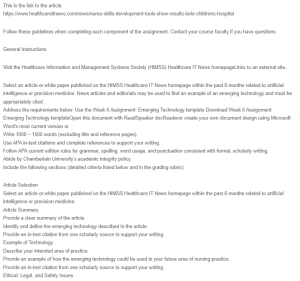
Article Summary – Emerging Technologies
Visit the Healthcare Information and Management Systems Society (HIMSS) Healthcare IT News homepageLinks to an external site..
Select an article or white paper published on the HIMSS Healthcare IT News homepage within the past 6 months related to artificial intelligence or precision medicine. News articles and editorials may be used to find an example of an emerging technology and must be appropriately cited.
Address the requirements below. Use the Week 6 Assignment: Emerging Technology template Download Week 6 Assignment: Emerging Technology templateOpen this document with ReadSpeaker docReaderor create your own document design using Microsoft Word’s most current version or
Write 1000 – 1500 words (excluding title and reference pages).
Use APA in-text citations and complete references to support your writing.
Follow APA current edition rules for grammar, spelling, word usage, and punctuation consistent with formal, scholarly writing.
Abide by Chamberlain University’s academic integrity policy.
Include the following sections (detailed criteria listed below and in the grading rubric):
Article Selection
Select an article or white paper published on the HIMSS Healthcare IT News homepage within the past 6 months related to artificial intelligence or precision medicine.
Article Summary
Provide a clear summary of the article.
Identify and define the emerging technology described in the article.
Provide an in-text citation from one scholarly source to support your writing.
Example of Technology
Describe your intended area of practice.
Provide an example of how the emerging technology could be used in your future area of nursing practice.
Provide an in-text citation from one scholarly source to support your writing.
Ethical, Legal, and Safety Issues
Describe at least one legal issue related to the emerging technology.
Describe at least one ethical concern related to the emerging technology.
Describe at least one client safety concern related to the emerging technology.
Provide an in-text citation from one scholarly source to support your writing.
Mitigating Strategies
Describe a mitigating strategy for the identified legal issue related to the emerging technology.
Describe a mitigating strategy for the identified ethical concern related to the emerging technology.
Describe a mitigating strategy for the identified client safety concern related to the emerging technology.
Provide an in-text citation from one scholarly source to support your writing.
Reflection
Identify whether you support the use of the technology in healthcare.
Provide a rationale for why or why not.
Reflect on how the knowledge will improve your effectiveness as an advanced practice nurse.
 Complete the order form and upload all of your files, including any instructions, rubrics, or other materials provided by your instructor.
  Complete the order payment after filling in the order form. We’ll receive your order and assign it to a writer.
 The assigned writer will complete your paper and forward it to our Editing Team for review and approval.
 Once approved by the editor, the completed paper will be uploaded to your account for you to download, review and approve.