
Article Review: Does Power Corrupt the Mind? The Influence of Power on Moral Reasoning and Self-Interested Behavior
The article “Does Power Corrupt the Mind? The Influence of Power on Moral Reasoning and Self-Interested Behavior” by Giurge et al. (2021) investigates how power affects leaders’ self-interested behavior and moral reasoning. The researchers conducted an experimental study that utilized a two-dimensional manipulation of power: power over others (number of followers) and power to assert one’s will (number of payout options). The study aimed to inquire if greater power leads to less moral principle and greater self-interest, and whether moral reasoning mediates the relationship between power and self-interest. The study aligns with the field of group dynamics by probing the degree to which leaders’ power in groups influences ethical decisions and interpersonal outcomes.
Methods
The study used a sample of 445 European university undergraduate business students. Members were randomly assigned to a leadership or followership role, and data on 149 leaders were exclusively included in the final analysis following exclusions on the basis of anonymity violations and inconsistent responding. Leaders were assigned to one of four conditions within a 2×2 factorial design: low or high power over (one vs. three followers) and low or high power to (three vs. four option payouts). Moral reasoning was assessed using the Defining Issues Test (DIT), and a P-score of principled moral reasoning was obtained. Self-interested behavior was manipulated by leaders’ decisions concerning how to allocate monetary rewards between themselves and their followers. The researchers ensured anonymity and experimental control inside the laboratory to reduce demand characteristics.
Results
The results indicated that leaders who had higher control over followers were characterized by significantly lower principled moral reasoning. This suggests that access to more subordinates will decrease a leader’s moral reasoning. Conversely, those leaders who possessed greater power to assert their will exhibited more self-interested action, but their moral reasoning was not affected. Structural equation modeling showed a statistically significant indirect effect: power over more followers decreased principled moral reasoning, and that was a predictor of higher self-interested action. Yet, power to act was not mediated by moral thinking, and thus points to two distinct routes by which various types of power affect behavior.
Discussion
The findings support the hypothesis that power affects behavior and underlying moral thinking as well. More powerful leaders seemed more likely to override ethical considerations, perhaps due to reduced accountability or inflated self-esteem. Giurge et al.’s (2021) research contributes to understanding why moral reasoning is not a fixed property but variable in social context, challenging traditional positions like Kohlberg’s stage theory, where moral reasoning develops in a linear, irreversible fashion. This is consistent with more flexible models of moral cognition that consider contextual factors like social hierarchy. Additionally, the study shows how power leverages into self-interest cognitive webs, which can overwhelm moral thinking depending on the type of power held.
Conclusion
Giurge et al.’s (2021) study effectively demonstrates how power, particularly power over others, can undermine moral thinking and empower self-interested action. The results are immediately transferable to principles in group dynamics, particularly leadership, ethical decision-making, and power dynamics in groups. Understanding these dynamics is of essential importance to any group leader who wishes to create ethical cultures. This study was particularly valuable to me as it prompted me to think more about my future as a group facilitator. I would be more attuned to how my role of influence could affect my ethical choices if I were a student organization or work team leader. To help offset this, I would seek feedback actively, encourage responsibility, and develop participatory decision-making mechanisms in order to counteract the corrupting effect of power and facilitate principled group interactions.
References
Giurge, L. M., van Dijke, M., Zheng, M. X., & De Cremer, D. (2021). Does power corrupt the mind? The influence of power on moral reasoning and self-interested behavior. The Leadership Quarterly, 32(4). https://doi.org/10.1016/j.leaqua.2019.03.003
ORDER A PLAGIARISM-FREE PAPER HERE
We’ll write everything from scratch
Question 
Title of Your Paper
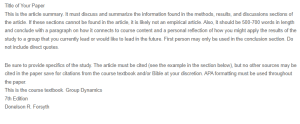
This is the article summary. It must discuss and summarize the information found in the methods, results, and discussions sections of the article. If these sections cannot be found in the article, it is likely not an empirical article. Also, it should be 500-700 words in length and conclude with a paragraph on how it connects to course content and a personal reflection of how you might apply the results of the study to a group that you currently lead or would like to lead in the future. First person may only be used in the conclusion section. Do not include direct quotes.
Does Power Corrupt the Mind? The Influence of Power on Moral Reasoning and Self-Interested Behavior
Be sure to provide specifics of the study. The article must be cited (see the example in the section below), but no other sources may be cited in the paper save for citations from the course textbook and/or Bible at your discretion. APA formatting must be used throughout the paper.
This is the course textbook. Group Dynamics
7th Edition
Donelson R. Forsyth
 Complete the order form and upload all of your files, including any instructions, rubrics, or other materials provided by your instructor.
  Complete the order payment after filling in the order form. We’ll receive your order and assign it to a writer.
 The assigned writer will complete your paper and forward it to our Editing Team for review and approval.
 Once approved by the editor, the completed paper will be uploaded to your account for you to download, review and approve.