
Article Analysis – Social Cognitive Theory (SCT)
Question One: Main Points and Research Questions
The paper’s primary goal is to investigate how low-income Black American adolescents in the lower Mississippi Delta region consume fruits and vegetables in relation to their personal, behavioral, and environmental circumstances. The authors aim to answer the following questions: What factors affect fruit and vegetable consumption in this group? How can these factors be understood and addressed using Social Cognitive Theory (SCT)? The study aims to develop insights for creating culturally relevant nutrition interventions (Molaison et al., 2005, p. 246).
Question Two: The Authors’ Utilization of the Theory
The authors applied Social Cognitive Theory (SCT) by categorizing the factors influencing dietary choices into three domains: personal, behavioral, and environmental. SCT postulates that behavior is influenced by interactions among personal, behavioral, and environmental factors. The study categorized various factors such as self-efficacy, taste preferences, social support, and environmental availability within these domains. This approach helped them identify key drivers and barriers for increasing fruit and vegetable consumption among adolescents (Molaison et al., 2005, p. 247-248).
Question Three: Interesting Aspects About the Paper
One of the most interesting findings was the significant influence of extended family, particularly grandmothers, on dietary choices. Many participants noted that their grandmothers were key figures in promoting fruit and vegetable consumption, indicating the importance of family support in fostering healthy eating behaviors. Additionally, the cultural practice of adding sugar to vegetables and the adolescents’ preference for sweet fruits were noteworthy and unique insights (Molaison et al., 2005, p. 249).
Question Four: Questions About the Paper
A few questions arise from the study:
- How can interventions be designed to involve extended family members, particularly grandmothers, in promoting healthy eating behaviors?
- What are some effective strategies to counteract peer pressure, which was identified as a significant barrier to fruit and vegetable consumption, especially in social settings among adolescents? (Molaison et al., 2005, p. 250).
Question Five: Parallels Drawn From the Readings to Today’s Issues
The findings regarding the importance of family support and the influence of environmental factors like availability are highly relevant today. Issues such as limited access to healthy foods and peer pressure still affect low-income and minority communities. Additionally, the cultural aspects of food choices, like the sweetness preference for fruits, continue to shape dietary patterns among youth. These findings can inform modern public health interventions addressing childhood obesity and promoting healthier eating habits, especially in underserved communities (Molaison et al., 2005, p. 251).
References
Molaison, E. F., Connell, C. L., Stuff, J. E., Yadrick, M. K., & Bogle, M. (2005). Influences on fruit and vegetable consumption by low-income black american adolescents. Journal of Nutrition Education and Behavior, 37(5), 246–251. https://doi.org/10.1016/s1499-4046(06)60279-0
ORDER A PLAGIARISM-FREE PAPER HERE
We’ll write everything from scratch
Question 
Article Analysis – Social Cognitive Theory (SCT)
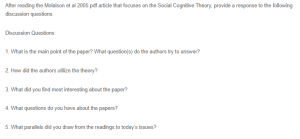
After reading the Molaison et al 2005.pdf article that focuses on the Social Cognitive Theory, provide a response to the following discussion questions.
Discussion Questions:
Article Analysis – Social Cognitive Theory (SCT)
1. What is the main point of the paper? What question(s) do the authors try to answer?
2. How did the authors utilize the theory?
3. What did you find most interesting about the paper?
4. What questions do you have about the papers?
5. What parallels did you draw from the readings to today’s issues?
 Complete the order form and upload all of your files, including any instructions, rubrics, or other materials provided by your instructor.
  Complete the order payment after filling in the order form. We’ll receive your order and assign it to a writer.
 The assigned writer will complete your paper and forward it to our Editing Team for review and approval.
 Once approved by the editor, the completed paper will be uploaded to your account for you to download, review and approve.