
Applying Research Skills-Medication Errors
Medication errors cause preventable effects that can harm the patient or even cause death. Medication errors are the leading causes of morbidity, mortality, hospital readmissions, increased care costs, and length of stay (Formica et al., 2018). Medication errors occur when a patient takes the wrong medication or uses an incorrect dose due to a combination of drugs without consulting with the health care professional, when medications are taken at a bad rate, and when medications are used past their expiration date. These medication errors can be caused by the healthcare professional or by mistakes from the patient.
As a registered nurse (RN), one of my main responsibilities is administering medications to patients. I ensure that they take the right medication, at the right dosage, at the right time. I have experienced several cases related to medication errors that led me to further my interest in understanding these cases and how to prevent them. For instance, once a nurse student was left unsupervised to give medications to in-patients in the pediatric wards. As she administered the medication to her third patient, her mother inquired about checking the medication. It was found that she was giving the wrong medication to the patient. Upon investigation, it was found that the last two patients had also received the wrong medication. The patients were given first aid and placed under observation. Fortunately, there were no adverse drug events reported. However, the student nurse was disciplined for the mistake, and the supervisor was suspended.
Identification of Academic Peer-Reviewed Literature and Search Criteria
I conducted a database search in PubMed Central and the Cochrane Library for scholarly peer-reviewed literature related to medication errors. The keywords used for the literature search include “medication administration,” “medication errors,” “medication safety,” and “medication error prevention.” Multiple search results were returned. I utilized the database’s advanced search options to filter the results using tools such as “publication date,” which was set for articles published between 2019 and 2022; “systematic reviews,” which returned systematic review articles on the search topic; and “publication type,” which was set for journals.
Assessment of the Credibility, Currency, and Relevance of the Journal Articles
For credibility and relevance of the articles to the topic, all articles selected were published in peer-reviewed journals. It was also confirmed that they provided facts based on research and statistics focusing on preventing medication errors. The author’s authority over the subject and topic was also accessed for each selected journal article. For journal currency, only articles published between 2019 and 2022 were selected.
Annotated Bibliography
Choi, Y. J., & Kim, H. (2019). Effect of pharmacy-led medication reconciliation in emergency departments: A systematic review and meta-analysis. Journal of Clinical Pharmacy and Therapeutics, 44(6), 932–945. https://doi.org/10.1111/JCPT.13019
In this systematic review and meta-analysis, the authors aimed to investigate how pharmacy-led medication reconciliation impacted medication discrepancies and potential adverse drug events in the emergency department. The authors’ main objective was to assess the benefits of pharmacy services in preventing medication errors during medication reconciliation.
Eight articles were meta-analyzed. The major medication errors identified in the ED during medication reconciliation included medication omission, incorrect and omitted doses, and wrong dose frequencies. The authors found that pharmacy-led medication reconciliation reduced medication discrepancies by 68% compared to normal physician-led care. The authors also found that pharmacy-led medication reconciliation for patients with several comorbidities and those using numerous medications simultaneously had higher chances of reducing medication discrepancies than normal medication reconciliation. The authors concluded that pharmacy-led medication reconciliation could substantially reduce medication discrepancies and suggested further research. This article is relevant to me as it provides evidence of how the pharmacy department can be used to prevent medication errors.
Manias, E., Kusljic, S., & Wu, A. (2020). Interventions to reduce medication errors in adult medical and surgical settings: a systematic review. Therapeutic Advances in Drug Safety, 11. https://doi.org/10.1177/2042098620968309
This article aimed to compare the effectiveness of various interventions in acute medical and surgical settings to reduce prescribing, dispensing, and administration of medication errors. The authors conducted a meta-analysis of 21 controlled trials of 12 interventions to reduce medication errors in adult and acute medical or surgical settings.
The review found single interventions with the highest probability of reducing medication errors in adult and surgical settings. These included pharmacist partnership, pharmacist-led medication reconciliation, medication reconciliation by trained mentors, computerized medication reconciliation, computerized physician order entry (CPOE), and prescriber education. The authors also found no single intervention for reducing drug dispensation errors. However, the authors concluded that combining interventions such as CPOE and automated drug distribution systems had higher chances of reducing and preventing medication errors and should be considered in reducing medication errors in adult and surgical settings. Future research should include control groups besides single-site hospitals. This article is relevant as it compares different interventions and details interventions to combine for improved medication error prevention and reduction.
Marufu, T. C., Bower, R., Hendron, E., & Manning, J. C. (2022). Nursing interventions to reduce medication errors in paediatrics and neonates: Systematic review and meta-analysis. Journal of Pediatric Nursing, 62, e139–e147. https://doi.org/10.1016/J.PEDN.2021.08.024
In this systematic review and meta-analysis, the authors aimed to identify the various nursing interventions that can be applied during medication administration to reduce medication administration errors. The authors included 18 studies in the meta-analysis on multiple interventions focused on reducing medication administration errors in paediatrics, children, and neonates.
The authors identified seven interventions: education programs, medication information services, clinical pharmacist involvement, double checking, barriers to reducing interruptions during drug calculation and preparation, implementation of smart pumps, and improvement strategies. The systematic review and meta-analysis identified medication educational interventional interventions as the most commonly used approach to reduce medication administration errors, with a 64% success rate in lowering errors post-intervention. The authors concluded that medication safety education was the most important intervention that could be applied to reduce administration errors in paediatrics and neonate settings. This paper is relevant to the topic as it provides various interventions, identifies the most effective medication error prevention and reduction, and suggests considering error causes before intervention implementation.
Roumeliotis, N., Sniderman, J., Adams-Webber, T., Addo, N., Anand, V., Rochon, P., Taddio, A., & Parshuram, C. (2019). Effect of Electronic Prescribing Strategies on Medication Error and Harm in Hospital: a Systematic Review and Meta-analysis. Journal of General Internal Medicine, 34(10), 2210. https://doi.org/10.1007/S11606-019-05236-8
The authors of this systematic review and meta-analysis aimed to assess the impact of electronic prescribing strategies on medication errors and patient harm in hospitalized patients. Accordingly, 38 studies, including 11 RCTs and 27 non-randomized interventional studies comparing various hospital-based electronic prescribing strategies with control groups on medication error or patient harm, were included in the systematic review.
The authors found that electronic prescribing strategies significantly reduced medication administration and dosing errors. The reviewed studies showed that the electronic prescribing strategy significantly reduced medication errors with advancing years of publication. However, the electronic prescribing strategy did not affect preventable ADEs, hypoglycemia, length of stay, or mortality incidents. The authors rated the quality of evidence in the reviewed articles; however, they concluded that electronic prescribing strategies effectively reduced medication errors and ADEs but had no impact on other patient outcomes. This article is relevant to the topic as it reviews evidence on the application of electronic prescription strategies to reduce and prevent dosing and administration of medication errors.
What I Learned from Developing This Annotated Bibliography
I have learned how to carry out topic-specific searches through filtering tools. I have also known that medication errors are a worldwide public health concern. I have further learned how medication errors affect patient safety and how they can be reduced and prevented. Although preventable, I have also known that medication errors occur in diverse ways, and there is no one sure way of eliminating medication errors. For instance, Marufu et al. (2022) described medication errors as multifaceted, noting the need for bundled interventional approaches. Manias et al. (2020) argue that combined interventions were more effective in reducing medication errors than single interventions.
References
Choi, Y. J., & Kim, H. (2019). Effect of pharmacy-led medication reconciliation in emergency departments: A systematic review and meta-analysis. Journal of Clinical Pharmacy and Therapeutics, 44(6), 932–945. https://doi.org/10.1111/JCPT.13019
Formica, D., Sultana, J., Cutroneo, P. M., Lucchesi, S., Angelica, R., Crisafulli, S., Ingrasciotta, Y., Salvo, F., Spina, E., & Trifirò, G. (2018). The economic burden of preventable adverse drug reactions: a systematic review of observational studies. Https://Doi.Org/10.1080/14740338.2018.1491547, 17(7), 681–695. https://doi.org/10.1080/14740338.2018.1491547
Manias, E., Kusljic, S., & Wu, A. (2020). Interventions to reduce medication errors in adult medical and surgical settings: a systematic review. Therapeutic Advances in Drug Safety, 11. https://doi.org/10.1177/2042098620968309
Marufu, T. C., Bower, R., Hendron, E., & Manning, J. C. (2022). Nursing interventions to reduce medication errors in paediatrics and neonates: Systematic review and meta-analysis. Journal of Pediatric Nursing, 62, e139–e147. https://doi.org/10.1016/J.PEDN.2021.08.024
Roumeliotis, N., Sniderman, J., Adams-Webber, T., Addo, N., Anand, V., Rochon, P., Taddio, A., & Parshuram, C. (2019). Effect of Electronic Prescribing Strategies on Medication Error and Harm in Hospital: a Systematic Review and Meta-analysis. Journal of General Internal Medicine, 34(10), 2210. https://doi.org/10.1007/S11606-019-05236-8
ORDER A PLAGIARISM-FREE PAPER HERE
We’ll write everything from scratch
Question 
Create a 2-4 page annotated bibliography and summary based on your research on best practices addressing one of the health care problems or issues in the Assessment Topic Areas media piece a health care organization faces that interests you.
Applying Research Skills-Medication Errors
Introduction
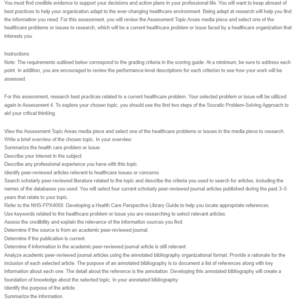
You must find credible evidence to support your decisions and action plans in your professional life. You will want to keep abreast of best practices to help your organization adapt to the ever-changing healthcare environment. Being adept at research will help you find the information you need. For this assessment, you will review the Assessment Topic Areas media piece and select one of the healthcare problems or issues to research, which will be a current healthcare problem or issue faced by a healthcare organization that interests you.
Instructions
Note: The requirements outlined below correspond to the grading criteria in the scoring guide. At a minimum, be sure to address each point. In addition, you are encouraged to review the performance-level descriptions for each criterion to see how your work will be assessed.
For this assessment, research best practices related to a current healthcare problem. Your selected problem or issue will be utilized again in Assessment 4. To explore your chosen topic, you should use the first two steps of the Socratic Problem-Solving Approach to aid your critical thinking.
View the Assessment Topic Areas media piece and select one of the healthcare problems or issues in the media piece to research. Write a brief overview of the chosen topic. In your overview:
Summarize the health care problem or issue.
Describe your interest in the subject.
Describe any professional experience you have with this topic.
Identify peer-reviewed articles relevant to healthcare issues or concerns.
Search scholarly peer-reviewed literature related to the topic and describe the criteria you used to search for articles, including the names of the databases you used. You will select four current scholarly peer-reviewed journal articles published during the past 3–5 years that relate to your topic.
Refer to the NHS-FPX4000: Developing a Health Care Perspective Library Guide to help you locate appropriate references.
Use keywords related to the healthcare problem or issue you are researching to select relevant articles.
Assess the credibility and explain the relevance of the information sources you find.
Determine if the source is from an academic peer-reviewed journal.
Determine if the publication is current.
Determine if information in the academic peer-reviewed journal article is still relevant.
Analyze academic peer-reviewed journal articles using the annotated bibliography organizational format. Provide a rationale for the inclusion of each selected article. The purpose of an annotated bibliography is to document a list of references along with key information about each one. The detail about the reference is the annotation. Developing this annotated bibliography will create a foundation of knowledge about the selected topic. In your annotated bibliography:
Identify the purpose of the article.
Summarize the information.
Provide a rationale for the inclusion of each article.
Include the conclusions and findings of the article.
Write your annotated bibliography in paragraph form. The annotated bibliography should be approximately 150 words (1–3 paragraphs).
List the full reference for the source in APA format (author, date, title, publisher, et cetera) and use APA format for the annotated bibliography.
Make sure the references are listed in alphabetical order, are double-spaced, and use hanging indents.
Summarize what you have learned from developing an annotated bibliography.
Summarize what you learned from your research in a separate paragraph or two at the end of the paper.
List the main points you learned from your research.
Summarize the main contributions of your chosen sources and how they enhanced your knowledge about the topic.
 Complete the order form and upload all of your files, including any instructions, rubrics, or other materials provided by your instructor.
 Complete the order payment after filling in the order form. We’ll receive your order and assign it to a writer.
 The assigned writer will complete your paper and forward it to our Editing Team for review and approval.
 Once approved by the editor, the completed paper will be uploaded to your account for you to download, review and approve.