
Applying Research Skills – Medication Errors
Medication administration is an area where safety safeguards and quality improvement measures in healthcare are sometimes compromised. Medication errors are preventable adverse events occurring when a patient takes the wrong medication or dosage. Regardless of the cause, medication errors present considerable harmful effects on patients. These errors affect more than seven million Americans annually and are responsible for 3.5 million hospital visitations. Nearly 9000 Americans die yearly because of these errors (Rasool et al., 2020). This highlights the need to address this issue. Current approaches focus on educating medical staff involved in medication handling, improving medication packages to eliminate technical errors that may be apparent during medication administration, and training patients on medication safety. Regulatory bodies such as the Joint Commission hold care organizations accountable in their efforts to lessen medication errors. They require care organizations to conduct a root cause analysis for all error incidents to inform appropriate action plans to lower the health effects of these errors (Rasool et al., 2020). This has enabled care organizations to be at the forefront of implementing safety and quality improvement measures related to medication errors.
Healthcare provider-related errors account for the majority of all reported adverse events in the hospital setting. As a caregiver, I owe it to the patients to embrace judicious medication handling to minimize these errors. My specific interest in this topic is to embrace the best medication handling and administration practices to lead the fight against medication errors. Having worked in an inpatient clinical setting, I have witnessed the adverse events of wrong dosing as a form of medication administration errors. For this reason, addressing this issue remains a priority for me.
Peer-Reviewed Articles Relevant to Medication Errors
An online web search was conducted to locate peer-reviewed articles on medication errors. Several peer-reviewed articles were identified. The ask, acquire, appraise, apply, and assess criteria were used to determine the suitability and conformity of various research articles to the thematic areas under scrutiny. These searches were conducted via the Summon search tool. Summon was selected because it is fast and provides results relevant to the topic under scrutiny. Specific keywords utilized when conducting these searches include medication errors, best practices in addressing medication administration errors, health information technologies that address medication administration errors, and care coordination as a tool for addressing medication errors. Four articles were identified that conformed to the thematic areas outlined.
Assessment of the Credibility and Explanation of the Relevance of the Information Sources Found
The articles selected met the credibility criteria of timeliness, authority, relevance, accuracy, and purpose. All the articles identified are current because they contained current information and were within the age range of three years. Three of the four articles were published in 2020, and one article was published in 2021. The articles also met the criteria of purpose and accuracy as they address aspects of medication errors and their management, and the conclusion drawn is informed by scientific research. These articles are also authoritative as the author’s information and knowledge base are displayed. These articles maintain relevance to the management of medication errors. Findings from these sources can inform aspects of managing medication errors.
Annotated Bibliography
Devin, J., Cleary, B. J., & Cullinan, S. (2020). The impact of health information technology on prescribing errors in Hospitals: A systematic review and behavior change technique analysis. Systematic Reviews, 9(1). https://doi.org/10.1186/s13643-020-01510-7
This article details the effectiveness of health information technologies in lessening medication errors. According to the author of this article, these technologies lower prescription errors, thereby lowering the likelihood of adverse events. This article demonstrates the effectiveness of emerging and available health information technologies in minimizing medication errors and was, therefore, selected. Healthcare providers and care organizations can thus leverage meaningful technologies such as electronic health records to reduce prescription errors.
Hanifin, R., & Zielenski, C. (2020). Reducing medication error through a collaborative committee structure: An effort to implement change in a community-based health system. Quality Management in Health Care, 29(1), 40–45. https://doi.org/10.1097/qmh.0000000000000240
This article points to the significance of collaborative structures in healthcare in lowering the rates of medication errors in care organizations. Collaborative structures drawing diverse care professionals help identify medication errors and establish a framework to address them. The author postulates that care organizations can maintain better accountability in minimizing medication errors through these structures. This article was selected because it details an effective strategy for lessening medication errors. Collaborative structures maintain effectiveness in over-sighting care operationalization, enabling the identification and address of medication errors.
Laatikainen, O., Sneck, S., & Turpeinen, M. (2020). The risks and outcomes resulting from medication errors reported in the Finnish tertiary care units: Frontiers in Pharmacology, 10. https://doi.org/10.3389/fphar.2019.01571
This article details the outcomes of medication errors in a tertiary care unit. Medication errors have negative consequences on the health of patients. The author opines that the clinical outcomes are considerably worse when medications with narrow therapeutic indices are involved. This reinforces the need to address these errors. This article was selected because it details the harmful effects of medication errors and reinforces the need to address them. This article implores healthcare providers to maintain better accountability and prudence when handling medications. This will not only ensure better safety safeguards for the patients but also ensure quality improvement in care operationalization.
Mutair, A. A., Alhumaid, S., Shamsan, A., Zaidi, A. R., Mohaini, M. A., Al Mutairi, A., Rabaan, A. A., Awad, M., & Al-Omari, A. (2021). The effective strategies to avoid medication errors and improve reporting systems. Medicines, 8(9), 46. https://doi.org/10.3390/medicines8090046.
This article outlines specific strategies that caregivers can use to avoid medication errors. The author points to the significance of transparent reporting in lessening medication errors and opines that efficient and effective systems of reporting medication errors are pivotal in ensuring safety safeguards and quality improvement during medication handling. This resource was included as it details one of the best practices in addressing medication errors. Establishing transparent error reporting systems can help identify causal factors for these errors and are thus valuable to healthcare organizations.
Learning from the Research
The research highlights specific aspects of medication errors. Through this research, I gathered considerable knowledge on medication errors as a source of safety compromises in healthcare and how various scholars opine on the strategies and best practices in addressing the issue. Across these articles, there is a consensus on the harmful effects of medication errors and how they impact the safety of patients. Therefore, caregivers must know these provisions to make them better accountable during their medication-handling processes.
References
Devin, J., Cleary, B. J., & Cullinan, S. (2020). The impact of health information technology on prescribing errors in Hospitals: A systematic review and behavior change technique analysis. Systematic Reviews, 9(1). https://doi.org/10.1186/s13643-020-01510-7
Hanifin, R., & Zielenski, C. (2020). Reducing medication error through a collaborative committee structure: An effort to implement change in a community-based health system. Quality Management in Health Care, 29(1), 40–45. https://doi.org/10.1097/qmh.0000000000000240
Laatikainen, O., Sneck, S., & Turpeinen, M. (2020). The risks and outcomes resulting from medication errors reported in the Finnish Tertiary Care Units: Frontiers in Pharmacology, 10. https://doi.org/10.3389/fphar.2019.01571
Mutair, A. A., Alhumaid, S., Shamsan, A., Zaidi, A. R., Mohaini, M. A., Al Mutairi, A., Rabaan, A. A., Awad, M., & Al-Omari, A. (2021). The effective strategies to avoid medication errors and improve reporting systems. Medicines, 8(9), 46. https://doi.org/10.3390/medicines8090046
Rasool, M. F., Rehman, A. ur, Imran, I., Abbas, S., Shah, S., Abbas, G., Khan, I., Shakeel, S., Ahmad Hassali, M. A., & Hayat, K. (2020). Risk factors associated with medication errors among patients suffering from chronic disorders. Frontiers in Public Health, 8. https://doi.org/10.3389/fpubh.2020.531038
ORDER A PLAGIARISM-FREE PAPER HERE
We’ll write everything from scratch
Question 
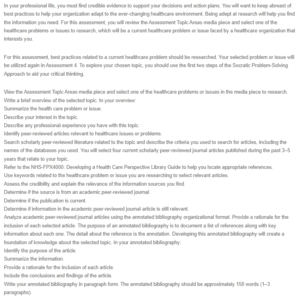
In your professional life, you must find credible evidence to support your decisions and action plans. You will want to keep abreast of best practices to help your organization adapt to the ever-changing healthcare environment. Being adept at research will help you find the information you need. For this assessment, you will review the Assessment Topic Areas media piece and select one of the healthcare problems or issues to research, which will be a current healthcare problem or issue faced by a healthcare organization that interests you.
Applying Research Skills – Medication Errors
For this assessment, best practices related to a current healthcare problem should be researched. Your selected problem or issue will be utilized again in Assessment 4. To explore your chosen topic, you should use the first two steps of the Socratic Problem-Solving Approach to aid your critical thinking.
View the Assessment Topic Areas media piece and select one of the healthcare problems or issues in the media piece to research. Write a brief overview of the selected topic. In your overview:
Summarize the health care problem or issue.
Describe your interest in the topic.
Describe any professional experience you have with this topic.
Identify peer-reviewed articles relevant to healthcare issues or problems.
Search scholarly peer-reviewed literature related to the topic and describe the criteria you used to search for articles, including the names of the databases you used. You will select four current scholarly peer-reviewed journal articles published during the past 3–5 years that relate to your topic.
Refer to the NHS-FPX4000: Developing a Health Care Perspective Library Guide to help you locate appropriate references.
Use keywords related to the healthcare problem or issue you are researching to select relevant articles.
Assess the credibility and explain the relevance of the information sources you find.
Determine if the source is from an academic peer-reviewed journal.
Determine if the publication is current.
Determine if information in the academic peer-reviewed journal article is still relevant.
Analyze academic peer-reviewed journal articles using the annotated bibliography organizational format. Provide a rationale for the inclusion of each selected article. The purpose of an annotated bibliography is to document a list of references along with key information about each one. The detail about the reference is the annotation. Developing this annotated bibliography will create a foundation of knowledge about the selected topic. In your annotated bibliography:
Identify the purpose of the article.
Summarize the information.
Provide a rationale for the inclusion of each article.
Include the conclusions and findings of the article.
Write your annotated bibliography in paragraph form. The annotated bibliography should be approximately 150 words (1–3 paragraphs).
List the full reference for the source in APA format (author, date, title, publisher, et cetera) and use APA format for the annotated bibliography.
Make sure the references are listed in alphabetical order, are double-spaced, and use hanging indents.
Summarize what you have learned from developing an annotated bibliography.
Summarize what you learned from your research in a separate paragraph or two at the end of the paper.
List the main points you learned from your research.
Summarize the main contributions of your chosen sources and how they enhanced your knowledge about the topic.
Topic 3:
Medication Errors
Short Description:
A medication error is a preventable adverse effect of a patient taking the wrong medication or dosage, whether or not it is evident or harmful to the patient. Medication errors can be a source of serious patient harm, including death.
Potential Intervention Approaches:
– Medical staff education
– Packaging improvements
– Patient medication safety training
Keywords for Articles:
Medication administration, medication errors, medication safety
 Complete the order form and upload all of your files, including any instructions, rubrics, or other materials provided by your instructor.
 Complete the order payment after filling in the order form. We’ll receive your order and assign it to a writer.
 The assigned writer will complete your paper and forward it to our Editing Team for review and approval.
 Once approved by the editor, the completed paper will be uploaded to your account for you to download, review and approve.