
Application of Cognitive Behavior Theory
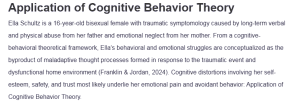
Ella Schultz is a 16-year-old bisexual female with traumatic symptomology caused by long-term verbal and physical abuse from her father and emotional neglect from her mother. From a cognitive-behavioral theoretical framework, Ella’s behavioral and emotional struggles are conceptualized as the byproduct of maladaptive thought processes formed in response to the traumatic event and dysfunctional home environment (Franklin & Jordan, 2024). Cognitive distortions involving her self-esteem, safety, and trust most likely underlie her emotional pain and avoidant behavior: Application of Cognitive Behavior Theory.
To explore her case further, I would ask her, “What are your thoughts when thinking about reconnecting with your mom?” and “How do you interpret interactions with your dad from the past, and how have those affected your emotions and behaviors today?” Treatment goals would be helping Ella develop healthier, adaptive thinking patterns about her self-worth and family relationships, and symptom reduction of fear, anxiety, and traumatic avoidance.
The treatment plan would involve cognitive restructuring and behavioral activation (Cuijpers et al., 2023). These would challenge Ella’s negative thinking of Ella toward herself and others and promote healthy social engagement and emotional regulation.
One outcome measure of the success of the intervention would be a decrease in Ella’s negative automatic thoughts and cognitive distortions, measured with self-report instruments such as the Cognitive Distortions Scale. This aligns with cognitive behavior theory’s (CBT) approach of measuring changes quantitatively with regard to cognition and behavior.
One strength of CBT is that it is a structured, goal-set approach whereby the client, such as Ella, can take control of their thoughts and behavior. One weakness of CBT is that it will not address underlying emotional or structural pathology (Gkintoni et al., 2025). For example, her emotional fears of rejection based upon her bisexuality will not be addressed.
In terms of diversity, treating Ella with CBT would need to be considerate of her sexual identity and cultural background. According to González-Prendes and Thomas (2009), culturally responsive clinical practice requires the practitioner to consider the artistic value and meaning of the client’s behaviors and belief patterns. Ella’s world is informed by stigma based on her identity and the heritage of skewed power. A culturally sensitive CBT approach would then be an acknowledgment of her experiential world while addressing the behavioral and cognitive challenges.
References
Cuijpers, P., Karyotaki, E., Harrer, M., & Stikkelbroek, Y. (2023). Individual behavioral activation in the treatment of depression: A meta-analysis. Psychotherapy Research, 33(7), 1–12. https://doi.org/10.1080/10503307.2023.2197630
Franklin, C., & Jordan, C. (2024). Turners social work treatment (7th ed.). Oxford University Press Academic. https://mbsdirect.vitalsource.com/books/9780197678046.
Gkintoni, E., Vassilopoulos, S. P., & Nikolaou, G. (2025). Mindfulness-based cognitive therapy in clinical practice: A systematic review of neurocognitive outcomes and applications for mental health and well-being. Journal of Clinical Medicine, 14(5), 1703. https://doi.org/10.3390/jcm14051703
González-Prendes, A. A., & Thomas, S. A. (2009). Culturally sensitive treatment of anger in African American women: A single case study. Clinical Case Studies, 8(5), 383–402. https://doi.org/10.1177/1534650109345004
ORDER A PLAGIARISM-FREE PAPER HERE
We’ll write everything from scratch
Question 
*This week, your theoretical orientation is cognitive behavior theory. You will use the same case study that you chose in Week 2 and have been analyzing in this course. Use the Analysis of a Theory worksheet to help you dissect the theory.*To Prepare
- *Use the same case study that you chose in Week 2.
- *Use the Analysis of a Theory Worksheet to help you dissect the theory. Use this tool to dissect the theory, employ the information in the table to complete your Assignment.
- *Read this article listed in the Learning Resources: González-Prendes, A. A., & Thomas, S. A. (2009). Culturally sensitive treatment of anger in African American women: A single case study. Clinical Case Studies, 8(5), 383–402. https://doi.org/10.1177/
1534650109345004 - Note: This article provides an appropriate framework for how the authors’ cognitive-behavioral theoretical orientation shaped the conceptualization of the case and assessment and intervention.

Application of Cognitive Behavior Theory
- Note: This article provides an appropriate framework for how the authors’ cognitive-behavioral theoretical orientation shaped the conceptualization of the case and assessment and intervention.
QUESTION:
- *In 1–2 sentences, identify and describe the presenting problem.
- *In 1–2 sentences, briefly define and conceptualize the problem from a cognitive-behavioral theoretical orientation.
- *Formulate two assessment questions that you will ask the client to better understand the client’s problem. Remember, the assessment questions should be guided by cognitive-behavioral theory.
- *In 1–2 sentences, identify two goals for treatment. Again, remember, the goals should be consistent with cognitive-behavioral theory.
- *In 1–2 sentences, describe the treatment plan from a cognitive-behavioral theoretical orientation. Remember, the treatment plan should align with the goal(s) for work.
- *Discuss one outcome you would measure, if you were to determine whether the intervention worked, and explain how this is consistent with cognitive behavior theory. Explain how one merit and one limitation of cognitive behavior theory relates to the case study.
- *Analyze the application of cognitive-behavioral theory in relation to a diversity issue pertinent to the case.
*Submit also, as a separate document, your Analysis of a Theory Worksheet.
 Complete the order form and upload all of your files, including any instructions, rubrics, or other materials provided by your instructor.
  Complete the order payment after filling in the order form. We’ll receive your order and assign it to a writer.
 The assigned writer will complete your paper and forward it to our Editing Team for review and approval.
 Once approved by the editor, the completed paper will be uploaded to your account for you to download, review and approve.