
Answering Patients Concerns
Synchronous Scenario 1.
A patient presenting for an appointment only to realize that the doctor’s office is no longer in network with their insurance plan will be very disappointed. The patient will be troubled as they will have to pay more to continue enjoying the services offered before. The patient, who has depression, will be forced to look for another clinic, especially if he cannot afford the new cost. This will negatively affect his well-being as it will take a while to establish a similar rapport with a healthcare provider in a different facility.
As the health care provider, I would explain to my patient why my office is no longer in the network with his insurance plan (Busch & Kyanko, 2020). I would then apologize for any inconvenience caused, after which I would point out the new cost of treatment. I would provide a list of qualified physicians still in contact with the insurance plan as an alternative so that the patient does not incur extra charges seeking medical care at my clinic.
Withdrawal from patients’ insurance plans could be detrimental to the clinic. The clinic can lose a lot of clients as they can no longer afford the charges for the services being offered. The clinic can also face litigation, significantly, when the patient is overcharged without knowing that the doctor’s office is no longer in network with his insurance plan.
Synchronous Scenario 2.
A patient arrived for an appointment only to find his name missing from the schedule after a co-worker deleted Coworkere irate. The patient will be annoyed as he has sacrificed his time and money to come to the clinic only to find his name missing from the appointment schedule. The patient might act out and cause a scene that may disrupt other doctors and patients.
As one of the clinic staff, I would ask the patient to calm down. I would slowly explain the situation and tell him anyone can make an error. I would assure him that we would try to rectify the mistake and ensure that he sees the doctor. Failure to do this, we would schedule another appointment date and cover any extra charges he incurs (Srinivas & Ravindran, 2020). Mixing up of appointment schedules leading to re-scheduling often results in the office incurring additional costs as the office is responsible for footing any bills incurred due to appointment mishaps. This habit also leads to losing faith in the patients towards the office and a slow build-up of resentment.
Asynchronous scenario 1.
After discovering that her insurance policy is no longer active, a patient receiving a hospital bill probably feels overwhelmed and annoyed. The patient feels overwhelmed as she did not know that her insurance policy was canceled after her husband switched jobs, with the hospital still expecting her to pay her bill despite being in a situation where she cannot afford to pay.
“Hello Mrs. Barbara Smith. We are writing this email in response to your recent email where you highlighted your inability to pay the hospital bill (Droz & Jacobs, 2019). We understand your current situation and are still in communication with the insurance provider to see if any solution can be reached. The hospital provides flexible payment schemes that would lessen the burden on you and make it easier to clear your bill. You can visit our office, and we will discuss an effective payment plan. We apologize for any inconveniences caused.”
The clinic loses money due to a failure of payment by patients, resulting in losses (Johnston et al., 2018). The possibility of the patient suing the office will hurt the outlook of the health facility as it will tarnish the institution’s image with claims that its primary aim is simply profit-making. This could result in the loss of clients.
Asynchronous Scenario 2.
A patient hearing two employees gossiping about a patient is agitated and annoyed. The patient is concerned about the lack of professionalism and confidentiality that the employees are displaying (Ceylan & Çetinkaya, 2020). He feels that he can no longer trust the employees at the office with his intimate details as they will be left discussing him after he departs from the office.
“Hello Mr. Samuel Jones, I am writing this email in response to the email we received from you explaining your concerns after hearing two of our employees discussing a patient. While we try to uphold the highest level of professionalism here at our office, instances such as this one do occur once in a while. We apologize for the instance and assure you that further action will be taken to ensure that such instances do not repeat themselves. Thank you for your feedback.”
The lack of professionalism could lead to the loss of trust by patients (Lee et al., 2019). Patients feel their information is no longer safe with the hospital staff, who blatantly gossip about patients. This could lead to the withdrawal of patients from our clinic to other clinics as they seek help from other people they deem more professional. This consequently leads to the development of a poor reputation and fewer people seeking medical help from our clinic.
References
Busch, S. H., & Kyanko, K. A. (2020). Incorrect Provider Directories Associated With Out-Of-Network Mental Health Care And Outpatient Surprise Bills: Examining inaccurate Provider Directories’ role in Out-of-Network Mental health treatment and surprise bills. Health Affairs, 39(6), 975-983.
Ceylan, S. S., & Çetinkaya, B. (2020). Attitudes towards gossip and patient privacy among pediatric nurses. Nursing ethics, 27(1), 289-300.
Droz, P. W., & Jacobs, L. S. (2019). Genre chameleon: Email, professional writing curriculum, and workplace writing expectations. Technical Communication, 66(1), 68-92.
Johnston, K. J., Wen, H., Hockenberry, J. M., & Maddox, K. E. J. (2018). Association between patient cognitive and functional status and Medicare total annual cost of care: implications for value-based payment. JAMA Internal Medicine, 178(11), 1489-1497.
Lee, T. H., McGlynn, E. A., & Safran, D. G. (2019). A framework for increasing trust between patients and the organizations that care for them. Jama, 321(6), 539-540.
Srinivas, S., & Ravindran, A. R. (2020). Designing schedule configuration of a hybrid appointment system for a two-stage outpatient clinic with multiple servers. Health care management science, 1-27.
ORDER A PLAGIARISM-FREE PAPER HERE
We’ll write everything from scratch
Question 
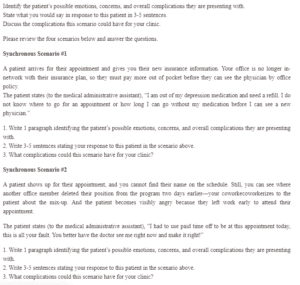
Identify the patient’s possible emotions, concerns, and overall complications they are presenting with.
State what you would say in response to this patient in 3-5 sentences.
Discuss the complications this scenario could have for your clinic.
Answering Patients Concerns
Please review the four scenarios below and answer the questions.
Synchronous Scenario #1
A patient arrives for their appointment and gives you their new insurance information. Your office is no longer in-network with their insurance plan, so they must pay more out of pocket before they can see the physician by office policy.
The patient states (to the medical administrative assistant), “I am out of my depression medication and need a refill. I do not know where to go for an appointment or how long I can go without my medication before I can see a new physician.”
1. Write 1 paragraph identifying the patient’s possible emotions, concerns, and overall complications they are presenting with.
2. Write 3-5 sentences stating your response to this patient in the scenario above.
3. What complications could this scenario have for your clinic?
Synchronous Scenario #2
A patient shows up for their appointment, and you cannot find their name on the schedule. Still, you can see where another office member deleted their position from the program two days earlier—your coworkers to the patient about the mix-up. And the patient becomes visibly angry because they left work early to attend their appointment.
The patient states (to the medical administrative assistant), “I had to use paid time off to be at this appointment today, this is all your fault. You better have the doctor see me right now and make it right!”
1. Write 1 paragraph identifying the patient’s possible emotions, concerns, and overall complications they are presenting with.
2. Write 3-5 sentences stating your response to this patient in the scenario above.
3. What complications could this scenario have for your clinic?
Asynchronous Scenario #1
After billing your patient’s insurance for their most recent office visit and lab work at Rassy Clinic, you received a denial from their insurance stating their policy was no longer active on the date of service, so the insurance company will not pay and the patient, Barbara Smith, is responsible for the total amount. You send the patient their bill with a letter stating why their insurance did not pay and asking them to update your office with the policy information if they have a new insurance plan. Several days later, you receive this email from the patient:
“This is Barb Smith, I received your bill and I’m not going to pay it! I did not know my husband’s insurance policy was cancelled when he switched jobs but I cannot afford the bill and if you do not stop billing me I will sue you!”
1. Write one paragraph explaining how the patient is probably feeling now and why.
2. Write a professional email response to this patient. It should include an element to de-escalate the situation and explain options so your office can receive reimbursement and continue to treat the patient.
3. What complications could this scenario have for your clinic?
Asynchronous Scenario #2
Samuel Jones, a patient, recently had an appointment at your clinic. The next day, you received the following email:
“I had an appointment in your office yesterday and overheard two employees gossiping about a patient while I was waiting in the reception area. I wanted to bring this to your attention because this is very unprofessional, and I do not want to go to a clinic that behaves this way.
Sam Jones
1. Write one paragraph explaining how the patient is probably feeling now and why.
2. Write a professional email response to this patient. It should include an element to de-escalate the situation and explain options so your office can receive reimbursement and continue to treat the patient.
3. What complications could this scenario have for your clinic?
 Complete the order form and upload all of your files, including any instructions, rubrics, or other materials provided by your instructor.
  Complete the order payment after filling in the order form. We’ll receive your order and assign it to a writer.
 The assigned writer will complete your paper and forward it to our Editing Team for review and approval.
 Once approved by the editor, the completed paper will be uploaded to your account for you to download, review and approve.