
Analyzing Medication Errors as a Current Health Care Problem
Medication errors are preventable. Common medication errors occur as a result of patients taking the wrong medication, the wrong amount of dosage, dose omissions, and overdosing (Dirik et al., 2019). Medication errors can also occur when drugs are combined without consideration of their interactions. When patiently using medicines at a rate that is not recommended.
Do you need an original copy of “Analyzing Medication Errors as a current Health Care problem “ ? Contact us.
Due to the complex nature of medication errors on a patient’s health, safety career, and reputational outcomes of healthcare professionals and organizations linked to medication errors, it is important to explore various solutions that can help reduce and prevent medication errors. This assessment analyzes medication errors as a health care issue of concern, their causes, the content and significance of medication errors, the affected populations, potential solutions, and ethical principles to consider when implementing solutions for medication errors.
Possible Causes for Medication Errors
Medication errors can be linked to mistakes within practice settings, such as during medication prescriptions, dispensation, administration, carrying out procedures, healthcare product labelling, and poor communication. Existing literature has linked all these factors to medication errors during the preparation or administration of medication. According to Escrivá Gracia et al. (2019), medication errors have a significant relationship with the level of medication knowledge. Medication errors also occur due to a lack of experience with prescribing, dispensing, and administering medications or making rushed decisions during the prescription or administration phases of the medication process. Newly graduated nurses are likelier to have limited nursing experience in medication prescription or administration. They, therefore, are more likely to make related errors. Errors may also result from nurses and other care providers prescribing and administering medications beyond their authority. Other system-related factors contributing to medication errors include lower levels of professional staffing and poor physician-nurse relationships. Medication errors can also occur as a result of patients taking multiple medications for one condition or comorbid conditions, especially in elderly patients or receiving care from various providers. The nature of the environment while administering medications, such as patient disturbances, can also lead to medication errors.
Context and Significance of Medication Errors
Medication errors can occur within in-hospital and out-of-hospital settings during prescription, recording, preparation, and administration. As a registered nurse, I am interested in medication errors due to their significance. Medication errors are common in nursing practice and threaten patient and nursing outcomes. The nurses’ work settings contribute to making major mistakes at some point in the medication process. However, nurses also identify, flag, and prevent medication errors before they occur or cause patient harm.
Medication errors disrupt the treatment process and may lead to patient harm and failure to achieve treatment goals. This means they may have serious outcomes besides those of the targeted disease (Escrivá Gracia et al., 2019). Medication errors also can induce extra care needs, prolong the length of stay, increase care costs, and cause death. The consequences related to medication errors prevent nurses from reporting identified medication errors (Dirik et al., 2019). Medication errors are linked to adverse mental and emotional health outcomes for the involved providers, leading to burnout, posttraumatic stress syndrome, lack of work motivation, and intentions to leave (Robertson & Long, 2018).
Populations Affected by Medication Errors
Medication errors have direct and indirect effects on all patient populations and caregivers. All patient populations are at risk of being affected by medication. Children are at the highest risk of medication errors, especially those in inpatient settings, pediatric intensive care wards and emergency departments. This may be due to insufficient evidence supporting dosage and medication options in pediatric care. Medication errors are also common among patients using different types of medications or patients with multiple comorbidities. Elderly patients, due to age-related disease comorbidities, are more likely to be affected by medication errors.
Potential Solutions for Medication Errors
Several solutions have the potential to reduce and prevent medication errors in nursing care significantly and within hospital and home settings. Available research identifies various evidence-based solutions that nurses can implement within their work role to reduce and prevent medication errors. For instance, pharmacy-led medication reconciliation teams are used during patient discharge or ward transfers. A study by Choi and Kim (2019) found that the use of pharmacy-led medication reconciliation for patients using numerous medications at the same time significantly reduced medication errors and related discrepancies compared to normal medication reconciliation teams. Another solution is the use of electronic medical records (EMRs). The use of electronic systems in prescription can support the prescription and administration processes and significantly reduce the occurrence of medication errors and patient harm. Other evidence-based solutions that have been noted to reduce and prevent the occurrence of medication errors include nurses taking time to double-check medications and prescriptions before administration, educating and training nurses and patients on medications and drug interactions to improve their medication knowledge and risk factors for medication errors and their significance, and follow-up with the patient after patient discharge or during the transition of care.
Implement Requirements for Solution to Medication Errors
Using pharmacist-led medication reconciliation, prescription, and administration teams is the best solution to reduce medication errors in nursing. The implementation process utilizes an interprofessional approach to achieve the goal of medication error prevention and reduction. The solution will use the available pharmacists to lead all medication therapies within the hospital. These include determining the rate, time, and dosage of medications administered and supervising nurses and other care professionals in preparing, storing handling, and dispensing drugs. The implementation will also require t central monitoring system for the pharmacists to coordinate the medication processes efficiently and efficiently.
Pros and Cons of the Proposed Solutions
Using pharmacists to lead all medication therapies within and outside the hospital will significantly help reduce medication errors. Pharmacists’ involvement in the medication process within pediatric settings has been largely associated with a significant reduction in the rate of occurrence of medication errors occurrence (Naseralallah et al., 2020). Pharmacists also reduce the work burden for nurses and improve the efficiency of the medication process, including medication reconciliation, by enhancing the clarity of medical communication. However, the use of pharmacists in the medication process requires additional workforce. If no new pharmacists are employed, there is a risk of overburdening the available ones. Staffing shortages are the number one cause of burnout within healthcare organizations and a leading cause of medication errors. The hospital will also require extra financial resources to employ and maintain an expanded workforce.
Ethical Principles in the Implementation of Proposed Solution
Medication errors affect the ethical principles of Beneficence, nonmaleficence, Autonomy, and Justice. As noted, pharmacist-led use to manage medication therapies will include the collaboration of an interprofessional team. In nurses’ interprofessional collaboration within clinical practice, ethical considerations should focus on factors that influence the patient’s perception of care, how they receive the care, their wishes, professional choices to communicate the truth to the patients, and the interprofessional views on the patient’s condition such as pain and cultural beliefs. Using a pharmacist to manage medications will observe all the ethical principles. It will require guarantees on providing care that can lead to no harm and is beneficial to the patient’s health. The created interprofessional team must respect the patient’s choices to take or refuse medication. However, they must provide sufficient information to the patient to make professionally informed decisions.
Conclusion
Medication errors are prevalent in nursing practice due to their central role in patient care. Medication errors can lead to adverse drug effects, including patient harm, paralysis, and even death. This makes them a healthcare problem of significant concern. The safety, economic, and reputational concerns related to medication errors require adopting evidence-based solutions to help prevent and reduce such errors.
References
Choi, Y. J., & Kim, H. (2019). Effect of pharmacy-led medication reconciliation in emergency departments: A systematic review and meta-analysis. Journal of Clinical Pharmacy and Therapeutics, 44(6), 932–945. https://doi.org/10.1111/JCPT.13019
Dirik, H. F., Samur, M., Seren Intepeler, S., & Hewison, A. (2019b). Nurses’ identification and reporting of medication errors. Journal of Clinical Nursing, 28(5–6), 931–938. https://doi.org/10.1111/JOCN.14716
Escrivá Gracia, J., Brage Serrano, R., & Fernández Garrido, J. (2019). Medication errors and drug knowledge gaps among critical-care nurses: A mixed multi-method study. BMC Health Services Research, 19(1), 1–9. https://doi.org/10.1186/S12913-019-4481-7/TABLES/3
Naseralallah, L. M., Hussain, T. A., Jaam, M., & Pawluk, S. A. (2020). Impact of pharmacist interventions on medication errors in hospitalized pediatric patients: a systematic review and meta-analysis. International Journal of Clinical Pharmacy 2020 42:4, 42(4), 979–994. https://doi.org/10.1007/S11096-020-01034-Z
Robertson, J. J., & Long, B. (2018). Suffering in Silence: Medical Error and its Impact on Health Care Providers. The Journal of Emergency Medicine, 54(4), 402–409. https://doi.org/10.1016/J.JEMERMED.2017.12.001
ORDER A PLAGIARISM-FREE PAPER HERE
We’ll write everything from scratch
Question 
Write a 4-6 page analysis of a current problem or issue in health care, including a proposed solution and possible ethical implications.
Introduction
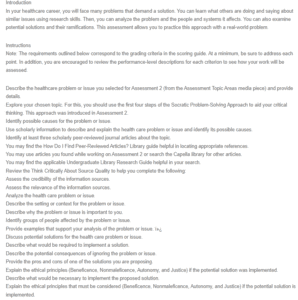
In your healthcare career, you will face many problems that demand a solution. You can learn what others are doing and saying about similar issues using research skills. Then, you can analyze the problem and the people and systems it affects. You can also examine potential solutions and their ramifications. This assessment allows you to practice this approach with a real-world problem.
Analyzing Medication Errors as a Current Health Care Problem
Instructions
Note: The requirements outlined below correspond to the grading criteria in the scoring guide. At a minimum, be sure to address each point. In addition, you are encouraged to review the performance-level descriptions for each criterion to see how your work will be assessed.
Describe the healthcare problem or issue you selected for Assessment 2 (from the Assessment Topic Areas media piece) and provide details.
Explore your chosen topic. For this, you should use the first four steps of the Socratic Problem-Solving Approach to aid your critical thinking. This approach was introduced in Assessment 2.
Identify possible causes for the problem or issue.
Use scholarly information to describe and explain the health care problem or issue and identify its possible causes.
Identify at least three scholarly peer-reviewed journal articles about the topic.
You may find the How Do I Find Peer-Reviewed Articles? Library guide helpful in locating appropriate references.
You may use articles you found while working on Assessment 2 or search the Capella library for other articles.
You may find the applicable Undergraduate Library Research Guide helpful in your search.
Review the Think Critically About Source Quality to help you complete the following:
Assess the credibility of the information sources.
Assess the relevance of the information sources.
Analyze the health care problem or issue.
Describe the setting or context for the problem or issue.
Describe why the problem or issue is important to you.
Identify groups of people affected by the problem or issue.
Provide examples that support your analysis of the problem or issue. 
Discuss potential solutions for the health care problem or issue.
Describe what would be required to implement a solution.
Describe the potential consequences of ignoring the problem or issue.
Provide the pros and cons of one of the solutions you are proposing.
Explain the ethical principles (Beneficence, Nonmaleficence, Autonomy, and Justice) if the potential solution was implemented.
Describe what would be necessary to implement the proposed solution.
Explain the ethical principles that must be considered (Beneficence, Nonmaleficence, Autonomy, and Justice) if the potential solution is implemented.
Provide examples from the literature to support the points you are making.
Competency 1: Apply information literacy and library research skills to obtain scholarly information in health care.
Use scholarly information to describe and explain a healthcare problem or issue and identify its possible causes.
 Complete the order form and upload all of your files, including any instructions, rubrics, or other materials provided by your instructor.
  Complete the order payment after filling in the order form. We’ll receive your order and assign it to a writer.
 The assigned writer will complete your paper and forward it to our Editing Team for review and approval.
 Once approved by the editor, the completed paper will be uploaded to your account for you to download, review and approve.