
Analyzing a Research Article: Post-Operative Hernia Repair
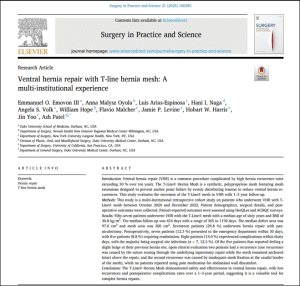
Abstract Screenshot
Sentinel U Screenshot
Below is a screenshot of the selected patient and diagnosis from the Sentinel U simulation.
Study Design and Level of Evidence
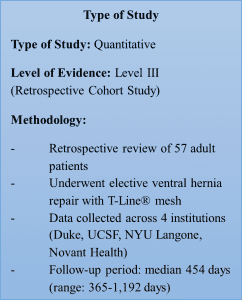
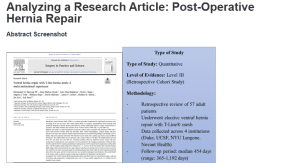
The selected article, “Ventral Hernia Repair with T-Line Hernia Mesh: A Multi-Institutional Experience” by Emovon et al. (2025), employs a quantitative, retrospective cohort design, which places it at Level III on the hierarchy of evidence. Conducted across four leading institutions—Duke University, UCSF, NYU Langone Health, and Novant Health—the study assessed 57 adult patients who underwent elective ventral hernia repair with T-Line® mesh between October 2020 and December 2022: Analyzing a Research Article: Post-Operative Hernia Repair.
A median follow-up of 454 days (range 365-1,192) provided robust data on outcomes including recurrence, surgical site infection (SSI), emergency department (ED) visits, readmissions, and patient-reported quality of life using validated tools such as HerQLes and ACHQC. Although not as strong as randomized controlled trials, this design offers valuable real-world insight into post-surgical recovery.
Credibility of the Article
This article meets high standards of scholarly credibility. It is published in Surgical Practice Science, a peer-reviewed journal, ensuring rigorous academic oversight. The study received Institutional Review Board (IRB) approval at all participating centers, demonstrating ethical compliance. The inclusion criteria are clearly defined, enhancing the study’s internal validity. In addition to objective surgical outcomes, the researchers incorporated validated patient-reported outcome measures, which improve construct validity and center the patient experience.
Transparency is further established through conflict-of-interest disclosures, as several authors report financial relationships with the mesh manufacturer Deep Blue Medical Advances. Despite these disclosures, the multi-institutional nature of the study and objective reporting of outcomes bolster the article’s trustworthiness.
Relevance to Post-Operative Hernia Repair
The study’s findings are directly relevant to the selected diagnosis of post-operative hernia repair. The recurrence rate reported was 3.5%, with no failures of the mesh itself—only technical issues with fixation. Nursing professionals can draw from this to improve collaboration with surgeons on secure mesh placement. Moreover, 12.3% of patients visited the ED, and 8.8% were readmitted within 30 days post-surgery, primarily due to SSIs.
These complications underscore the importance of thorough post-operative assessment and wound monitoring in nursing care. Notably, none of the patients required pain medication for abdominal wall discomfort at follow-up, which supports the effectiveness of the T-Line® mesh and has implications for nursing-led patient education regarding pain expectations and recovery trajectory.
Applicability to Clinical Practice
The article’s findings are highly applicable to nursing practice in surgical and post-surgical units. Preoperatively, nurses can collaborate with physicians to educate patients about mesh options and expected recovery outcomes. In the immediate post-operative phase, nursing interventions should focus on infection surveillance, wound care, and monitoring for early complications like ED visits or readmissions. The research also advocates HerQLes surveys to evaluate patient-reported outcomes, which nurses can incorporate in calls during follow-up or in clinic sessions.
These practices enhance a patient-centered model, and all of them are compatible with quality improvement. The case-selection process of the study is sufficiently representative that its findings can be broadly applied to general surgical departments across the board.
Conclusion
This article gives powerful evidence about the safety and effectiveness of T-Line ® mesh in post-surgery hernias. Emovon et al. (2025) provide plausible and morally acceptable research with evident findings to nursing practice. This study contributes to various aspects of nursing roles, including preventing complications early and educating patients in the long term, among others. Nurses can enhance quality post-operative and raise the quality of care by applying its findings in their practice and conducting an evidence-based intervention customized to hernia repair patients.
Article Link: https://doi.org/10.1016/j.sipas.2025.100285
Reference
Emovon, E. O., Oyola, A. M., Arias-Espinosa, L., Naga, H. I., Volk, A. S., Hope, W., Malcher, F., Levine, J. P., Harris, H. W., Yoo, J., & Patel, A. (2025). Ventral hernia repair with T-line hernia mesh: A multi-institutional experience. Surgery in Practice and Science, 21(76), 100285. https://doi.org/10.1016/j.sipas.2025.100285
ORDER A PLAGIARISM-FREE PAPER HERE
We’ll write everything from scratch
Question 
NOTES:
- NO AI USE AT ALL
- NO FALSIFYING OF RESOURCES/REFERENCES/CITATIONS
Identify and write a summary of the various factors that contribute to the credibility of a research article related to a diagnosis of interest that you identified from the Sentinel U simulation on Patient Management & Delegation. In the module, there are 10 patients listed with various diagnosis. Select one diagnosis (Post- op Hernia repair) of interest to you from the simulation.
Evidence-based practice (EBP) integrates the best evidence available to guide optimal nursing care, with a goal to enhance safety and quality. EBP is crucial to nursing practice because it incorporates the best evidence from current literature, along with the expertise of the practicing nurse. The concern for quality care that flows from EBP generates a desired outcome.
Without these factors, a nurse cannot be an effective leader. It is important to lead not only from this position but from knowledge and expertise. To gain the knowledge, you require a good understanding of how to search for scholarly resources, as well as make decisions regarding the content of the scholarly resources.
Professional Context
As a baccalaureate-prepared nurse, you will be responsible for providing patient-centered, competent care based on current evidence-based best practices. You will be required to do research, analysis, and dissemination of best evidence to stay abreast of these best practices. Understanding where to go to find credible evidence, determining the type of evidence and being able to make decisions based on the findings of credible evidence is the foundation of evidence-based care.
Preparation
Review the What Is Scholarly? Campus page. Specifically, look at the following two items on the page:
- What Are Peer-Reviewed Articles?
- Anatomy of a Scholarly Article.
These will give you the factors that contribute to credibility, which you will need to identify in the article you choose for this assessment.
Also, look at the “Find EPB Articles” section of the Evidence-Based Practice in Nursing & Health Sciences library guide (found in the guide’s left-hand menu). This may help you locate an article to use for this assessment.
Analyzing a Research Article: Post-Operative Hernia Repair
Instructions
Write a 2-page analysis of a scholarly research article, demonstrating your ability to locate credible, useful evidence related to a diagnosis of interest selected from the Sentinel U simulation on Patient Management & Delegation. There are 10 patients, each with a different medical diagnosis. Select one patient with a diagnosis of interest to you.
Once you have chosen your diagnosis of interest from the Sentinel U simulation, complete the following:
- Use a credible search engine to locate a research article on your topic.
- Review the article for the following criteria:
- Type of study (quantitative or qualitative, the level on the pyramid of evidence, methodology).
- Credibility factors.
- Importance of content to selected diagnosis.
- The ability to apply the content in your current workplace or patient population.
- Take a screenshot of the abstract and paste it into a Word document (see the Example of Screenshot [PDF] (ATTACHED). You can refer to the instructions in the Taking Screenshots [PDF] document.
- Create a table or series of text boxes next to or below the screenshot and use that to label each criterion.
- Also take a screenshot of the patient and the diagnosis from Sentinel U simulation you used.
- Write up a summary of your findings on the second page. Note what information is important to your specified diagnosis. How credible is the article you’ve found and how useful is it related to your specified diagnosis and your ability to apply it?
- Include a link to your article.
- Include a reference to your article in APA format.
Review the Analyzing a Research Paper scoring guide for specific details of grading prior to submission. (ATTACHED)
Competencies Measured
By successfully completing this assessment, you will demonstrate your proficiency in the following course competencies and scoring guide criteria:
- Competency 1: Interpret findings from scholarly quantitative, qualitative, and outcomes research articles and studies.
- Determine the type of study and the level of evidence according to the pyramid of evidence.
- Identify the credibility factors of an article.
- Summarize the findings of an article, noting what information is important to a specified diagnosis.
- Competency 2: Analyze the relevance and potential effectiveness of evidence when making a decision.
- Summarize the ability to generalize article findings in a specified work space and patient population.
- Competency 5: Apply professional, scholarly communication strategies to lead practice changes based on evidence.
- Provide an APA-formatted reference and link to an article.
Scoring Guide
- Use the scoring guide to understand how your assessment will be evaluated. (ATTACHED)
- Post- op Hernia repair
 Complete the order form and upload all of your files, including any instructions, rubrics, or other materials provided by your instructor.
  Complete the order payment after filling in the order form. We’ll receive your order and assign it to a writer.
 The assigned writer will complete your paper and forward it to our Editing Team for review and approval.
 Once approved by the editor, the completed paper will be uploaded to your account for you to download, review and approve.