
Analyzing a Current Health Care Problem or Issue
Medication errors continue to undermine the safety safeguards for patients. Medication errors are preventable events that result in inappropriate use of medicines and consequent harm to the patients when the medication is under the control of a caregiver. Several forms of medication errors have been documented. Improper dosing, prescription errors, utilization of unauthorized drugs, and administration errors have been shown to cause significant harm to patients. This paper analyzes medication errors, outlining possible causes, potential solutions to medication errors, and the ethicality of the postulated solutions.
Elements of the Problem
Description and Explanation of Medication Errors Using Scholarly Articles
Medications remain critical for therapeutic and diagnostic purposes. Their effectiveness in managing diseases makes them the cornerstone of healthcare provisions. Medication administration errors are a common source of quality and safety compromises in healthcare. These errors can occur throughout the medication use system.
Medication errors have significant health impacts on patients. These errors have been implicated in patient suffering, escalated healthcare costs, and an overall reduction in the quality of care. Atanasov et al. (2020) report that a recent analysis of mortalities puts medication errors among the top killers in the U.S. These errors are the third major cause of death in the country, trailing only cancer and heart disease. Additionally, these errors are responsible for up to 41% of all hospital readmission rates, placing a substantial burden of their management on the patients, the healthcare organization, and caregivers. In the U.S. alone, the estimated cost of managing medication errors is more than 177 billion dollars.
This statistic reinforces the need to address medication errors. Addressing this issue, however, requires an elaborate plan that starts with the identification of the possible causal factors for medication errors. Staff inexperience or inadequacy in medication knowledge remains one of the leading causal factors for providers’ related medication errors. Notably, staff inexperience or inadequacy hinders sound decision-making regarding aspects of the medications, such as dosing and route of administration (Rasool et al., 2020). Illegible prescriptions are another possible cause of medication errors. Illegible prescriptions often result when physicians scribble down clinical orders that are not legible. In case of mistakes, the impact is often felt by the patients. High provider-patient ratios have also been associated with medication errors. Medication errors in these instances are often attributable to provider-related factors such as fatigue and burnout due to a high workload. Rasool et al. (2020) report that the strain on hospital staff accustomed to staffing shortages and subsequent overload results in inadequate monitoring of the patients, failure by the medical personnel to take the required precautions when administering medications, and technical errors that cause considerable harm to the patients.
Analysis
Critical in medication administration is the recognition of various errors that occur along the medication administration chain. This helps in the early identification of potential areas where mistakes can occur, resulting in medication errors. It also provides a framework for addressing these errors whenever they occur. Nurses being the primary handlers of medicines, should be wary of best practices in medication handling to lessen their likelihood of making mistakes.
The Setting or Context for the Problem
The advancement of medical operationalizations and the emergence of innovative approaches in healthcare have placed much emphasis on quality care provision. Healthcare organizations must conform to the prescribed quality standards to get accreditation and high approval from the communities they serve. Medication errors remain prevalent in the inpatient settings of various healthcare organizations. They erode quality improvement and safety safeguard measures placed by different care organizations to promote and preserve the lives of the communities they serve. This remains a concern for the patients and care organizations at large.
Relevance of the Problem
As a caregiver, safeguarding the safety of my patients and ensuring their well-being remains my mandate. The rise in medication errors is a clarion call for caregivers to maintain accountability in their care provision processes. By abiding by the available policies on medication handling and utilizing best practices in administering and handling medications, caregivers can effectively lessen these errors. It forms part of the pursuit to ensure the safety of patients and enhance quality care provision. Thus, all caregivers must recognize the scale of these problems and participate in addressing them.
Groups of People Affected by the Problem
While many people across society feel the impact of medication errors, patients with chronic disorders are disproportionately affected by this problem. This may be due to the high frequency of taking medication to manage their disease. Comorbidity with chronic illnesses is a recipe for medication errors due to the high pill burden on these patients. This warrants comprehensive approaches when managing these patients to ensure all aspects of their disease and management are monitored closely.
Examples that Support Analysis of the Problem
Medication errors are common among older individuals with chronic illnesses. Mira (2019) postulates that the high prevalence of medication errors in this group is due to the accumulation of factors such as polypharmacy, poly-morbidity, and fragmentation of care. This has been evident across many healthcare systems. Many cases of medication errors continue to be reported in long-term residential care settings, with the majority being associated with high pill burden and fragmentation of care processes.
Considering Options
Several options for addressing medication errors exist. Coordinative approaches, technology use, and maintaining professionalism may help lessen medication errors. Coordinative approaches utilizing collaborative paradigms promote unilateral decision-making processes among caregivers involved in patient handling. These approaches also provide a framework for information sharing and role interdependence and foster greater accountability in delivering.
Secondly, health information technologies provide another option for addressing medication errors. Electronic transmission of prescriptions minimizes errors attributable to the illegibility of prescriptions. Electronic health records are an example of a health information technology that is valuable in this respect. Lastly, maintaining professionalism during medication handling is also valuable in lessening medication errors. Significant in this regard is the ability of caregivers to read medication labels before administering medication, attend educational programs to expand their knowledge base, and maintain stewardship in error prevention (Salar et al., 2020). These strategies are likely to lower their chances of making mistakes, resulting in errors. It is thus important that all caregivers act professionally when administering medications.
Solution
Coordinative approaches provide a framework for addressing medication errors. These approaches address traditional problems of fragmented care implicated in medication errors, bridge knowledge gaps on medications, and foster therapeutic relationships between caregivers, thus enabling early detection of errors. Through this approach, caregivers can remain accountable when handling medications and utilize best practices in medication administration (Pals et al., 2020). However, implementation of this approach may be impeded by staff availability, lack of goodwill to conform to this approach, and interpersonal barriers between individual caregivers.
Implementation
Successful implementation of a coordinative approach utilizing a collaborative approach requires the availability of professionals from different cadres of healthcare. These professionals will work concertedly in patient handling and management. All these professionals must be equipped with the best strategies in healthcare collaborations, such as effective communication, information sharing, and respect. Also fundamental in implementing this plan is effective leadership. Leadership not only inspires change in the members but also guides the change process.
The first step in implementing this proposal is to educate organizational members on the significance of healthcare collaborations. This will enable the creation of buy-in to the plan and enhance the members’ readiness for the change. A gradual and systematic implementation of the process follows this. Errida & Lotfi (2021) assert the significance of organizational leadership in change management. This includes role definition to prevent role confusion and effective leadership, guiding the change, and overseeing the implementation process. The success of the implementation process will depend on the employee’s conformation with the change process and their knowledge of collaborative strategies required in these coordinative approaches.
Ethical Implications
Ethical considerations have to be made when implementing the proposed solution. The principles of beneficence and non-maleficence will be put into consideration. Beneficence requires caregivers to promote the welfare of their patients, while non-maleficence requires them to not harm. In this regard, professionals’ recognition of their collective mandate on the patients will implore them to embrace this approach as a measure for promoting the welfare of their patients and enhancing their well-being.
Conclusion
Medication errors remain a healthcare concern and have been implicated in significant morbidity and mortality. Possible causal factors for medication include poor care coordination and illegible prescriptions. A coordinative approach utilizing collaborative paradigms maintains effectiveness in lessening medication errors. As a result, this warrants its implementation in all healthcare systems.
References
Atanasov, A. G., Yeung, A. W., Klager, E., Eibensteiner, F., Schaden, E., Kletecka-Pulker, M., & Willschke, H. (2020). First, do no harm (gone wrong): Total-scale analysis of medical errors in scientific literature. Frontiers in Public Health, 8. https://doi.org/10.3389/fpubh.2020.558913.
Errida, A., & Lotfi, B. (2021). The determinants of Organizational Change Management Success: Literature Review and Case Study. International Journal of Engineering Business Management, 13, 184797902110162. https://doi.org/10.1177/18479790211016273.
Mira, J. J. (2019). Medication errors in the older people population. Expert Review of Clinical Pharmacology, 12(6), 491–494. https://doi.org/10.1080/17512433.2019.1615442.
Pals, R. A., Drejer, S., Laursen, R. H., Oest, L., Levisen, V. D., Krogh, N. R., & Hempler, N. F. (2020). Implementing a collaborative model in Health Education Practice: A process evaluation of a health education program targeting users with mental health problems. BMC Health Services Research, 20(1). https://doi.org/10.1186/s12913-019-4819-1.
Rasool, M. F., Rehman, A. ur, Imran, I., Abbas, S., Shah, S., Abbas, G., Khan, I., Shakeel, S., Ahmad Hassali, M. A., & Hayat, K. (2020). Risk factors associated with medication errors among patients suffering from chronic disorders. Frontiers in Public Health, 8. https://doi.org/10.3389/fpubh.2020.531038.
Salar, A., Kiani, F., & Rezaee, N. (2020). Preventing the medication errors in hospitals: A qualitative study. International Journal of Africa Nursing Sciences, 13, 100235. https://doi.org/10.1016/j.ijans.2020.100235.
ORDER A PLAGIARISM-FREE PAPER HERE
We’ll write everything from scratch
Question 
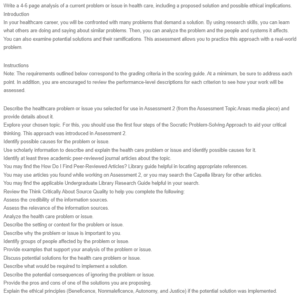
Analyzing a Current Health Care Problem or Issue
Write a 4-6 page analysis of a current problem or issue in health care, including a proposed solution and possible ethical implications.
Introduction
In your healthcare career, you will be confronted with many problems that demand a solution. By using research skills, you can learn what others are doing and saying about similar problems. Then, you can analyze the problem and the people and systems it affects. You can also examine potential solutions and their ramifications. This assessment allows you to practice this approach with a real-world problem.
Instructions
Note: The requirements outlined below correspond to the grading criteria in the scoring guide. At a minimum, be sure to address each point. In addition, you are encouraged to review the performance-level descriptions for each criterion to see how your work will be assessed.
Describe the healthcare problem or issue you selected for use in Assessment 2 (from the Assessment Topic Areas media piece) and provide details about it.
Explore your chosen topic. For this, you should use the first four steps of the Socratic Problem-Solving Approach to aid your critical thinking. This approach was introduced in Assessment 2.
Identify possible causes for the problem or issue.
Use scholarly information to describe and explain the health care problem or issue and identify possible causes for it.
Identify at least three academic peer-reviewed journal articles about the topic.
You may find the How Do I Find Peer-Reviewed Articles? Library guide helpful in locating appropriate references.
You may use articles you found while working on Assessment 2, or you may search the Capella library for other articles.
You may find the applicable Undergraduate Library Research Guide helpful in your search.
Review the Think Critically About Source Quality to help you complete the following:
Assess the credibility of the information sources.
Assess the relevance of the information sources.
Analyze the health care problem or issue.
Describe the setting or context for the problem or issue.
Describe why the problem or issue is important to you.
Identify groups of people affected by the problem or issue.
Provide examples that support your analysis of the problem or issue.
Discuss potential solutions for the health care problem or issue.
Describe what would be required to implement a solution.
Describe the potential consequences of ignoring the problem or issue.
Provide the pros and cons of one of the solutions you are proposing.
Explain the ethical principles (Beneficence, Nonmaleficence, Autonomy, and Justice) if the potential solution was implemented.
Describe what would be necessary to implement the proposed solution.
Explain the ethical principles that need to be considered (Beneficence, Nonmaleficence, Autonomy, and Justice) if the potential solution is implemented.
Provide examples from the literature to support the points you are making.
 Complete the order form and upload all of your files, including any instructions, rubrics, or other materials provided by your instructor.
 Complete the order payment after filling in the order form. We’ll receive your order and assign it to a writer.
 The assigned writer will complete your paper and forward it to our Editing Team for review and approval.
 Once approved by the editor, the completed paper will be uploaded to your account for you to download, review and approve.