
Advancing the Understanding of Quantitative Concepts
Problem Statement
The general problem is that graduate students’ academic procrastination is detrimental to their well-being and academic achievement. The problem is that graduate students experience high levels of academic procrastination, which may be a sign of high levels of stress and lower academic achievement, forming barriers to the completion of academic degrees. There is evidence that indicates graduate student procrastination is associated with higher levels of psychological distress and lower academic achievement, with findings that 80-95% of graduate students are culpable of procrastination behaviors that significantly impact academic progress (Steel, 2007).
Purpose Statement
The purpose of this quantitative correlational study is to examine the predictive relationships between academic procrastination levels and both stress levels and academic performance among graduate students enrolled in accredited master’s and doctoral programs.
Research Questions and Hypotheses
- RQ1: To what extent does academic procrastination predict stress levels in graduate students?
- H1: Higher levels of academic procrastination will significantly predict higher stress levels in graduate students.
- RQ2: To what extent does academic procrastination predict academic performance in graduate students?
- H2: Higher levels of academic procrastination will significantly predict lower academic performance (GPA) in graduate students.
Research Design and Variables
The study takes a correlational design with multiple regression analysis in examining predictive associations among naturally occurring variables. The application of the correlational method is appropriate, considering research questions are regarding associations among variables that could not be experimentally intervened upon for ethical concerns (Edmonds & Kennedy, 2017). The independent variable is academic procrastination, operationally defined as scores on a proven scale of delay behaviors in academic work. The dependent variables are stress levels (measured in terms of standardized scores on the stress inventory) and academic performance, defined operationally as cumulative GPA. Academic procrastination is a continuous variable, and the measurement is on the interval scale, while GPA is a ratio-level measurement. The stress levels are to be scored on the interval scale through standardized test devices.
References
Edmonds, W. A., & Kennedy, T. D. (2017). An applied guide to research designs: Quantitative, qualitative, and mixed methods (2nd ed.). SAGE.
Steel, P. (2007). The nature of procrastination: A meta-analytic and theoretical review of quintessential self-regulatory failure. Psychological Bulletin, 133(1), 65–94. https://doi.org/10.1037/0033-2909.133.1.65
ORDER A PLAGIARISM-FREE PAPER HERE
We’ll write everything from scratch
Question 
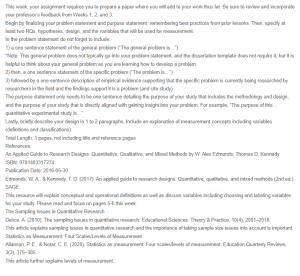
This week, your assignment requires you to prepare a paper where you will add to your work thus far. Be sure to review and incorporate your professor’s feedback from Weeks 1, 2, and 3.
Begin by finalizing your problem statement and purpose statement, remembering best practices from prior lessons. Then, specify at least two RQs, hypotheses, design, and the variables that will be used for measurement.
Advancing the Understanding of Quantitative Concepts
In the problem statement do not forget to include:
1) a one sentence statement of the general problem (“The general problem is…”)
*Note: This general problem does not typically go into your problem statement, and the dissertation template does not require it, but it is helpful to think about your general problem as you are learning how to develop a problem.
2) then, a one sentence statement of the specific problem (“The problem is…”)
3) followed by a one-sentence description of empirical evidence supporting that the specific problem is currently being researched by researchers in the field and the findings support it is a problem (and cite study)
The purpose statement only needs to be one sentence detailing the purpose of your study that includes the methodology and design, and the purpose of your study that is directly aligned with gaining insight into your problem. For example, “The purpose of this quantitative experimental study is…”
Lastly, briefly describe your design in 1 to 2 paragraphs. Include an explanation of measurement concepts including variables (definitions and classifications).
Total Length: 1 pages, not including title and reference pages
References:
An Applied Guide to Research Designs: Quantitative, Qualitative, and Mixed Methods by W. Alex Edmonds; Thomas D. Kennedy
ISBN: 9781483317274
Publication Date: 2016-05-30
Edmonds, W. A., & Kennedy, T. D. (2017). An applied guide to research designs: Quantitative, qualitative, and mixed methods (2nd ed.). SAGE.
This resource will explain conceptual and operational definitions as well as discuss variables including choosing and labeling variables for your study. Please read and focus on pages 5-6 this week.
The Sampling Issues in Quantitative Research
Delıce, A. (2010). The sampling issues in quantitative research. Educational Sciences: Theory & Practice, 10(4), 2001–2018.
This article explains sampling issues in quantitative research and the importance of taking sample size issues into account is important.
Statistics as Measurement: Four Scales/Levels of Measurement
Allanson, P. E., & Notar, C. E. (2020). Statistics as measurement: Four scales/levels of measurement. Education Quarterly Reviews, 3(3), 375–385.
This article further explains levels of measurement.
 Complete the order form and upload all of your files, including any instructions, rubrics, or other materials provided by your instructor.
  Complete the order payment after filling in the order form. We’ll receive your order and assign it to a writer.
 The assigned writer will complete your paper and forward it to our Editing Team for review and approval.
 Once approved by the editor, the completed paper will be uploaded to your account for you to download, review and approve.