
Adidas – Business Analysis
Hello, and welcome to today’s presentation. The presentation is about Adidas, one of the leading sports shoes, equipment, and apparel companies.
To begin with, this presentation will highlight the company’s mission and an explanation of how this mission supports sporting activities. Besides, Adidas’ competitiveness based on Porter’s five forces will be highlighted. Next, we will delve into the BCG Matrix that describes Adidas’ relative market share and conclude with recommendations for the organization.
Let’s begin with the company’s mission.
Adidas’ mission is “To be the best sports brand in the world” (Adidas, 2024). All endeavors at the company are geared toward changing lives through sports. To achieve this mission, Adidas embraces courage, ownership, and innovation. Through innovation, the company can gain a competitive edge and create effective products fit for sports activities. The company can improve its mission statement by adjusting it to “helping athletes be the best version of themselves” to stress its focus on athletes.
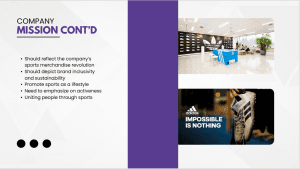
Further analysis of Adidas’ mission statement shows that the company is prepared to leverage internally available tools to revolutionize sports merchandise to bolster athletes’ capabilities. Besides, the mission statement stresses the company’s inclusivity and diversity objectives. All customers, regardless of age, gender, size, and athletic capabilities, can get products that suit their unique needs. Besides, the mission statement shows that the company promotes its products as being more than enablers of competitive sport, as customers can use them for lifestyle activities such as going for morning runs.
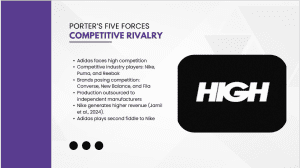
The sports fashion and merchandise industry is characterized by stiff competition. The company’s leading competitors in the industry include Nike, Puma, and Reebok. Besides, other brands such as New Balance, Converse, and Fila also pose significant competition. In a bid to reduce production costs so that the company can cope with competition, it outsources its manufacturing operations to independent manufacturers who can undertake production activities at a relatively low cost. Despite Adidas’ superb performance, it still plays second fiddle to Nike, which made a revenue of $46.71 billion, while Adidas made a paltry $23.7 billion (Jamil et al., 2024).
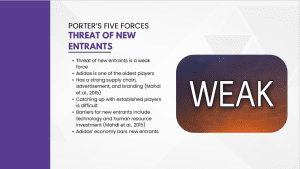
Second, the threat of new entrants in Adidas’ industry is a weak force. As one of the oldest industry players, Nike has established strong networks that will be difficult for new players to achieve. Among others, Adidas has strong supply chains and a strong advertising and branding presence (Mahdi et al., 2015). Although establishing a new entrant is easy, achieving the presence Adidas has achieved over time will be a hard task. Besides, significant technology and human resource investment achieved by established players like Nike, Adidas, and Puma is difficult due to economic limitations.
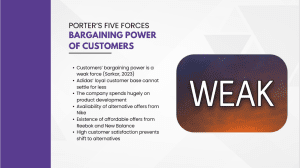
Third, Adidas customers’ bargaining power is a weak force. This is attributed to the company’s loyal customer base established over the years Adidas has been in operation (Sarkar, 2023). Since these customers have been attached to the company’s products, they cannot just switch, hence they have low bargaining power. This situation is largely attributed to Adidas’ significant investment in new product development, which ensures they have products that align with their loyal customer base’s demands. Although there are alternative offers from Nike and cheap offers from New Balance and Reebok, Adidas’ high customer satisfaction prevents them from switching, hence low bargaining power.
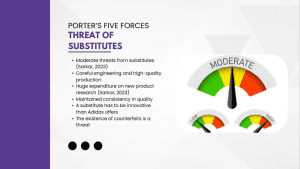
Fourth, the threat from alternative offers to Adidas products is a moderate force. Some of the factors that make it difficult to dislodge Adidas products include the company’s commitment to careful engineering and the production of high-quality apparel (Sarkar, 2023). Besides, Adidas has been consistent in dedicating significant finances to research on new product development, implying that whatever they produce has an edge over alternatives (Sarkar, 2023). On the flip side, counterfeits are a threat because they are cheap, hence attractive to on-budget consumers.
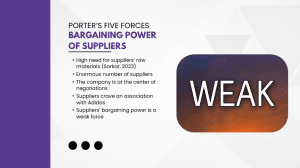
Fifth, Adidas suppliers’ bargaining power is a weak force. Owing to the company’s need for raw materials such as cotton from suppliers to maintain consistent production, it has created networks with an enormous number of suppliers globally, implying there is no overdependence on one supplier (Sarkar, 2023). This puts Adidas at the center of negotiations with suppliers since it has a huge pool of suppliers to select from. Besides, suppliers crave being associated with Adidas due to its strong brand name, thus limiting their bargaining power.
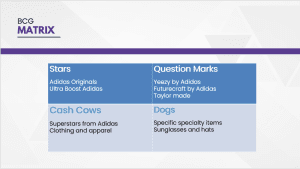
The above BCG matrix shows that stars are doing well, and Adidas should invest in them for future growth. On the other hand, Adidas should strive to maintain the market share of cash cows, and in this case, they are superstars from Adidas. Besides, Adidas should re-evaluate the potential of question marks, including Yezy and Futurecraft, to decide whether it is sustainable to continue with their production. Finally, Adidas should consider relocating or selling the dogs, which include hats, sunglasses, and specialty items.
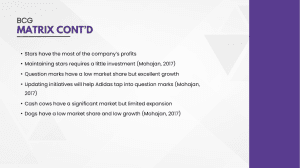
In addition, Adidas originals and Ultra boots contribute the most to Adidas’ profits, with competition from players like Nike. The company only needs to make a small investment to maintain the stars’ position (Mohajan, 2017). On the other hand, updating initiatives will help question marks, including Yeezy and Futurecraft by Adidas, and Taylor Made products gain significant market share since they show great growth strides. Besides, expanding to certain geographical locations will help cash cows achieve growth. Finally, investing in a relevant market for dogs, including hats and sunglasses, will offer them a lifeline.
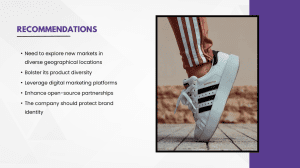
Based on the BCG matrix analysis, Adidas needs to explore new markets in diverse geographical locations. This will help Adidas products that are doing well in North America and European markets but have struggled to gain a foothold elsewhere. Also, the company should continue engaging in new product research and development to create diverse products to compete with Nike favorably. It is worth noting that legitimate Adidas products have not made significant inroads in developing economies. Another opportunity for Adidas to expand its market share is by marketing on digital platforms, such as social media platforms including Instagram and Facebook. Given the growth of these platforms, marketing will significantly bolster the company’s sales.
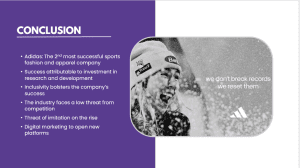
In summary, Adidas is the second most successful sportswear and apparel company after Nike in terms of revenue and brand awareness. The company’s success is attributable to its significant investment in research and development. Also, Nike’s inclusivity culture, creating products for diverse ages, sizes, and genders, has enhanced its market reach. Given the brand loyalty and quality engineering exhibited by Adidas, it is difficult for substitute products to dislodge the company. Notably, the emergence of cheaper imitations threatens Adidas’ market share among budget customers. To bolster sales, Adidas should explore digital marketing platforms, particularly social media.
Adidas. (2024). Adidas – Profile. Adidas. https://www.adidas-group.com/en/about/profile
Jamil, K., Alloubani, B., Abdulsalam, F., Al, N., Islam, S., & Nobanee, H. (2024). A decade of competition: A financial analysis of Adidas vs. Nike. ResearchGate. https://www.researchgate.net/publication/384675907
Mahdi, H., Abbas, M., Ilyas Mazar, T., & George, S. (2015). A comparative analysis of strategies and business models of Nike, Inc. and Adidas Group with special reference to competitive advantage in the context of a dynamic and competitive environment. International Journal of Business Management and Economic Research (IJBMER), 6(3), 167-177. https://www.ijbmer.com/docs/volumes/vol6issue3/ijbmer2015060302.pdf
Mohajan, H. (2017). An analysis on BCG growth sharing matrix – Munich Personal RePEc Archive. Uni Muenchen.de, 2(1). https://mpra.ub.uni-muenchen.de/84237/1/MPRA_paper_84237.pdf
Sarkar, S. (2023, March 25). Porter`s five forces analysis of ADIDAS. Medium. https://medium.com/@swagniksarkar/porter-s-five-forces-analysis-of-adidas-844e0575b5a0
ORDER A PLAGIARISM-FREE PAPER HERE
We’ll write everything from scratch
Question 
Adidas – Business Analysis
Create a PowerPoint presentation that analyzes a company, business, or organization in the realm of sports management. Within your presentation, you are required to provide the properly referenced, mission statement for your chosen organization. Provide an evaluation of the mission statement by describing your overall opinion. Be sure to include any modifications to the mission statement that you feel would improve the organization’s ability to meet their objectives.
The PowerPoint presentation should be done as if you were going to actually give this presentation, meaning the slides should present an overview, or outline of what you are presenting. The mission statement should written out on the slide exactly as the company has it, however that’s the only slide that should use full sentences on the slide. Please be sure to review the attached Power Point Dos and Don’ts document.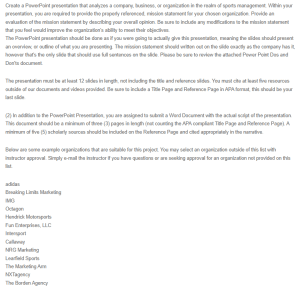
The presentation must be at least 12 slides in length, not including the title and reference slides. You must cite at least five resources outside of our documents and videos provided. Be sure to include a Title Page and Reference Page in APA format, this should be your last slide.
(2) In addition to the PowerPoint Presentation, you are assigned to submit a Word Document with the actual script of the presentation. This document should be a minimum of three (3) pages in length (not counting the APA compliant Title Page and Reference Page). A minimum of five (5) scholarly sources should be included on the Reference Page and cited appropriately in the narrative.
Below are some example organizations that are suitable for this project. You may select an organization outside of this list with instructor approval. Simply e-mail the instructor if you have questions or are seeking approval for an organization not provided on this list.
adidas
Breaking Limits Marketing
IMG
Octagon
Hendrick Motorsports
Fun Enterprises, LLC
Intersport
Callaway
NRG Marketing
Learfield Sports
The Marketing Arm
NXTagency
The Borden Agency
TNS Sports and Sponsorship
EA Sports
Sports Mark
GameFace
Sports Group International
https://www.mindtools.com/at7k8my/porter-s-five-forces
 Complete the order form and upload all of your files, including any instructions, rubrics, or other materials provided by your instructor.
  Complete the order payment after filling in the order form. We’ll receive your order and assign it to a writer.
 The assigned writer will complete your paper and forward it to our Editing Team for review and approval.
 Once approved by the editor, the completed paper will be uploaded to your account for you to download, review and approve.