
Case Study: Health History and Physical Assessment
Health History: Subjective Data
The patient is a 46-year-old African American woman residing in an urban neighborhood and presented for treatment with complaints of ongoing fatigue and shortness of breath on exertion. She reports that her primary reason for seeking medical attention is increasing difficulty with routine activities, particularly climbing stairs and carrying groceries, due to shortness of breath. Using the PQRST model, she describes the current illness as step-wise in length over the past three months, with a worsening induced by effort and a relief by rest. She describes her overall state of health as “fair” but admits to having missed routine checks due to the pressures of working as an administrator in a school. Her history includes hypertension diagnosed at 38, type 2 diabetes at 42, and a recent admission for pneumonia. Current medications are lisinopril, metformin, and atorvastatin with no drug allergies. Her vaccination history indicates that she is up-to-date on influenza and COVID-19, but not the pneumococcal vaccine.
Family history of medical disease is robust for cardiovascular and metabolic disease. Her father died at age 58 due to a myocardial infarction, and her mother now has hypertension and osteoarthritis. One of her siblings has type 2 diabetes, and the other has high cholesterol. Her review of systems is positive for fatigue, trivial lower extremity edema, and nocturia, but otherwise negative for chest pain, palpitations, or neurological deficits. Per Erikson’s psychosocial stages, she is at the generativity versus stagnation stage, in which individuals strive to contribute to family and society. The patient reports having attained the accomplishments of this stage in that she mentors younger teachers and instructs in community literacy. At the cultural level, she is in accordance with African American traditions, which place emphasis on family strength, prayer, and faith healing. She believes in using herbal teas as adjunct therapy, but takes the prescribed medications initially when managing her chronic illnesses. Psychosocially, she receives adequate support from her husband and two adult children, but caregiving for her elderly mother at times creates stress. She participates actively in church work on a weekly basis, which provides emotional support. Shared resources to her are the use of an urban health clinic, her church group, and diabetes classes in the community, all of which enable her degree of participation in care.
Physical Examination: Objective Data
The patient was well-nourished but overweight with a BMI of 31.2, which classifies her as obese. HEENT examination was normal; pupils were equal, round, and light reactive, and oropharynx was moist without lesions. The neck was supple with no thyromegaly, but cervical lymph node examination was negative for enlargement. Respiratory examination revealed clear but diminished breath sounds bilaterally, with brief expiratory wheezes noted on auscultation. Cardiovascular examination revealed a normal rate and rhythm with an 82-beat-per-minute apical pulse, but there was a grade II/VI systolic murmur heard along the left sternal border. Neurological examination revealed intact cranial nerves II–XII, normal motor strength, and intact sensory function. Gastrointestinal examination revealed a soft, nontender abdomen with active bowel sounds in all four quadrants. Musculoskeletal examination revealed mild bilateral knee crepitus consistent with early osteoarthritis. Peripheral vascular examination revealed trace bilateral pedal edema but palpable dorsalis pedis pulses. Overall, these findings suggest comorbidities of obesity, hypertension, and possible early failure of the heart, and thus, additional diagnostic workup.
Needs Assessment
There are two primary health education needs determined from the health history and physical assessment: weight management with lifestyle change and adherence to cardiovascular risk reduction therapies. Education about nutrition, exercise, and weight loss is paramount because obesity is a modifiable risk factor that aggravates hypertension and diabetes. Besides, structured dietary counseling and physical activity reduce cardiovascular risk and improve quality of life among patients with metabolic syndrome (Ghodeshwar et al., 2023). Referral to a registered dietitian, a diabetes self-management education program, and progression to exercises such as walking or aquatic therapy would be helpful to the patient to prevent putting additional strain on her knees. Secondly, adherence to cardiovascular risk reduction strategies, including blood pressure monitoring, medication adherence, and abstinence from smoking, is of utmost importance. Informing and reminding the patient about the importance of medication adherence and follow-up in the clinic on a regular basis decreases long-term complications. Essentially, regular participation in evidence-based cardiovascular education interventions has a substantial effect in reducing morbidity and mortality among middle-aged women with comorbidities of hypertension and diabetes (Chaturvedi et al., 2023).
The physiological, developmental, cultural, and psychosocial factors all interact to impact the effectiveness of these interventions. Physiologically, the patient’s comorbidities pose challenges to physical endurance, requiring individually tailored activity recommendations. Developmentally, she wants to be healthy to continue to contribute to family and society, as outlined in Erikson’s theory of generativity. Culturally, the application of spiritual rituals and herbal therapies can be supplemented with formal medical care if it is respected and added to her education plan. Psychosocially, good family support and religious status provide a basis to assist in compliance with health habits, though caregiver stress may disrupt her consistency. Motivation to remain independent, responsibility to family, and availability of clinical and community resources are her strengths. These can be utilized to enhance compliance with nutrition, exercise, and cardiovascular care plans. Also, community-based programs, such as diabetes support groups and culturally sensitive nutrition classes, may reduce barriers by addressing her entire person needs (Singh et al., 2022). Collectively, the patient’s strengths and collaborative resources available are a foundation for achieving improved health outcomes through personalized education.
Reflection
Conducting this physical examination and health history was informative and educational, allowing for theoretical knowledge to be synthesized with its practical application. The interview was conducted in a private clinical environment late in the morning and thus offered a relaxed setting that lends itself to open communication. My method was active listening, therapeutic presence, and cultural sensitivity. The patient appeared receptive and talked freely about her health problems and lifestyle. Unlike classroom learning, this real interaction served to highlight the importance of flexibility since patients have a tendency to provide unanticipated information requiring adjustment of questioning. The difficulties encountered were the occasional difficulty in getting clear symptom development descriptions, something I overcame by rewording questions within a language that people can relate to. Time constraint was also a difficulty, and I had to tackle important assessment factors while maintaining rapport. What was successful was the willingness of the patient to talk about sensitive health information, which I attribute to confidentiality and an unbiased attitude. In future interactions, I would allow more time for explanation and utilize motivational interviewing to enhance willingness for life change. Overall, the experience reaffirmed the interconnectedness of physical, cultural, psychosocial, and developmental factors within nursing assessment and underscored the critical nature of holistic, patient-focused care.
References
Chaturvedi, A., Zhu, A., Gadela, N. V., Prabhakaran, D., & Jafar, T. H. (2023). Social determinants of health and disparities in hypertension and cardiovascular diseases. Hypertension, 81(3), 387–399. https://doi.org/10.1161/hypertensionaha.123.21354
Ghodeshwar, G. K., Dube, A., & Khobragade, D. (2023). Impact of lifestyle modifications on cardiovascular health: A narrative review. Cureus, 15(7). https://doi.org/10.7759/cureus.42616
Singh, H., Fulton, J., Mirzazada, S., Saragosa, M., Uleryk, E. M., & Nelson, M. L. A. (2022). Community-based culturally tailored education programs for black communities with cardiovascular disease, diabetes, hypertension, and stroke: Systematic review findings. Journal of Racial and Ethnic Health Disparities, 10(6), 2986–3006. https://doi.org/10.1007/s40615-022-01474-5

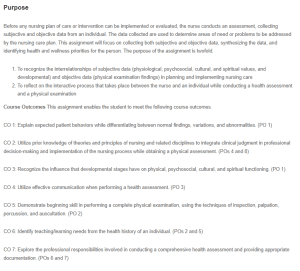
Before any nursing plan of care or intervention can be implemented or evaluated, the nurse conducts an assessment, collecting subjective and objective data from an individual. The data collected are used to determine areas of need or problems to be addressed by the nursing care plan. This assignment will focus on collecting both subjective and objective data, synthesizing the data, and identifying health and wellness priorities for the person. The purpose of the assignment is twofold.
Case Study – Health History and Physical Assessment
- To recognize the interrelationships of subjective data (physiological, psychosocial, cultural, and spiritual values, and developmental) and objective data (physical examination findings) in planning and implementing nursing care
- To reflect on the interactive process that takes place between the nurse and an individual while conducting a health assessment and a physical examination
Course Outcomes This assignment enables the student to meet the following course outcomes.
CO 1: Explain expected patient behaviors while differentiating between normal findings, variations, and abnormalities. (PO 1)
CO 2: Utilize prior knowledge of theories and principles of nursing and related disciplines to integrate clinical judgment in professional decision-making and implementation of the nursing process while obtaining a physical assessment. (POs 4 and 8)
CO 3: Recognize the influence that developmental stages have on physical, psychosocial, cultural, and spiritual functioning. (PO 1)
CO 4: Utilize effective communication when performing a health assessment. (PO 3)
CO 5: Demonstrate beginning skill in performing a complete physical examination, using the techniques of inspection, palpation, percussion, and auscultation. (PO 2)
CO 6: Identify teaching/learning needs from the health history of an individual. (POs 2 and 5)
CO 7: Explore the professional responsibilities involved in conducting a comprehensive health assessment and providing appropriate documentation. (POs 6 and 7)
 Complete the order form and upload all of your files, including any instructions, rubrics, or other materials provided by your instructor.
  Complete the order payment after filling in the order form. We’ll receive your order and assign it to a writer.
 The assigned writer will complete your paper and forward it to our Editing Team for review and approval.
 Once approved by the editor, the completed paper will be uploaded to your account for you to download, review and approve.