
Discussion: Becoming a Thought Leader
My initial reaction to the concept of becoming a thought leader is that it is both inspiring and humbling. A thought leader is more than an expert; they shape perspectives and guide others toward truth through scholarship and service. Johnson (2010) explains that the dialogue between psychology and Christianity has often been marked by tension, yet also fruitful integration. Similarly, Sproul reflects on Romans 1 and highlights Paul’s self-identification as a “slave of Christ,” reminding the audience that genuine leadership begins in humility and submission to God (Sproul, n.d.). From a personal perspective, becoming a thought leader means engaging psychology with academic rigor while remaining firmly grounded in biblical convictions.
The research area that interests me the most is the intersection of Christian spirituality and behavioral health leadership. As a doctoral student in psychology, I feel called to examine how faith-based principles enhance resilience, healing, and flourishing within behavioral health systems. Besides, Johnson (2010) traces how Christian scholars such as Augustine and Aquinas developed deep insights into human nature through integration with theology. This example affirms that psychological research informed by Christian truth can be both rigorous and spiritually transformative.
Within this research area, I believe there is a great need for more scientific study on the impact of spiritual disciplines on mental health outcomes. While positive psychology emphasizes gratitude and forgiveness, fewer empirical studies examine prayer, discipleship, and worship as therapeutic resources. In addition, Dunn and Robinson-Lane (2020) argue that spirituality provides coping mechanisms during suffering, yet more research is needed to demonstrate measurable effectiveness in clinical and organizational settings.
Equally important is examining how Christian leadership shapes healthcare institutions. Sproul (n.d.) reminds believers that they are “called to be saints,” a vocation requiring humility and service. Leaders influence policies and cultures; therefore, research into faith-based leadership could address disparities in behavioral health. Additionally, integrating psychology with Christian virtues provides a model for ethical, transformative leadership (Dunn & Robinson-Lane, 2020).
In conclusion, becoming a thought leader requires stewardship of knowledge under Christ’s authority. Like Paul, who identified himself as Christ’s servant first, I hope to integrate faith and scholarship to promote resilience and flourishing.
References
Dunn, K. S., & Robinson-Lane, S. G. (2020). A philosophical analysis of spiritual coping. Advances in Nursing Science, 43(3), 239–250. https://doi.org/10.1097/ans.0000000000000323
Johnson, E. L. (2010). Psychology and Christianity: Five views (2nd ed.). IVP Academic.
Sproul, R. C. (n.d.). Introduction. Ligonier Ministries. https://learn.ligonier.org/sermons/introduction
ORDER A PLAGIARISM-FREE PAPER HERE
We’ll write everything from scratch
Question 
Prompt:
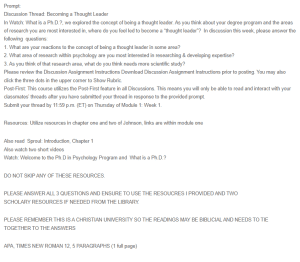
Discussion Thread: Becoming a Thought Leader
In Watch: What is a Ph.D.?, we explored the concept of being a thought leader. As you think about your degree program and the areas of research you are most interested in, where do you feel led to become a “thought leader”? In discussion this week, please answer the following questions:
Discussion – Becoming a Thought Leader
1. What are your reactions to the concept of being a thought leader in some area?
2. What area of research within psychology are you most interested in researching & developing expertise?
3. As you think of that research area, what do you think needs more scientific study?
Please review the Discussion Assignment Instructions Download Discussion Assignment Instructions prior to posting. You may also click the three dots in the upper corner to Show Rubric.
Post-First: This course utilizes the Post-First feature in all Discussions. This means you will only be able to read and interact with your classmates’ threads after you have submitted your thread in response to the provided prompt.
Submit your thread by 11:59 p.m. (ET) on Thursday of Module 1: Week 1.
Resources: Utilize resources in chapter one and two of Johnson, links are within module one
Also read Sproul: Introduction, Chapter 1
Also watch two short videos
Watch: Welcome to the Ph.D in Psychology Program and What is a Ph.D.?
DO NOT SKIP ANY OF THESE RESOURCES.
PLEASE ANSWER ALL 3 QUESTIONS AND ENSURE TO USE THE RESOUCRES I PROVIDED AND TWO SCHOLARY RESOURCES IF NEEDED FROM THE LIBRARY.
PLEASE REMEMBER THIS IS A CHRISTIAN UNIVERSITY SO THE READINGS MAY BE BIBLICIAL AND NEEDS TO TIE TOGETHER TO THE ANSWERS
APA, TIMES NEW ROMAN 12, 5 PARAGRAPHS (1 full page)
 Complete the order form and upload all of your files, including any instructions, rubrics, or other materials provided by your instructor.
  Complete the order payment after filling in the order form. We’ll receive your order and assign it to a writer.
 The assigned writer will complete your paper and forward it to our Editing Team for review and approval.
 Once approved by the editor, the completed paper will be uploaded to your account for you to download, review and approve.