
Discussion: Fostering Innovation for Practice in Organizations and Leading Change
An Intervention or Policy Needing Change
One policy in my healthcare practice that requires change is the inconsistent use of interdisciplinary rounds. While these rounds are meant to foster collaboration and holistic care, they are often fragmented or limited to physicians and nurses. According to Mackoff (2023), effective change leadership relies on vision, collaboration, communication, and resilience. My vision would be to expand rounds into a consistent, team-based practice that includes social workers, pharmacists, and case managers. Collaboration would create shared goals for patient care, communication would ensure transparency across disciplines, and resilience would help staff adapt to time constraints or resistance. By reframing rounds as essential to safety and efficiency rather than “extra work,” I could help transition the team toward a more inclusive, sustainable practice model.
Initiating Innovation as a Leader
As a leader, I would apply Umiker’s seven keys to change implementation: planning, communication, participation, delegation, evaluation, rewards, and reinforcement (Ellison, 2025). Planning would address workflow barriers, participation would engage all disciplines, and reinforcement would recognize consistent contributors. I would also align with Weberg and Davidson’s (2021) evidence–innovation–leadership framework, which emphasizes linking innovation to outcomes through evidence-based practice. Combining structured management skills with relational leadership provides a balanced approach that makes innovation systematic yet adaptable to complexity.
Reflection on Values Exercise
The value that surfaced most strongly in my exercise was equity. This matches how I make decisions and interact with others, as I strive to ensure fairness in care regardless of socioeconomic status or culture. In practice, this drives me to advocate for vulnerable patients and address barriers to health literacy. As a leader, equity will guide me to create inclusive policies, support staff diversity, and reduce disparities. Besides, Weberg and Davidson (2021) emphasize that modern leadership must move from hierarchy toward distributed, networked models. By embedding equity, I can foster patient-centered decisions and trust within the organization.
Advancing Health Equity in Practice
The Future of Nursing 2020–2030 podcast highlights how social determinants—such as transportation and housing—affect outcomes. In my practice, unreliable transportation prevents many patients from attending follow-ups or obtaining medications. As a leader, I would advocate for ride-share or shuttle partnerships and educate staff to screen for transportation needs at discharge. These steps reflect the report’s call for nurses to address inequities beyond clinic walls (Cochran et al., 2022). By doing so, I can help reduce readmissions and promote equitable access to care.
References
Cochran, A. L., McDonald, N. C., Prunkl, L., Vinella-Brusher, E., Wang, J., Oluyede, L., & Wolfe, M. (2022). Transportation barriers to care among frequent health care users during the COVID pandemic. BMC Public Health, 22(1). https://doi.org/10.1186/s12889-022-14149-x
Ellison, R. (2025). Umiker’s management skills for the new health care supervisor (8th ed.). Jones and Bartlett.
Mackoff, B. (2023). Leadership laboratory for nurse leaders. Cognella.
Weberg, D. R., & Davidson, S. (2021). Leadership for evidence-based Innovation in Nursing and Health Professions (2nd ed.). Jones & Bartlett Learning.
ORDER A PLAGIARISM-FREE PAPER HERE
We’ll write everything from scratch
Question 
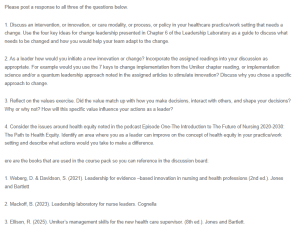
Please post a response to all three of the questions below.
1. Discuss an intervention, or innovation, or care modality, or process, or policy in your healthcare practice/work setting that needs a change. Use the four key ideas for change leadership presented in Chapter 6 of the Leadership Laboratory as a guide to discuss what needs to be changed and how you would help your team adapt to the change.
Fostering Innovation for Practice in Organizations and Leading Change
2. As a leader how would you initiate a new innovation or change? Incorporate the assigned readings into your discussion as appropriate. For example would you use the 7 keys to change implementation from the Umiker chapter reading, or implementation science and/or a quantum leadership approach noted in the assigned articles to stimulate innovation? Discuss why you chose a specific approach to change.
3. Reflect on the values exercise. Did the value match up with how you make decisions, interact with others, and shape your decisions? Why or why not? How will this specific value influence your actions as a leader?
4. Consider the issues around health equity noted in the podcast Episode One-The Introduction to The Future of Nursing 2020-2030: The Path to Health Equity. Identify an area where you as a leader can improve on the concept of health equity in your practice/work setting and describe what actions would you take to make a difference.
ere are the books that are used in the course pack so you can reference in the discussion board:
1. Weberg, D. & Davidson, S. (2021). Leadership for evidence –based innovation in nursing and health professions (2nd ed.). Jones and Bartlett
2. Mackoff, B. (2023). Leadership laboratory for nurse leaders. Cognella
3. Ellison, R. (2025). Umiker’s management skills for the new health care supervisor. (8th ed.). Jones and Bartlett.
 Complete the order form and upload all of your files, including any instructions, rubrics, or other materials provided by your instructor.
  Complete the order payment after filling in the order form. We’ll receive your order and assign it to a writer.
 The assigned writer will complete your paper and forward it to our Editing Team for review and approval.
 Once approved by the editor, the completed paper will be uploaded to your account for you to download, review and approve.