
Quality Improvement Worksheet: Curriculum Development
-
Introduction:
Quality Issue Identification
As a nurse educator, one quality issue that may be pertinent is the challenges in curriculum development. The challenges in curriculum development can negatively impact the quality of the education that future nurses receive. It is the responsibility of the nurse educator to ensure these challenges are addressed so that the nursing students receive the necessary knowledge and skills so that they can provide safe patient care.
Background of the Issue
Curriculum development challenges in nursing education can lead to inconsistencies in the knowledge, skills, and clinical judgment of graduating nurses. These issues may stem from outdated course content, a lack of alignment with current clinical practice standards, or inadequate integration of simulation and competency-based learning. The impact is far-reaching, as it can compromise patient safety, hinder professional readiness, and reduce program accreditation standing. This issue was selected because improving curriculum quality directly enhances both educational outcomes and patient care quality.
-
Quality Measures:
Selected NCQA HEDIS Performance Measure
The NCQA HEDIS performance measure most relevant to this issue is Effectiveness of Care – Clinical Training and Competency Outcomes. This measure evaluates the extent to which nursing programs prepare graduates to perform evidence-based clinical interventions effectively and safely (NCQA, n.d.). It focuses on ensuring that the education provided aligns with current best practices and measurable competency standards. This measure can be addressed directly to curriculum development by translating into clinical performance improvement of nursing graduates.
Data to Inform Quality Improvement
Some of the data that would be collected would be the pass rates of students on licensure exams, their competency assessment scores during simulation, their assessment scores during clinical settings, and surveys about the satisfaction of students with their curriculum relevance. Feedback from the employers about the graduates and their subsequent rates of employment would also be key indicators (Flaubert et al., 2021). Also, the remediation rate of particular skills and performance patterns over time may serve as an indication to identify gaps in the curriculum. These data points give quantitative and qualitative insights regarding the success of the educational program.
-
-
Regulatory Guidelines and Benchmarks:
-
Regulatory Guidelines to Inform Quality Improvement
Curriculum standards are based on regulatory guidelines by the American Association of Colleges of Nursing (AACN) and state Board of Nursing competency requirements. Accreditation organizations like the Commission on Collegiate Nursing Education (CCNE) guarantee that nursing programs adhere to national quality standards (Budin, 2022). These regulations mandate programs to keep evidence-based program content, provide proper clinical exposure, and systematically assess learning. Adherence to these rules will guarantee the credibility of the programs as well as the preparedness of the students.
Internal and External Benchmarks That Would Exhibit Success in Quality Improvement
Internal benchmarks will encompass ensuring a minimum pass rate of 85 percent in internal competency tests, 90 percent student satisfaction with curriculum quality, and institutional graduation rate attainment. External benchmarks will include meeting or exceeding the national average NCLEX pass rate, high employer satisfaction polls, and meeting or surpassing AACN Essentials-based curriculum results (Lewis et al., 2023). Such benchmarks give indicators of the curriculum quality and measure effectiveness.
-
Data Analysis Techniques:
- Data Analysis Technique to Evaluate the Problem
Root Cause Analysis (RCA) is a powerful tool that can be used to assess the curriculum gap. According to Singh et al. (2024), RCA pinpoints the underlying causes behind poor outcomes, such as a lack of learning materials, faculty training, or a lack of simulation resources. RCA also allows focusing on specific interventions by analyzing patterns in the data of student performance, as well as student feedback. This approach can help focus on the real cause of the issues to achieve a more stable curriculum reform.
-
Dissemination:
Ways to Disseminate Quality Improvement Results
Quality improvement results can be disseminated internally through faculty development workshops and academic committee presentations. Externally, findings can be shared at nursing education conferences and in peer-reviewed academic journals to reach a broader professional audience (Ravinetto & Singh, 2022). These dissemination strategies ensure that improvements are both implemented locally and contribute to the broader body of nursing education best practices.
Key Stakeholders
Key stakeholders include nursing faculty, curriculum committees, and academic administrators responsible for program oversight. External stakeholders include accreditation agencies, clinical placement partners, and employers who hire program graduates (Nasrabadi et al., 2021). Involving these stakeholders ensures that curriculum improvements meet educational, regulatory, and workforce needs effectively.
-
Reflections
Applying the Quality Improvement Strategies in Practice
In my practice, I will implement continuous monitoring of curriculum effectiveness through structured data collection and analysis. Regular faculty collaboration sessions will be used to align content with evolving clinical standards and best practices. Such approaches will keep the curriculum dynamic to the needs of students and the demands of the healthcare industry.
Reflection on the Assignment
The assignment has indicated that it is essential to relate curriculum development to measurable standards of quality and regulatory standards. With the help of this course, I now understand that successful quality improvement in the educational sector must involve systematic data collection, proper analysis, and stakeholder involvement. Putting such principles into practice will contribute to maintaining high-quality nursing education, which will eventually lead to better outcomes in patient care.
References
Budin, W. C. (2022). Benefits of accreditation. The Journal of Perinatal Education, 31(1), 3–5. https://doi.org/10.1891/jpe-2021-0031
Flaubert, J. L., Menestrel, S. L., Williams, D. R., & Wakefield, M. K. (2021). Educating nurses for the future. In www.ncbi.nlm.nih.gov. National Academies Press (US). https://www.ncbi.nlm.nih.gov/books/NBK573912/
Lewis, L. S., Willingham, T., Myers, J. S., & Hatch, D. (2023). Effect of a commercial NCLEX-RN preparation product on first time pass rates. SAGE Open Nursing, 9(1). https://doi.org/10.1177/23779608231196842
Nasrabadi, A. N., Mohammadi, N., Rooddehghan, Z., Shabani, E. A., Bakhshi, F., & Ghorbani, A. (2021). The stakeholders’ perceptions of the requirements of implementing innovative educational approaches in nursing: A qualitative content analysis study. BMC Nursing, 20(1). https://doi.org/10.1186/s12912-021-00647-7
NCQA. (n.d.). HEDIS and performance measurement. NCQA. https://www.ncqa.org/hedis/
Ravinetto, R., & Singh, J. A. (2022). Responsible dissemination of health and medical research: Some guidance points. BMJ Evidence-based Medicine, 28(3), 144–147. https://doi.org/10.1136/bmjebm-2022-111967
Singh, G., Patel, R. H., Vaqar, S., & Boster, J. (2024, February 12). Root cause analysis and medical error prevention. StatPearls – NCBI Bookshelf. https://www.ncbi.nlm.nih.gov/books/NBK570638/
ORDER A PLAGIARISM-FREE PAPER HERE
We’ll write everything from scratch
Question 
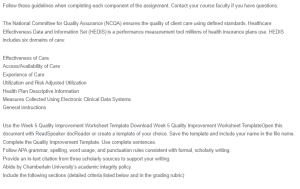
Follow these guidelines when completing each component of the assignment. Contact your course faculty if you have questions.
The National Committee for Quality Assurance (NCQA) ensures the quality of client care using defined standards. Healthcare Effectiveness Data and Information Set (HEDIS) is a performance measurement tool millions of health insurance plans use. HEDIS includes six domains of care:
Quality Improvement Worksheet: Curriculum Development
Effectiveness of Care
Access/Availability of Care
Experience of Care
Utilization and Risk Adjusted Utilization
Health Plan Descriptive Information
Measures Collected Using Electronic Clinical Data Systems
General instructions
Use the Week 5 Quality Improvement Worksheet Template Download Week 5 Quality Improvement Worksheet TemplateOpen this document with ReadSpeaker docReader or create a template of your choice. Save the template and include your name in the file name.
Complete the Quality Improvement Template. Use complete sentences.
Follow APA grammar, spelling, word usage, and punctuation rules consistent with formal, scholarly writing.
Provide an in-text citation from three scholarly sources to support your writing.
Abide by Chamberlain University’s academic integrity policy.
Include the following sections (detailed criteria listed below and in the grading rubric)
Introduction
Identify a quality or client safety issue.
Provide a background of the issue, including the scope, impact, and rationale for the selected issue.
Quality Measures
Select one NCQA HEDIS performance measure Download NCQA HEDIS performance measureOpen this document with ReadSpeaker docReaderrelated to your selected quality or client safety issue.
Select and define the data that would be collected to inform the QI project.
Provide an in-text citation from one scholarly source to support your writing.
Regulatory Guidelines and Benchmarks
Identify regulatory guidelines to inform quality improvement.
Identify the internal and external benchmarks that would exhibit success in quality improvement.
Provide an in-text citation from one scholarly source to support your writing.
Data Analysis Techniques
Describe one data analysis technique used in quality improvement that could be used to evaluate the problem.
Provide an in-text citation from one scholarly source to support your writing.
Dissemination
Identify at least two ways to disseminate the quality improvement results.
Identify the key stakeholder to whom the information would be disseminated.
Provide an in-text citation from one scholarly source to support your writing.
Reflection
Discuss how you will apply the quality improvement strategies in your practice.
Reflect on what you have learned from this assignment.
 Complete the order form and upload all of your files, including any instructions, rubrics, or other materials provided by your instructor.
  Complete the order payment after filling in the order form. We’ll receive your order and assign it to a writer.
 The assigned writer will complete your paper and forward it to our Editing Team for review and approval.
 Once approved by the editor, the completed paper will be uploaded to your account for you to download, review and approve.