
Rose Bowl Stadium: Management & Viability Analysis
Hello. Welcome to today’s presentation on the Rose Bowl Stadium Management and Viability Analysis.
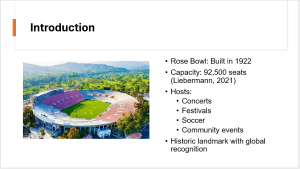
The Rose Bowl is one of the most iconic stadiums in the world. It was constructed in 1922 with a capacity of 92,500 (Liebermann, 2021). Notably, this capacity makes it one of the largest stadiums in the United States. The stadium is widely known for hosting the annual Bowl Game. However, it hosts other activities since it is a multipurpose stadium. Examples of activities that the stadium hosts include concerts, festivals, soccer matches, and community events. It is worth noting that its reputation as a historic landmark grants it global recognition.
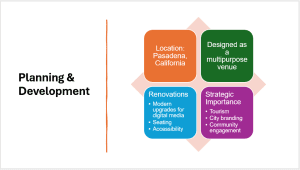
Planning and development of the stadiums were aimed at hosting numerous activities. Due to its huge capacity, the Rose Bowl was designed to host sporting and cultural events. The stadium is strategically located in Pasadena. Accordingly, this makes it a community hub and a tourist attraction. Over the decades, it has undergone major renovations to modernize its facilities. Major improvements include updated seating, better media facilities, and accessibility upgrades.
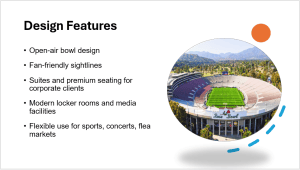
The design of the Rose Bowl is unique and functional. Its open-air bowl structure ensures spectators achieve excellent sightlines. The stadium features premium suites and club seating for corporate guests. Notably, this generates additional revenue. Renovations have allowed new locker rooms, advanced media facilities, and modern concession areas (Kanzius & Quirk, 2021). The stadium design provides flexibility, making it suitable for football and activities like concerts, flea markets, and international soccer events.
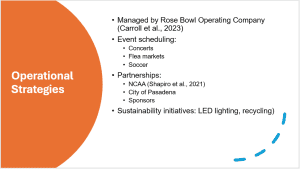
The operations of the Rose Bowl are primarily a function of the Rose Bowl Operating Company. This non-profit organization works closely with the city of Pasadena (Carroll et al., 2023). The company ensures that various events are sought and hosted by the stadium all year round. As a result, revenues and usage are maximized. The company ensures proper scheduling for soccer matches, concerts, and community flea markets (Shapiro et al., 2021). Sustainability initiatives such as LED lighting and recycling programs have been integrated into daily operations in recent years.
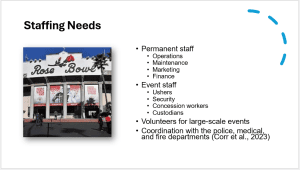
The Rose Bowl has extensive staffing needs. It is a complex affair that has seen the employment of permanent staff to manage daily operations, maintenance, marketing, and financial oversight of the stadium. There are occasions when additional temporary staff, such as security personnel, custodians, ushers, and concession workers, are hired. The stadium relies on large-scale events such as the Rose Bowl Game for enhanced revenue generation. Despite the large capacity and huge number of fans attending, the Pasadena police, fire, and medical services ensure safety and smooth operations (Corr et al., 2023).
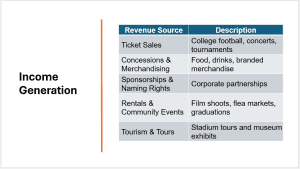
A crucial aspect of the Rose Bowl is revenue generation. The major revenue avenues include ticket sales, concessions and merchandising, sponsorships and naming rights, rentals and community events, and tourism. Essentially, it is crucial that these revenue-generating avenues are maintained and diversified for the long-term sustainability of the stadium.
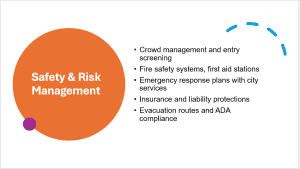
Safety and risk management is an important feature for the Rose Bowl. The control over the stadium with a capacity of more than 90,000 fans presupposes perfecting the crowd control strategies and emergency planning. Bag policies, metal detectors, and security checks are universal to any entrance of any facility. Moreover, there is a fire safety system, first aid posts, and medical personnel in the stadium at all times. In addition, definite evacuation paths relate to the ADA requirements. Finally, the stadium maintains close cooperation with the local police, fire, and emergency services for coordinated response plans.
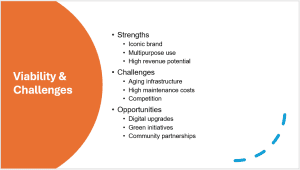
Although there have been efforts and gains, the viability and the challenges of the stadium cannot be ignored. The evaluation of the strengths and weaknesses of the Rose Bowl portrays an image of iconic status, multipurpose facilities, and good revenue generation. Some of these problems include high maintenance costs, obsolescence, and the emergence of newer stadiums. To remain competitive, the Rose Bowl should keep on making investments in digital enhancements and experience-related fan, and sustainability-related measures. Placing on the renowned history of the stadium, a possibility to gain worldwide attention and a loyal audience exists.
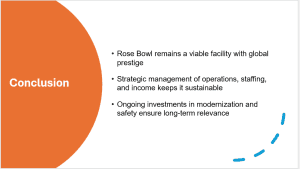
In conclusion, the Rose Bowl is more than a stadium. It will continue to stand as a timeless cultural and sporting landmark that survives almost a hundred years after its completion. Notably, it is necessary to ensure that its revenue-generating capabilities are improved and safeguarded. The stadium’s ability to balance tradition with innovation makes it a viable sports facility and a vital part of Pasadena’s community and America’s sporting heritage.
References
Carroll, B., Palmer, P., & Thorn, J. (2023). The hidden game of football: A revolutionary approach to the game and its statistics. University of Chicago Press.
Corr, C., Southall, R. M., Southall, C., & Hart, R. J. (2023). Hyperprofessionalized and commodified: A case study examination of FBS bowl games and the utilization of football players as programmatic promotional material. International Journal of Sport Communication, 16(2), 228–238. https://doi.org/10.1123/ijsc.2022-0200
Kanzius, C., & Quirk, C. E. (2021). Agents, athletes, and academics. In Sports and the Law (pp. 201–204). Routledge.
Liebermann, R. C. (2021). Reminiscences of days as an undergraduate at Caltech in the 1960s: Geology, student body politics and intercollegiate football. International Journal of Geosciences, 12(08), 653–666. https://doi.org/10.4236/ijg.2021.128037
Shapiro, S. L., Schulte, A., Popp, N., & Bates, B. (2021). An examination of secondary ticket market pricing trends and determinants at the NCAA Football Bowl Subdivision level. Journal of Issues in Intercollegiate Athletics, 14(1), 8. https://scholarcommons.sc.edu/jiia/vol14/iss1/8
ORDER A PLAGIARISM-FREE PAPER HERE
We’ll write everything from scratch
Question 
Rose Bowl Stadium: Management & Viability Analysis

Management & Viability Analysis
You will assess and analyze the management and viability of a specific sports facility of your choosing. You are recommended to select an intercollegiate, interscholastic, or recreational facility. Discuss its planning, design, operational strategies, staffing needs, income generation opportunities, and safety measures. Include photographs or diagrams if possible. This assignment should be created as a PowerPoint or other slide deck presentation.
 Complete the order form and upload all of your files, including any instructions, rubrics, or other materials provided by your instructor.
  Complete the order payment after filling in the order form. We’ll receive your order and assign it to a writer.
 The assigned writer will complete your paper and forward it to our Editing Team for review and approval.
 Once approved by the editor, the completed paper will be uploaded to your account for you to download, review and approve.