
Evidence-Based Proposal and Annotated Bibliography on Technology in Nursing
I have chosen the smart stethoscope as my technology topic because it is an essential innovation in respiratory evaluation, with its features including the artificial intelligence (AI)-aided analysis of sound, wireless communication, recording, and sharing high-quality lung sounds. The technology is a direct response to issues with conventional auscultation, which include inconsistency of clinician skill, noise in the environment that interferes with auscultation, and the absence of the ability to repeat measurements. I found it especially interesting due to its potential applications in chronic obstructive pulmonary disease (COPD) management, as the early identification of alterations in the lung sounds would help warn of future deterioration and minimize worsening and hospitalization. In my research process, I performed a focused literature search, where I identified and tested the latest peer-reviewed articles and reviews on innovative stethoscope technology within the context of nursing practice. I applied databases such as PubMed, CINAHL, and NCBI. Keywords used were smart stethoscope, digital stethoscope, AI-assisted auscultation, wearable stethoscope, nursing respiratory assessment, and telemedicine auscultation. These criteria helped to ascertain that the selected articles were up-to-date and highly applicable to clinical work.
Annotated Bibliography
Higashiyama, S., Tamakoshi, K., & Yamauchi, T. (2022). Effectiveness of a new interactive web teaching material for improving lung auscultation skills: Randomized controlled trial for clinical nurses. Nagoya Journal of Medical Sciences, 84(3), 526–538. https://doi.org/10.18999/nagjms.84.3.526
The focus of the study is on the educational component of auscultation, and it takes into account whether interactive, web-based learning tools are helpful to enhance the recognition capacity of nurses when it comes to accurate identification of lung sounds. A randomized controlled trial was used, with newly graduated nurses being categorized into web-based training, paper-based training, or having no intervention. The level of post-test score increased in both groups of intervention participants, with the group based on the web growing remarkably in identifying fine crackles. The impact on patient safety is highly significant: the acquired skills in auscultation enable earlier detection of respiratory degradation, which results in prompt intervention and possible aversion of serious complications (Higashiyama et al., 2022). Improvement of quality of care is achieved by enhancing consistency and reliability in clinical evaluations, and this decreases provider variability. Its application to nursing practice is in the fact that not only should nurses be provided with advanced auscultation devices, but also trained in the skills of interpreting the information generated by the devices. This publication was chosen because it addresses the vital role of combining technology and user skill and places emphasis on the fact that the most sophisticated tools can be effectively implemented only with trained, confident clinicians to enhance patient outcomes.
Kim, Y., Hyon, Y., Lee, S., Woo, S., Ha, T., & Chung, C. (2022). The coming era of a new auscultation system for analyzing respiratory sounds. BMC Pulmonary Medicine, 22(1). https://doi.org/10.1186/s12890-022-01896-1
This article focuses on the design and use of AI-enabled auscultation systems, such as digital stethoscopes combined with machine learning algorithms, to improve the recognition and discrimination of respiratory sounds. Kim et al. (2022) explore the limitations of traditional auscultation, such as subjectivity and its tie to the particular skill of the clinician, and the inability to analyze and exchange lung sound data. This publication gives an in-depth review of the technological innovation that allows these types of systems and how technology allows wireless capabilities, portable designs with manageable sizes, and support provided through AI to make diagnoses. The effect on patient safety is considerable, as it could help decrease variability and error rates in the diagnosis of abnormal lung sounds and introduce early action in diseases like COPD due to the objective nature of the AI-assisted analysis. Care quality also offers the possibility of documenting and monitoring lung sounds over a period, which works toward longitudinal care and evidence-based care modifications. It is relevant to nursing as it will allow nurses to conduct standardized assessments and easily incorporate auscultation records in patient records, as well as allow nurses to collaborate in a real-time environment with other medical professionals. This source was selected since it helps to close the gap between advanced technological possibilities and the practical demands of respiratory nursing to provide clear and evidence-based guidance on how AI-enabled auscultation can have a direct impact on patient outcomes.
Kim, Y., Hyon, Y., Woo, S., Lee, S., Lee, S., Ha, T., & Chung, C. (2023). Evolution of the stethoscope: Advances with the adoption of machine learning and development of wearable devices. Tuberculosis & Respiratory Diseases, 86(4), 251–263. https://doi.org/10.4046/trd.2023.0065
This review concentrates on the combination of machine learning algorithms and wearability into the design of a stethoscope with the aim of enhancing diagnostic capacities. The authors describe technical advances such as the use of high-fidelity sensors, discrete processors that are integrated, as well as Bluetooth connectivity, which makes real-time auscultation using artificial intelligence a practical situation. The article also relates such technical innovations to their practical clinical applications, mentioning how wearable smart stethoscopes can lessen the reliance on diagnostic imaging, which is expensive, by detecting respiratory problems faster through the analysis of sound data (Kim et al., 2023). Patient safety is increased because of constant monitoring and quick response to observed abnormal sounds, thus leading to intervention at an early stage before the condition is aggravated. Moreover, the quality of care can also be improved through the extension of monitoring to home-care and rural environments, where patients with limited access to healthcare services can avail themselves of advanced respiratory assessment. For nurses, wearable devices provide the possibility of active care in case of home visits or outreach programs, as they can immediately give the outcome to physicians and respiratory therapists to make informed decisions collectively. Notably, this article was selected for its solid evidence base confirming the practicality of the use of wearable smart stethoscopes and offers practical guidance on their value to the outcomes and effectiveness of respiratory care.
Seah, J. J., Zhao, J., Wang, D. Y., & Lee, H. P. (2023). Review on the advancements of stethoscope types in chest auscultation. Diagnostics, 13(9), 1545. https://doi.org/10.3390/diagnostics13091545
This article focuses on the modern evolution of the development of acoustic stethoscopes to newer electronic and digital models, their evaluations of the risks and benefits as compared with one another, as well as the prospects in terms of clinical practice. It discusses technologies like smartphone compatibility, wireless audio delivery, and wearables that enable continuous auscultation, and mentions specifically the role of these technologies in telemedicine. The review is relevant especially in the circumstances of COVID-19, where patient assessment remotely became a necessity in order to limit the exposure risks and keep the diagnostic quality intact (Seah et al., 2023). The article notes improved patient safety associated with advances in audio recording and transmission, which allow lung sounds to be heard in real-time. Accordingly, a clinician can detect abnormalities earlier, even remotely, and potentially offer treatment earlier and more effectively. The ability to make repeatable and accurate measurements, allowing trend analysis and the reduction in differences in diagnosis across providers, contributes to an improvement in the quality of care. The devices enhance efficiency in nursing practice because they facilitate the sharing of data and their application in diverse settings, such as noisy wards or patients’ homes. The article was selected because it provides a detailed comparison of stethoscope technologies, thus assisting healthcare practitioners to make informed decisions on the stethoscopes that suit their organizational factors, practice environments, and patient populations.
Summary of Recommendation
The four publications reviewed present a compelling, connected argument in support of the implementation of smart stethoscope technology in managing chronic respiratory diseases like COPD. Kim et al. (2022) highlight how AI-based auscultation technology breaks down the limits of non-iterative human stethoscopes by offering objective, repeatable analysis of lung sounds, which decreases interpretation variation and facilitates the early identification of worsened progression. The article by Seah et al. (2023) builds on the practical possibilities of contemporary devices, pointing to advances such as smartphone integration, wireless transmission, and wearable possibilities, which have personal value, especially in the telemedicine and remote care realities. Further benefits reported by Kim et al. (2023) include wearable device test results, which demonstrate that implementing continuous monitoring and real-time AI analysis creates a high-quality respiratory assessment extension beyond a hospital setting to home care and rural outreach. To complement these technology-focused insights, Higashiyama et al. (2022) also stress the importance of structured training in unlocking the potential of smart stethoscopes and show that these tools need skilled users to produce the best patient outcomes.
Organizational influences that might guide the choice in this technology are adherence to strict privacy and security guidelines, maintenance of the privacy of the recorded sound through encryption and secured transmission, allocation of resources to purchase the devices, software licensing, and maintenance, as well as the readiness of the infrastructure to support the transmission and connection of the device with the existing electronic health records (Junaid et al., 2022). To gain the buy-in of the staff and remain sustainable, cultural preparedness toward innovation owes to customer satisfaction, the commitment of the leadership in adopting technology, as well as extensive training programs. Education and participation in technology rollout decisions give employees a sense of ownership and confidence in their ability to use the devices provided effectively.
The implementation is justified as the literature confirms that smart stethoscopes directly impact patient safety, as they allow accurate diagnoses due to the earlier detection of unusual lung sounds, thereby allowing timely intervention and preventing rehospitalizations (Junaid et al., 2022). Reliable evidence-based decisions attributed to fresh, sharable data help improve the quality of care through interdisciplinary collaborations. These devices can help simplify nurse workflow since they can be easily incorporated during documentation and real-time consulting with physicians and respiratory therapists, even at distant or in noisy locations.
For healthcare organizations, these results translate into cost savings on needless hospital stays and tests, increased patient satisfaction, and work efficiency through streamlined sharing of information. When all members of the interdisciplinary team access the same objective data, it leads to a greater level of team satisfaction and cohesion, as there are fewer miscommunications and a greater level of clinical confidence. Moreover, the provision of nurses with new, efficient diagnostic devices can improve job satisfaction and retention, which is consistent with organizational goals and aimed at retaining a highly qualified and engaged professional workforce (Kim et al., 2023). For these evidence-based reasons, adopting smart stethoscope technology is not only effective but also a strategically beneficial move to facilitate patient-centered, high-quality, and low-cost care delivery.
Conclusively, smart stethoscope technology provides an effective solution to the respiratory evaluation process as it is embedded using AI-based analysis, wireless nature, and data-sharing options to make patient care more accurate, consistent, and timely. The evidence examined reveals its potential to enhance patients’ safety by providing early diagnostics of abnormalities, increasing care quality through a standardized and shareable assessment, and supporting interdisciplinary collaboration. Effective implementation depends on being able to match the capabilities of devices to the organizational infrastructure, policies, and well-designed training programs that guarantee clinical competency. In addition to producing better patient outcomes, smart stethoscopes potentially offer more efficient workflows, decreased unnecessary expenses, and improved staff satisfaction and retention. The implementation of healthcare technologies in nursing practice can help the healthcare organization to evolve toward a more effective, patient-centered, and proactive care delivery, both in the acute setting and in the community setting.
References
Higashiyama, S., Tamakoshi, K., & Yamauchi, T. (2022). Effectiveness of a new interactive web teaching material for improving lung auscultation skills: Randomized controlled trial for clinical nurses. Nagoya Journal of Medical Sciences, 84(3), 526–538. https://doi.org/10.18999/nagjms.84.3.526
Junaid, S. B., Imam, A. A., Balogun, A. O., De Silva, L. C., Surakat, Y. A., Kumar, G., Abdulkarim, M., Shuaibu, A. N., Garba, A., Sahalu, Y., Mohammed, A., Mohammed, T. Y., Abdulkadir, B. A., Abba, A. A., Kakumi, N. A. I., & Mahamad, S. (2022). Recent advancements in emerging technologies for healthcare management systems: A survey. Healthcare, 10(10), 1940. https://doi.org/10.3390/healthcare10101940
Kim, Y., Hyon, Y., Lee, S., Woo, S., Ha, T., & Chung, C. (2022). The coming era of a new auscultation system for analyzing respiratory sounds. BMC Pulmonary Medicine, 22(1). https://doi.org/10.1186/s12890-022-01896-1
Kim, Y., Hyon, Y., Woo, S., Lee, S., Lee, S., Ha, T., & Chung, C. (2023). Evolution of the stethoscope: Advances with the adoption of machine learning and development of wearable devices. Tuberculosis & Respiratory Diseases, 86(4), 251–263. https://doi.org/10.4046/trd.2023.0065
Seah, J. J., Zhao, J., Wang, D. Y., & Lee, H. P. (2023). Review on the advancements of stethoscope types in chest auscultation. Diagnostics, 13(9), 1545. https://doi.org/10.3390/diagnostics13091545
ORDER A PLAGIARISM-FREE PAPER HERE
We’ll write everything from scratch
Question 
Evidence-Based Proposal and Annotated Bibliography on Technology in Nursing
First, review the technologies presented in the Assessment 03 Supplement: Evidence-Based Proposal and Annotated Bib on Tech in Nursing [PDF] Download Assessment 03 Supplement: Evidence-Based Proposal and Annotated Bib on Tech in Nursing [PDF]resource and select one of the options to use as the focus for this assessment.
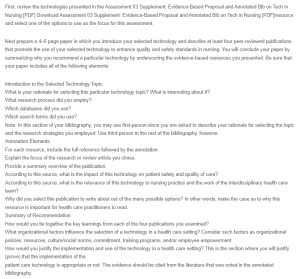
Evidence-Based Proposal and Annotated Bibliography on Technology in Nursing
Next prepare a 4–6 page paper in which you introduce your selected technology and describe at least four peer-reviewed publications that promote the use of your selected technology to enhance quality and safety standards in nursing. You will conclude your paper by summarizing why you recommend a particular technology by underscoring the evidence-based resources you presented. Be sure that your paper includes all of the following elements:
Introduction to the Selected Technology Topic
What is your rationale for selecting this particular technology topic? What is interesting about it?
What research process did you employ?
Which databases did you use?
Which search terms did you use?
Note: In this section of your bibliography, you may use first-person since you are asked to describe your rationale for selecting the topic and the research strategies you employed. Use third person in the rest of the bibliography, however.
Annotation Elements
For each resource, include the full reference followed by the annotation.
Explain the focus of the research or review article you chose.
Provide a summary overview of the publication.
According to this source, what is the impact of this technology on patient safety and quality of care?
According to this source, what is the relevance of this technology to nursing practice and the work of the interdisciplinary health care team?
Why did you select this publication to write about out of the many possible options? In other words, make the case as to why this resource is important for health care practitioners to read.
Summary of Recommendation
How would you tie together the key learnings from each of the four publications you examined?
What organizational factors influence the selection of a technology in a health care setting? Consider such factors as organizational policies, resources, culture/social norms, commitment, training programs, and/or employee empowerment.
How would you justify the implementation and use of the technology in a health care setting? This is the section where you will justify (prove) that the implementation of the
patient care technology is appropriate or not. The evidence should be cited from the literature that was noted in the annotated bibliography.
Consider the impact of the technology on the health care organization, patientcare/satisfaction, and interdisciplinary team productivity, satisfaction, and retention.
Example Assessment: You may use the following to give you an idea of what a Proficient or higher rating on the scoring guide would look like: (file attached)
4-6 typed, double spaced.
cite of a min FOUR peer reviewed publications; NOT WEBSITES
Font and font size: Use Times New Roman, 12 point.
APA: Follow APA style and formatting guidelines for all bibliographic entries. Refer to Evidence and APA as needed
 Complete the order form and upload all of your files, including any instructions, rubrics, or other materials provided by your instructor.
  Complete the order payment after filling in the order form. We’ll receive your order and assign it to a writer.
 The assigned writer will complete your paper and forward it to our Editing Team for review and approval.
 Once approved by the editor, the completed paper will be uploaded to your account for you to download, review and approve.