
Week 6 – Justifying Analysis: SPSS
SPSS Screenshot
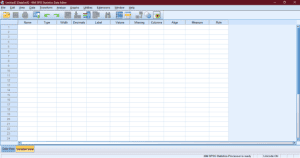
Summary of SPSS Learning Experience
The SPSS tutorial and Academic Success Center materials offered in-depth knowledge of the basic functions and uses of the Statistical Package for the Social Sciences (SPSS) in the analysis of quantitative research studies. With the guided tour, I became familiar with the intuitive interface of SPSS, which comprises the Data View and Variable View windows, whereby the researcher can efficiently input, manage, and manipulate datasets. The tutorial specified the need for adequate data preparation, variable coding, treatment of missing values, and data integrity before the analysis of the data using statistical tests. Besides, the materials also presented the capability of SPSS for extensive statistical tests, ranging from the simplest descriptive statistics to intricate multivariate tests, hence becoming a useful asset for all fields of research. The walkthrough presentations demonstrated the capability of SPSS in creating professional-grade tables as well as graphs, APA-formatted, which is of particular necessity in the documentation of research studies in academics.
Furthermore, the Academic Success Center materials specifically highlighted the essential interconnection of research design, data types, and suitable statistical test selection using SPSS. This learning reinforced the notion that successful quantitative analysis is contingent upon the consideration of variable measurement levels (nominal, ordinal, interval, ratio) and research queries in order to choose the most suitable statistical procedures. According to Field (2018), it is crucial to comprehend these fundamental concepts since the choice of statistical test depends on the type of data collected and the research question to be answered. The materials also offered useful information about interpreting the output of SPSS, such as interpreting significance levels, effect size, and assumption tests, which is an essential skill for performing rigorous quantitative research as well as for gathering valid conclusions based on the results of the statistical analysis.
References
Field, A. (2018). Discovering statistics using IBM SPSS statistics (5th ed.). SAGE Publications.
ORDER A PLAGIARISM-FREE PAPER HERE
We’ll write everything from scratch
Question 
Week 6 – Justifying Analysis: SPSS
Begin this week’s assignment by downloading the SPSS software utilizing the guide in this week’s resources. Review SPSS resources in the Academic Success Center (ASC) and this week’s resources. Then, complete the following three (3) steps below:
Step 1: Upload a screenshot showing you downloaded SPSS.
Week 6 – Justifying Analysis – SPSS
Step 2: Write a summary of what you learned from the SPSS tour/tutorial and/or the ASC SPSS resources.
Step 3: Use the “Which Stats Test” tool from Sage Research Methods located in the Week 6 Course Resources and Appendix E in the course textbook (Edmonds & Kennedy, 2017) to ‘walk’ through your final decisions for your study. Also, use any of the previous weekly resources and previous work, such as: the level of measurement of the variables you identified in Week 4, your design and RQs identified in Week 2, to identify the appropriate statistics you will use in your study. You are not required to conduct the analyses, but you will establish alignment between data type and type of analysis. You can do this verbally through Kaltura or in a decision tree.
Length:2 pages total: 1-page screenshot, 1-page summary,
References:
An Applied Guide to Research Designs: Quantitative, Qualitative, and Mixed Methods by W. Alex Edmonds; Thomas D. Kennedy
ISBN: 9781483317274
Publication Date: 2016-05-30
Edmonds, W. A., & Kennedy, T. D. (2017). An applied guide to research designs: Quantitative, qualitative, and mixed methods (2nd ed.). SAGE.
This textbook does not offer in-depth explanation of statistics. You do not need an in-depth understanding to complete this week’s assignment, but you can refer back to any chapter that may be helpful in completing the assignment for this week. Also, read Appendix E for analysis by design and Appendix D for reporting preliminary statistical findings.
* There is a “Show Page Numbers” function available when you access the book’s chapters. It is above the title of the chapter, off to the right. This is an example:
“Which Stats Test” tool
Sage Research Methods
This is a very easy-to-use tool that helps determine which statistical method is best for data. There are some excellent “Help” resources linked to this tool that can do much more to strengthen your understanding about choosing the correct statistical test for the type of data you are wanting to analyze based on the type of quantitative study you are proposing in assignments leading up to this one in Week 6. This tool, in combination with Appendix E in your textbook (Edmonds & Kennedy, 2017) offers examples of analyses that are aligned with various designs and provides a much more aligned and specific resource to help you grasp these concepts.
Data and Tests
Academic Success Center. (2020). Data and tests. National University.
From here, click on Types of Data and Statistical Tests to watch a step-by-step APA tutorial on analyzing data and for guidance on choosing what type of analysis best fits with your data.
Downloading IBM SPSS Statistics
Northcentral University. (2020). Downloading IBM SPSS statistics.
This NU resource provides detailed instructions to download SPSS. Please make sure to download SPSS as soon as you can during this first week.
Quantitative Data Analysis Tips and Strategies
Center for Teaching and Learning. (2018). Quantitative data analysis tips and strategies [PDF file]. Northcentral University.
This resource includes discussion and extra resources for data preparation issues.
How to Choose the Right Statistical Test
Nayak, B. K., & Hazra, A. (2011). How to choose the right statistical test? Indian Journal of Ophthalmology, 59(2), 85–86.
This resource gives valuable advice for how to choose the correct analysis for your study.
Creating a Data Analysis Plan: What to Consider When Choosing Statistics for a Study
Simpson, S. H. (2015). Creating a data analysis plan: What to consider when choosing statistics for a study. The Canadian Journal of Hospital Pharmacy, 68(4), 311–317.
This resources helps you develop your plan for analyzing your data that is in alignment with your study.
What Statistical Analysis Should I Use? Statistical Analyses using SPSS
UC Regents. (2021). What statistical analysis should I use? Statistical analyses using SPSS. Author.
This resource is a good summary of when to use each statistical test.
Laerd Statistics
Lund Research Ltd. (2018). Laerd statistics.
View resources on the Laerd statistics website to aid in your understanding of assumptions, SPSS, selecting the correct statistical test, and how to write statistical outcomes. There are options to pay for additional resources, but you do not need to do this (unless you would like additional help). There are plenty of free resources and information on this site.
 Complete the order form and upload all of your files, including any instructions, rubrics, or other materials provided by your instructor.
  Complete the order payment after filling in the order form. We’ll receive your order and assign it to a writer.
 The assigned writer will complete your paper and forward it to our Editing Team for review and approval.
 Once approved by the editor, the completed paper will be uploaded to your account for you to download, review and approve.