
Reflection: Theoretical Orientation and Preferred Social Work Practice Theories
After taking the Theoretical Orientation Scale (TOS), my top theoretical orientations were Multicultural Counseling (35), Integrative Therapy (35), and a tie in three areas, Person-Centered (34), Existential (34), and Cognitive (34). These scores indicate that I believe in the approach of inclusivity, client-centered, and adaptable therapy to a great extent. I was not surprised by the TOS results as they fit well with my values and manner, and I am inclined to treat people in need. I have always prioritized cultural competence, flexibility, and empathy in practice, and scores are high in Multicultural and Person-Centered approaches. The high mark on Integrative Therapy also made sense, as I tend to use various perspectives on addressing a particular client in a unique way to satisfy their demands.
Having learned about theories and models in this course, the three that most appealed to me were Ecological Systems Theory, Attachment Theory, and Feminist Theory. These methods align with my values of contextual understanding of clients, prioritizing early relations, and power dynamics. They provide holistic, compassionate frameworks for guiding effective, socially aware social work practice.
The values of empathy, justice, and inclusivity are what made me connect to Ecological Systems, Attachment, and Feminist Theories. Living in a heterogeneous setting and experiencing barriers through a system understanding heightened my path to a contextual, relational, and empowerment strategy. These match social work values of social justice and dignity, and support commitment to client-centered, culturally-achievable practice (Schmidt, 2022).
Focusing on the case of Ella Schultz through the course was tremendously beneficial because it allowed me to practice several theories on a single real-life issue. I learned how various models bring forth new knowledge about trauma, resilience, and identity. In the future, it would also be beneficial to bring in a second contrasting case to make a wider comparison.
References
Schmidt, J. (2022). Everyday ethics of dignity work: What social workers do to promote the dignity of service-users in times of austerity measures and welfare stigma. Ethics and Social Welfare, 16(3), 1–15. https://doi.org/10.1080/17496535.2022.2038229
ORDER A PLAGIARISM-FREE PAPER HERE
We’ll write everything from scratch
Question 
Reflection: Theoretical Orientation and Preferred Social Work Practice Theories
https://study.sagepub.com/system/files/Theoretical%20Orientation%20Scale%20Online_0.pdf
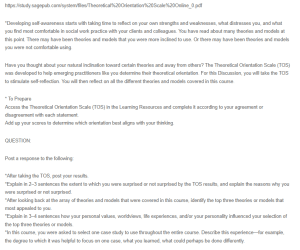
*Developing self-awareness starts with taking time to reflect on your own strengths and weaknesses, what distresses you, and what you find most comfortable in social work practice with your clients and colleagues. You have read about many theories and models at this point. There may have been theories and models that you were more inclined to use. Or there may have been theories and models you were not comfortable using.
Theoretical Orientation and Preferred Social Work Practice Theories
Have you thought about your natural inclination toward certain theories and away from others? The Theoretical Orientation Scale (TOS) was developed to help emerging practitioners like you determine their theoretical orientation. For this Discussion, you will take the TOS to stimulate self-reflection. You will then reflect on all the different theories and models covered in this course.
* To Prepare
Access the Theoretical Orientation Scale (TOS) in the Learning Resources and complete it according to your agreement or disagreement with each statement.
Add up your scores to determine which orientation best aligns with your thinking.
QUESTION:
Post a response to the following:
*After taking the TOS, post your results.
*Explain in 2–3 sentences the extent to which you were surprised or not surprised by the TOS results, and explain the reasons why you were surprised or not surprised.
*After looking back at the array of theories and models that were covered in this course, identify the top three theories or models that most appealed to you.
*Explain in 3–4 sentences how your personal values, worldviews, life experiences, and/or your personality influenced your selection of the top three theories or models.
*In this course, you were asked to select one case study to use throughout the entire course. Describe this experience—for example, the degree to which it was helpful to focus on one case, what you learned, what could perhaps be done differently.
 Complete the order form and upload all of your files, including any instructions, rubrics, or other materials provided by your instructor.
  Complete the order payment after filling in the order form. We’ll receive your order and assign it to a writer.
 The assigned writer will complete your paper and forward it to our Editing Team for review and approval.
 Once approved by the editor, the completed paper will be uploaded to your account for you to download, review and approve.