
Contemporary Issue in War and Peace
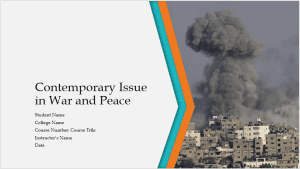
Hello, and welcome to today’s presentation on Contemporary Issues in War and Peace.
The latest round of violence in the Israel-Gaza conflict began in October 2023, when Hamas—a militant group based in Gaza—launched a surprise attack on Israel. This attack involved the killing of Israeli civilians, the taking of hostages, and the launching of thousands of rockets into residential areas (Samuel, 2023). In response, Israel initiated widespread military operations across Gaza, including airstrikes and ground invasions. As of 2024, thousands of people—many of them civilians—have been killed or wounded. Homes, schools, hospitals, and infrastructure have been destroyed. The humanitarian situation in Gaza is particularly dire, with limited access to food, water, and medical care. International actors, including the United Nations and religious leaders, have called for a ceasefire and for both sides to uphold human rights and international law. This conflict is morally urgent and raises serious ethical questions: who is acting justly, who is not, and how should Christians respond?
To assess this conflict, I will use Just War Theory, a moral framework rooted in Christian tradition and developed by theologians like Augustine and Thomas Aquinas. Just War Theory asks two main questions. First, is it morally just to go to war? This is jus ad bellum. Second, is it morally just to act a certain way within war? This is jus in bello. For a war to be morally acceptable, it must meet criteria such as having a just cause (like self-defense), being waged by a legitimate authority, using proportionate force, and being the last resort after all peaceful options have failed. During the war, combatants must avoid targeting civilians, must use force that is proportionate to the threat, and must maintain a clear distinction between military and non-military targets. Importantly, the ultimate goal should always be peace and justice, not vengeance or conquest. This theory gives Christians a structured way to judge whether participation in war aligns with moral values and the teachings of Christ.
Applying the Just War Theory to Hamas reveals that their actions clearly fail nearly every moral criterion. First, their initial attacks targeted civilians—killing families in their homes and taking hostages—which violates the principle of non-combatant immunity. These were not military actions aimed at legitimate targets; they were acts of terror. Second, Hamas does not meet the criterion of legitimate authority, since it does not operate within a recognized moral or political structure accountable to its people or to international law (Samuel, 2023). Third, their actions were not proportionate—they did not target military sites or try to minimize harm. Finally, they did not seek peace or exhaust diplomatic channels before resorting to violence. Therefore, based on Just War Theory, Hamas’s use of force is morally indefensible. Their actions are aggressive, unjust, and clearly violate Christian ethical teachings on warfare.
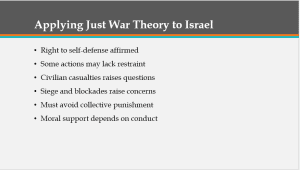
Evaluating Israel’s response is more complicated. Under Just War Theory, Israel clearly has a just cause—namely, defending its citizens from unprovoked attacks. This meets the jus ad bellum standard. However, Just War Theory also demands that a just cause be pursued with proportionality, restraint, and a strong regard for human life (Allman, 2008). Reports from humanitarian organizations have raised concerns that Israel’s bombing of residential areas, medical facilities, and infrastructure may exceed what is morally acceptable, even in the name of defense. The blockade of Gaza, which restricts access to food, water, electricity, and medical aid, also violates the principles of just conduct in war. If Israel’s actions harm more civilians than combatants or punish the entire population for the actions of a few, then those actions may not be just, even if the original cause is. So while Israel has moral grounds for self-defense, its conduct must remain within the boundaries of Just War Theory to retain that moral legitimacy.
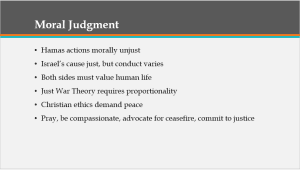
The Israel-Gaza conflict presents one of the clearest examples of why we need moral frameworks like Just War Theory. Hamas’s actions, especially the targeting of civilians, are clearly unjust and violate every principle of just warfare. Israel’s response began from a position of moral legitimacy, grounded in the right to defend its people (Allman, 2008). However, Just War Theory requires constant restraint, proportionality, and commitment to peace, and some of Israel’s actions raise serious ethical questions. From a Christian perspective, peace and human dignity must remain at the center of our judgment. We must pray for the victims on both sides, support humanitarian efforts, and encourage political leaders to pursue just and lasting peace. As followers of Christ, our moral responsibility is not only to analyze but also to act through compassion, advocacy, and an unwavering commitment to justice.
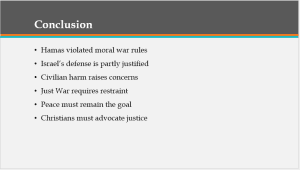
In conclusion, the application of Just War Theory shows that Hamas’s actions are morally indefensible—they deliberately targeted civilians and violated every major ethical principle of just warfare. Israel’s right to self-defense is justified, but how that defense is carried out matters deeply. Excessive force, collective punishment, and civilian suffering challenge the moral legitimacy of their response. As Christians, we are called to seek justice, uphold human dignity, and work toward lasting peace. Our faith demands that we not only analyze such conflicts but also act compassionately and ethically in response.
Allman, M. (2008). Who would Jesus kill?: War, peace, and the Christian tradition. Saint Mary’s Press.
Samuel, M. T. (2023). The Israel‐Hamas war: Historical context and international law. Middle East Policy, 30(4), 3–9. https://doi.org/10.1111/mepo.12723
ORDER A PLAGIARISM-FREE PAPER HERE
We’ll write everything from scratch
Question 
You will give a presentation where you make a moral judgment about some contemporary issue in war and peace. The choice of contemporary issue and of the moral method, framework, or principle you use for judgment are up to you.
Contemporary Issue in War and Peace
You will give a presentation that provides a moral judgment about a contemporary issue of war and peace. The presentation must cover three things:
1) A description of the contemporary issue in war and peace
2) An explanation of the moral method, framework, or principle that the student intends to use to evaluate the contemporary issue
3) An evaluation of the rightness, justice, or morality of the contemporary issue that is based on the moral method, framework, or principle
The presentation may be submitted as a narrated slide deck (e.g. PowerPoint, Google Slides), a recorded video (e.g. YouTube), or some other format with the instructor’s permission. The presentation should be about 5 minutes in length. This presentation is the University Explorations Key Assignment for this course.
 Complete the order form and upload all of your files, including any instructions, rubrics, or other materials provided by your instructor.
  Complete the order payment after filling in the order form. We’ll receive your order and assign it to a writer.
 The assigned writer will complete your paper and forward it to our Editing Team for review and approval.
 Once approved by the editor, the completed paper will be uploaded to your account for you to download, review and approve.