
Discussion: Diagram Problem, Purpose, RQs, Hypotheses, and Design
Qualitative Design: Phenomenological Study
The dissertation by Berkemeyer (2025) utilized a qualitative phenomenological approach. The problem addressed by the study was a gap in understanding how nature-based play affects children’s ability to self-regulate. The purpose was to explore the subjective experiences of children who participated in a nature camp and how they perceived changes in their self-regulation abilities. The research question guiding the study was, “How do children perceive their self-regulation after participating in a nature camp?” Since this is a qualitative design, hypotheses were not applicable. The phenomenological design was ideal because it allowed for an in-depth, narrative exploration of the lived experiences of the participants. This design is especially effective for capturing nuanced perceptions in the participants’ own words.
Correlational Design: Relationship between Strategies and Comprehension
Halterman’s (2013) dissertation adopted a correlational research design. The problem was that students with learning disabilities exhibited poor reading comprehension. The aim was to examine whether there was a relationship between strategy use in RAP paraphrasing and semantic mapping and reading comprehension achievements. The main research question was as follows: “Is there a relationship between strategy use and reading comprehension scores?” It was assumed in the hypothesis that a significant positive relationship exists between these strategies and reading achievements. The correlational design was suitable for quantifying the strength and direction of the relationship between variables without any control.
Quasi-Experimental Design: Intervention Impact on Licensing
The third dissertation by Wang (2018) is a quasi-experimental design. The issue that was discovered was that there was no empirical research on any effect of Technical Assistance (TA) and coaching on child care licensing compliance. The goal of the study was to look for any impact that TA/coaching had on the quantity and severity of licensing deficiencies. The research question for this study was, “What effect does TA have on the number and severity of deficiencies?” The hypothesis was that TA/coaching considerably minimizes a deficiency in compliance. A quasi-experimental structure was adopted based on a lack of ability to randomly assign participants, which made it highly appropriate for assessing real-world interventions in uncontrolled settings.
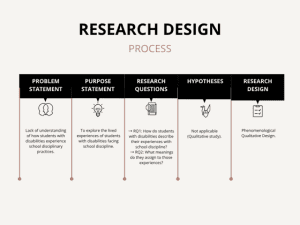
Flowchart
References
Berkemeyer, M. (2025). The impact of a play-based nature camp on self-regulation in school-age children. [Dissertation, University of San Francisco]. https://repository.usfca.edu/diss/705
Halterman, T., Jr. (2013). Effects of RAP Paraphrasing and semantic-mapping strategies on the reading comprehension of English learners and fully- English-proficient students with mild-to-moderate learning disabilities [Dissertation, University of San Francisco]. https://repository.usfca.edu/diss/79
Wang, W. (2018). A quasi-experimental study on the effectiveness of CCR&R TA/coaching on child care center licensing compliance [Doctoral Dissertation, University of South Carolina]. https://scholarcommons.sc.edu/etd/4848
ORDER A PLAGIARISM-FREE PAPER HERE
We’ll write everything from scratch
Question 
Discussion: Diagram Problem, Purpose, RQs, Hypotheses, and Design
Week 2 – Assignment: Diagram Problem, Purpose, RQs, Hypotheses, and Design
Begin this week’s assignment by locating three examples of dissertations (one for each of the main designs). You can use the experimental and quasi-experimental dissertations given in the resources for the week if you would like, as there are not many of these types of designs in educational dissertations. But, at least find your own correlational study for practice searching dissertations. For each dissertation, identify the problem, purpose, RQ(s), hypotheses, and design. Then, provide a one-sentence explanation of why that design best measures the RQ(s).
Based on this experience, design a flow chart or graphic of your proposed study. Get creative – it can be any type of flow chart or figure. Include the blueprint of your study: problem, purpose, RQ(s), hypotheses, and design. Be sure to incorporate your professor’s feedback from Week 1.
Length: APA 1 page
Diagram Problem, Purpose, RQs, Hypotheses, and Design
References:
An Applied Guide to Research Designs: Quantitative, Qualitative, and Mixed Methods by W. Alex Edmonds; Thomas D. Kennedy
ISBN: 9781483317274
Publication Date: 2016-05-30
Edmonds, W. A., & Kennedy, T. D. (2017). An applied guide to research designs: Quantitative, qualitative, and mixed methods (2nd ed.). SAGE.
This resource will explain more about sections of the design such as research questions and what variables to use in your study. Please read and focus on pp. 1-6, 21-23 this week.
* There is a “Show Page Numbers” function available when you access the book’s chapters. It is above the title of the chapter, off to the right. This is an example:
Developing Research Problems and Purpose Statements for Qualitative Studies
Developing Research Problems and Purpose Statements for Qualitative Studies. Webinar. https://resources.nu.edu/c.php?g=1006886&p=7294579
Dissertation Center: Problem and Purpose Development
NU Dissertation Center. (2023).
This guide is very helpful in walking you through examples of problem and purpose statements.
Conceptualizing an Aligned Study Problem, Purpose, Framework, and Questions by Paula Dawidowicz
ISBN: 9781533696540
Publication Date: 2016-06-08
Dawidowicz, P. (2016). Conceptualizing an aligned study problem, purpose, framework, and questions. Learning Research Series (v. 2).
The author discusses the importance of setting up the framework of the study-the problem, purpose, RQs, and theoretical/conceptual framework.
Research Question
Salkind, N. J. (2010). Research question. In Encyclopedia of research design (Vols. 1-0). SAGE.
The SAGE encyclopedia of research designs has several helpful and quick reference definitions of terms. This link is to information regarding research questions.
Understanding, Selecting, and Integrating a Theoretical Framework in Dissertation Research: Creating the Blueprint for Your “House”
Grant, C., & Osanloo, A. (2014). Understanding, selecting, and integrating a theoretical framework in dissertation research: Creating the blueprint for your “House.” Administrative Issues Journal: Connecting Education, Practice, and Research, 4(2), 12–26.
This article will help you to begin thinking about a blueprint for your study. Thoughtful consideration of the basic aspects of your study set a strong foundation.
 Complete the order form and upload all of your files, including any instructions, rubrics, or other materials provided by your instructor.
  Complete the order payment after filling in the order form. We’ll receive your order and assign it to a writer.
 The assigned writer will complete your paper and forward it to our Editing Team for review and approval.
 Once approved by the editor, the completed paper will be uploaded to your account for you to download, review and approve.