
Case Study: Managing Bipolar I Disorder
Respondingto Leatrice
Hello Leatrice,
Thank you for the submission of a well-thought-out and well-organized case. You did an excellent job of bringing out the nuances of managing bipolar I disorder, especially in elderly persons with limited social support and medication non-adherence. Your clinical skill at recognizing the patient’s manic episode and her impaired insight and functioning was outstanding and speaks well for your thoughtful diagnostic and care-planning approach.
For your question one, electroconvulsive therapy (ECT) could be considered when bipolar patients experience a severe manic or depressive episode that is unresponsive to drug therapy, or where there is an urgent need for immediate symptom control, such as in suicidal thoughts or psychotic mania (Salik & Marwaha, 2022). In the latter instance, if the patient had not had the encouragement of her daughter, ECT could have been an option in order to enable rapid stabilization on an inpatient basis.
To your question two about the assessment of decision-making capacity, nurse practitioners must evaluate the patient’s capacity to understand information about their treatment and disease, appreciate the consequences of accepting or refusing treatment, and communicate a clear decision (Scholten et al., 2021). Manic patients typically lack insight, which is assessed in such cases. A psychiatric evaluation for formal capacity assessment may be warranted in such situations.
Legally and morally, surrogate decision-makers such as a family member or court-appointed guardian may be used if the patient is found to be incompetent to make medical decisions. However, any treatment that is conducted involuntarily is subject to state regulations and ethical standards respecting the patient’s autonomy while ensuring safety (Varkey, 2021). Thank you for asking these thoughtful questions. Your case highlights the value of full-care thinking and ethical consideration in the care of severe psychiatric illness.
References
Salik, I., & Marwaha, R. (2022, September 19). Electroconvulsive therapy. PubMed; StatPearls Publishing. https://www.ncbi.nlm.nih.gov/books/NBK538266/
Scholten, M., Gather, J., & Vollmann, J. (2021). Equality in the informed consent process: Competence to consent, substitute decision-making, and discrimination of persons with mental disorders. The Journal of Medicine and Philosophy: A Forum for Bioethics and Philosophy of Medicine, 46(1), 108–136. https://doi.org/10.1093/jmp/jhaa030
Varkey, B. (2021). Principles of clinical ethics and their application to practice. Medical Principles and Practice, 30(1), 17–28. https://doi.org/10.1159/000509119
Responding to Adam
Hello Adam,
Well done on your comprehensive case presentation. You managed to communicate well the diagnostic nuance involved in distinguishing bipolar I disorder with psychotic symptoms from such other conditions as schizoaffective disorder and MDD with psychosis. Your assessment was sufficiently justified, and your pharmacological and psychotherapeutic management were thought-out.
To respond to your second discussion question, differentiation between schizoaffective disorder and bipolar disorder with psychotic features rests primarily on the temporal relationship between mood episodes and psychotic symptoms. Psychotic symptoms during bipolar disorder are congruent with mood and occur only during mood episodes, manic or depressive. Schizoaffective disorder, on the other hand, requires at least two weeks of psychosis independent of mood symptoms, which suggests a primary psychotic process separate from affective disturbance (American Psychiatric Association, 2022).
This is not just a difference in diagnosis but also in therapy. Bipolar disorder is about mood stabilization using mood stabilizers and adjunctive antipsychotics. Schizoaffective disorder often demands more antipsychotic monotherapy, sometimes supplemented by antidepressants or mood stabilizers (Wy & Saadabadi, 2023).
Further, to enhance diagnostic precision, clinicians ought to utilize longitudinal history, preferably in consultation with caregivers or case managers, and formalized instruments such as the SCID-5 in order to verify timing and overlap of symptoms (Shabani et al., 2021). In your patient, having hallucinations only when they are depressed was highly in favor of bipolar I than schizoaffective disorder. Thank you for provoking such an important debate. I look forward to hearing your feedback on how to apply this differentiation in complex clinical cases.
References
American Psychiatric Association. (2022). Diagnostic and Statistical Manual of Mental Disorders, Fifth Edition, Text Revision (DSM-5-TR). American Psychiatric Association Publishing. https://doi.org/10.1176/appi.books.9780890425787
Shabani, A., Masoumian, S., Zamirinejad, S., Hejri, M., Pirmorad, T., & Yaghmaeezadeh, H. (2021). Psychometric properties of structured clinical interview for DSM‐5 disorders‐clinician version (SCID‐5‐CV). Brain and Behavior, 11(5), e01894. https://doi.org/10.1002/brb3.1894
Wy, T. J. P., & Saadabadi, A. (2023, March 27). Schizoaffective disorder. Nih.gov; StatPearls Publishing. https://www.ncbi.nlm.nih.gov/books/NBK541012/
ORDER A PLAGIARISM-FREE PAPER HERE
We’ll write everything from scratch
Question 
Case Study: Managing Bipolar I Disorder
Hello there are three presenters this week and I am the participant. First post from me s due Thursday . Have to respond at least two times to each presenter. please let me know if you need a log in code and also the total cost for the replies.
Case Study – Managing Bipolar I Disorder
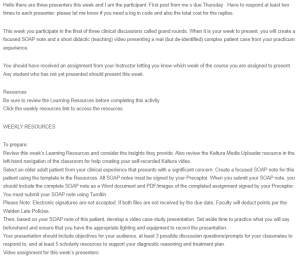
This week you participate in the final of three clinical discussions called grand rounds. When it is your week to present, you will create a focused SOAP note and a short didactic (teaching) video presenting a real (but de-identified) complex patient case from your practicum experience.
You should have received an assignment from your Instructor letting you know which week of the course you are assigned to present. Any student who has not yet presented should present this week.
Resources
Be sure to review the Learning Resources before completing this activity.
Click the weekly resources link to access the resources.
WEEKLY RESOURCES
To prepare:
Review this week’s Learning Resources and consider the insights they provide. Also review the Kaltura Media Uploader resource in the left-hand navigation of the classroom for help creating your self-recorded Kaltura video.
Select an older adult patient from your clinical experience that presents with a significant concern. Create a focused SOAP note for this patient using the template in the Resources. All SOAP notes must be signed by your Preceptor. When you submit your SOAP note, you should include the complete SOAP note as a Word document and PDF/images of the completed assignment signed by your Preceptor. You must submit your SOAP note using Turnitin.
Please Note: Electronic signatures are not accepted. If both files are not received by the due date, Faculty will deduct points per the Walden Late Policies.
Then, based on your SOAP note of this patient, develop a video case study presentation. Set aside time to practice what you will say beforehand and ensure that you have the appropriate lighting and equipment to record the presentation.
Your presentation should include objectives for your audience, at least 3 possible discussion questions/prompts for your classmates to respond to, and at least 5 scholarly resources to support your diagnostic reasoning and treatment plan.
Video assignment for this week’s presenters:
Record yourself presenting the complex case study for your clinical patient. In your presentation:
Dress professionally and present yourself in a professional manner.
Display your photo ID at the start of the video when you introduce yourself.
Ensure that you do not include any information that violates the principles of HIPAA (i.e., don’t use the patient’s name or any other identifying information).
State 3–4 objectives for the presentation that are targeted, clear, use appropriate verbs from Bloom’s taxonomy, and address what the audience will know or be able to do after viewing.
Present the full complex case study. Include chief complaint; history of present illness; any pertinent past psychiatric, substance use, medical, social, family history; most recent mental status exam; current psychiatric diagnosis including differentials that were ruled out; and plan for treatment and management.
Report normal diagnostic results as the name of the test and “normal” (rather than specific value). Abnormal results should be reported as a specific value.
Pose three questions or discussion prompts, based on your presentation, that your colleagues can respond to after viewing your video.
Be succinct in your presentation, and do not exceed 8 minutes. Specifically address the following for the patient, using your SOAP note as a guide.
Subjective: What details did the patient provide regarding their chief complaint and symptomology to derive your differential diagnosis? What is the duration and severity of their symptoms? How are their symptoms impacting their functioning in life?
Objective: What observations did you make during the psychiatric assessment?
Assessment: Discuss their mental status examination results. What were your differential diagnoses? Provide a minimum of three possible diagnoses and why you chose them. List them from highest priority to lowest priority. What was your primary diagnosis, and why? Describe how your primary diagnosis aligns with DSM-5-TR diagnostic criteria and is supported by the patient’s symptoms.
Plan: What was your plan for psychotherapy (include one health promotion activity and patient education)? What was your plan for treatment and management, including alternative therapies? Include pharmacologic and nonpharmacologic treatments, alternative therapies, and follow-up parameters, as well as a rationale for this treatment and management plan. Discuss an identified social determinate of health impacting this patient’s mental health status and provide your recommendation for a referral to assist this patient in meeting this identified need (students will need to conduct research on this topic both in the literature and for community resources).
Reflection notes: What would you do differently with this patient if you could conduct the session again? If you are able to follow up with your patient, explain whether these interventions were successful and why or why not. If you were not able to conduct a follow-up, discuss what your next intervention would be.
A note on grading:
Presenters: Review the Grand Rounds Presenter Rubric attached to this discussion to ensure you meet the scoring criteria.
Participants: Review the Grand Rounds Participant Rubric located on the following Week 9 Assignment 1 page to ensure you meet the scoring criteria. Note the Week 9 Assignment 1 page is for viewing the participant rubric only. Your response should be posted in the forum of this page.
Week 9 Presenters:
By Day 3
Post your video and your focused SOAP note to the Grand Rounds Discussion forum. You must submit two files for the SOAP note, including a Word document and scanned PDF/images of completed assignment signed by your Preceptor. Then, actively respond to and guide the conversation as your colleagues post responses to your video.
Week 9 Participants:
By multiple days between Days 4 and 7
Respond at least 2 times each to all colleagues who presented this week (should be 2-3 presenters each week). The goal is for the discussion forum to function as robust clinical conferences on the patients. Provide a response to 1 of the 3 discussion prompts that your colleagues provided in their video presentations. You may also provide additional information, alternative points of view, research to support treatment, or patient education strategies you might use with the relevant patient.
Complex Case Study Presentation
This week you participate in the final of three clinical discussions called grand rounds. When it is your week to present, you will create a focused SOAP note and a short didactic (teaching) video presenting a real (but de-identified) complex patient case from your practicum experience.
You should have received an assignment from your Instructor letting you know which week of the course you are assigned to present. Any student who has not yet presented should present this week.
Resources
Be sure to review the Learning Resources before completing this activity.
Click the weekly resources link to access the resources.
WEEKLY RESOURCES
Week 9 Participants:
By multiple days between Days 4 and 7
Respond at least 2 times each to all colleagues who presented this week (should be 2-3 presenters each week). The goal is for the discussion forum to function as robust clinical conferences on the patients. Provide a response to 1 of the 3 discussion prompts that your colleagues provided in their video presentations. You may also provide additional information, alternative points of view, research to support treatment, or patient education strategies you might use with the relevant patient.
 Complete the order form and upload all of your files, including any instructions, rubrics, or other materials provided by your instructor.
  Complete the order payment after filling in the order form. We’ll receive your order and assign it to a writer.
 The assigned writer will complete your paper and forward it to our Editing Team for review and approval.
 Once approved by the editor, the completed paper will be uploaded to your account for you to download, review and approve.