
Episodic Visit: Musculoskeletal Focused Note
Patient Information:
Initials: J.K. | Age: 45-years | Sex: Female | Race: Black
S.
CC (chief complaint): “My nose won’t stop running, and I keep sneezing—it’s been going on for about two weeks.”
HPI:
J.K. is a 45-year-old Black female who presents with a two-week history of persistent nasal symptoms. She reports a runny and itchy nose, sneezing, and watery eyes. The symptoms are worse in the mornings and when exposed to dust at work. She describes the discomfort as irritating and continuous. Associated symptoms include occasional frontal headaches and maxillary tenderness. She denies fever, fatigue, or chest symptoms. Symptoms began gradually and have remained constant. Tylenol provides minimal relief. She rates the severity as 5/10. No prior similar episodes reported. Symptoms impact her comfort and focus, especially in her classroom environment.
Current Medications:
- Amlodipine 5 mg PO daily – taken for hypertension for the past one year.
- Atorvastatin 40 mg PO daily – taken for hyperlipidemia for the past six months.
- Acetaminophen (Tylenol) 500 mg PO as needed – taken occasionally over the past two weeks for mild headaches and sinus discomfort.
Allergies: The patient denies having any known allergies to medications, foods, or environmental factors. She reports no previous reactions such as rash, hives, swelling (angioedema), or anaphylaxis to any substances. There is no history of medication intolerance or adverse effects. At this time, there are no documented medication, food, or environmental allergies.
PMHx: The patient has a past medical history of hypertension and hyperlipidemia, both of which are currently managed with daily medications. She denies any past surgical procedures or hospitalizations. Her immunizations are up to date, including an influenza vaccine received this season and a tetanus (Tdap) booster administered approximately three years ago. She has not experienced any major childhood illnesses beyond common infections, and there is no history of asthma, diabetes, or chronic respiratory conditions. Given the current complaint of nasal and sinus symptoms, there is no prior diagnosis of allergic rhinitis or sinusitis reported in her medical history.
Soc Hx: The patient is a kindergarten teacher who practices yoga twice weekly. She is married with one healthy teenage son. She denies tobacco, alcohol, or drug use. She lives in a safe suburban home, wears seatbelts, has working smoke detectors, avoids texting while driving, and has strong family support.
Fam Hx: The patient’s mother is 72 years old and has a history of hypertension and type 2 diabetes mellitus. Her father passed away at age 62 due to a myocardial infarction. She has no siblings. Her 16-year-old son is healthy with no known medical conditions. There is no known family history of asthma, allergies, or hereditary cancers. No contagious or chronic illnesses have been reported in other close relatives. There are no grandchildren at this time.
ROS
GENERAL: No weight loss, fever, chills, weakness, or fatigue.
HEAD: Occasional mild frontal headache, no trauma or dizziness.
EENT:
Eyes: Watery eyes; no blurred vision, visual loss, or discharge.
Ears: No hearing loss, tinnitus, or ear pain.
Nose: Persistent runny and itchy nose, sneezing; no epistaxis or congestion.
Throat: No sore throat, hoarseness, or dysphagia.
SKIN: No rash, hives, or itching elsewhere.
CARDIOVASCULAR: No chest pain, palpitations, or edema.
RESPIRATORY: No shortness of breath, wheezing, or cough.
GASTROINTESTINAL: No nausea, vomiting, abdominal pain, or diarrhea.
GENITOURINARY: No dysuria, urgency, or hematuria. Last menstrual period not discussed.
NEUROLOGICAL: No syncope, numbness, tingling, or gait disturbances.
MUSCULOSKELETAL: No joint pain, back pain, or stiffness.
HEMATOLOGIC: No history of bleeding, bruising, or anemia.
LYMPHATICS: No swollen lymph nodes or history of splenectomy.
PSYCHIATRIC: No anxiety, depression, or mood changes.
ENDOCRINOLOGIC: No heat or cold intolerance, polydipsia, or polyuria.
ALLERGIES: No history of asthma, eczema, or known allergic reactions.
O.
Physical Exam:
- General: The patient appears well-developed and well-nourished, in no acute distress. She is alert, oriented, and cooperative throughout the exam.
- Head: Normocephalic and atraumatic. No visible lesions or scalp tenderness noted.
- Eyes: Conjunctivae are clear with excessive tearing; no redness, discharge, or periorbital swelling. Pupils are equal, round, and reactive to light. Extraocular movements intact.
- Ears: External auditory canals clear; tympanic membranes intact with no erythema or bulging.
- Nose: Mucosa appears pale and boggy with clear watery discharge present bilaterally. Mild tenderness over the maxillary sinuses was noted with palpation. No nasal polyps observed.
- Throat: Oropharynx clear, moist mucosa; no erythema, tonsillar enlargement, or exudates.
- Neck: Supple, no cervical lymphadenopathy or masses appreciated on palpation.
- Respiratory: Breath sounds clear bilaterally without wheezes, rales, or rhonchi. No respiratory distress observed.
- Skin: Skin intact without rashes, urticaria, or dryness.
- Neurological: Alert and oriented x3. Cranial nerves II–XII grossly intact. No focal deficits noted.
Diagnostic Results:
No diagnostic tests were performed during the initial visit, as the patient’s presentation is consistent with uncomplicated allergic rhinitis based on history and physical exam findings. However, if symptoms persist beyond 3-4 weeks or worsen despite treatment, the following diagnostics may be warranted:
- Serum total IgE or allergen-specific IgE testing (RAST): Helps identify environmental allergens contributing to symptoms (Ansotegui et al., 2020).
- Nasal smear for eosinophils: May support allergic etiology when unclear.
- CBC with differential: To rule out infection if purulent discharge, fever, or fatigue develops.
- CT scan of sinuses: Reserved for cases with signs of chronic or complicated sinusitis (Kwon & O’Rourke, 2023).
A.
Differential Diagnoses
Allergic Rhinitis (J30.9) – Primary Diagnosis
Allergic rhinitis is the most probable diagnosis based on the two-week history of sneezing, non-viscous rhinorrhea, nasal congestion, runny eyes, and pale, boggy nasal mucous membranes. These results can be explained by the IgE inflammation caused by allergens in the environment. The patient works in a kindergarten, and it is highly likely that she encounters indoor allergens on a daily basis, as dust is one of the factors that can worsen symptoms. Other support in this diagnosis is the lack of fever, purulent discharge, or other signs of systemic symptoms. As Akhouri and House (2023) found out, the diagnosis of allergic rhinitis is clinically determined based on history and examination results.
Viral Rhinosinusitis (J00)
Viral rhinosinusitis can present similarly with nasal congestion and rhinorrhea. However, the duration of symptoms (over 10 days), lack of colored nasal discharge, fever, or myalgia, and the presence of allergen exposure make this diagnosis less likely. Viral infections are typically self-limiting within 7-10 days (Jaume et al., 2020).
Nonallergic Rhinitis (J31.0)
Nonallergic rhinitis is another possibility, especially in middle-aged adults. It can present with nasal congestion and rhinorrhea, but typically lacks sneezing, nasal pruritus, and identifiable allergic triggers. The presence of allergic symptoms and occupational exposure to potential allergens makes this diagnosis less probable (Leader & Geiger, 2020).
P.
Diagnostics:
No diagnostic studies are immediately required, as the clinical presentation strongly supports allergic rhinitis. However, if symptoms persist or worsen after four weeks of treatment, serum allergen-specific IgE testing or referral for skin-prick allergy testing may be warranted. A CBC with differential may be considered to rule out infection if purulence, fatigue, or fever develops.
Referrals:
If symptoms are refractory to first-line management, refer to an allergist for comprehensive evaluation and immunotherapy consideration.
Therapeutic Interventions:
- Cetirizine 10 mg PO once daily – first-line non-sedating antihistamine to reduce histamine-mediated symptoms.
- Fluticasone nasal spray 50 mcg, two sprays per nostril daily × 1 week, then one spray daily – intranasal corticosteroid to reduce inflammation (Wallace et al., 2020).
- Saline nasal spray – to moisturize the nasal mucosa and aid in symptom control.
- Continue Tylenol 500 mg PO PRN for mild sinus discomfort or headache.
Patient Education:
The patient was advised on the use of medications, especially the right technique of nasal spray, to get longer effectiveness of the drugs. She has been recommended to find and prevent common allergens such as dust and pollen, and discuss possible changes in the environment, like HEPA filters and beddings used, as well as everyday cleaning. It was also suggested that she be watchful of any swelling of the face, thick yellow/green nasal secretion, or fever that might be signs of bacterial infection.
Follow-Up:
Recheck after 2-3 weeks to assess the reaction to the treatment. Earlier review in case of worsening of symptoms or the development of new symptoms.
Reflection:
I agree with the current treatment plan, as it is consistent with clinical guidelines and effectively addresses the patient’s symptoms with first-line pharmacologic and nonpharmacologic measures. However, what I would do differently in a similar patient evaluation is incorporate a validated allergy symptom-tracking diary and use a standardized allergy screening questionnaire to help pinpoint environmental triggers more precisely. This proactive approach can aid in long-term management and improve the patient’s awareness of allergen exposures. This case reinforced the importance of targeted health education, especially considering the patient’s occupational exposure, comorbid hypertension and hyperlipidemia, and African American background—factors that may influence health outcomes and access to care. Promoting self-management and ensuring health equity are essential in supporting long-term control and preventing complications such as chronic sinusitis or sleep disturbances.
References
Akhouri, S., & House, S. A. (2023, July 16). Allergic rhinitis. PubMed; StatPearls Publishing. https://www.ncbi.nlm.nih.gov/books/NBK538186/
Ansotegui, I. J., Melioli, G., Canonica, G. W., Caraballo, L., Villa, E., Ebisawa, M., Passalacqua, G., Savi, E., Ebo, D., Gómez, R. M., Sánchez, O. L., Oppenheimer, J. J., Jensen-Jarolim, E., Fischer, D. A., Haahtela, T., Antila, M., Bousquet, J. J., Cardona, V., Chiang, W. C., . . . Zuberbier, T. (2020). IgE allergy diagnostics and other relevant tests in allergy, a World Allergy Organization position paper. World Allergy Organization Journal, 13(2), 100080. https://doi.org/10.1016/j.waojou.2019.100080
Jaume, F., Valls-Mateus, M., & Mullol, J. (2020). Common cold and acute rhinosinusitis: Up-to-date management in 2020. Current Allergy and Asthma Reports, 20(7). https://doi.org/10.1007/s11882-020-00917-5
Kwon, E., & O’Rourke, M. C. (2023, August 8). Chronic sinusitis. PubMed; StatPearls Publishing. https://www.ncbi.nlm.nih.gov/books/NBK441934/
Leader, P., & Geiger, Z. (2020, July 10). Vasomotor rhinitis. PubMed; StatPearls Publishing. https://www.ncbi.nlm.nih.gov/books/NBK547704/
ORDER A PLAGIARISM-FREE PAPER HERE
We’ll write everything from scratch
Question 
Episodic Visit: Musculoskeletal Focused Note
Scenario
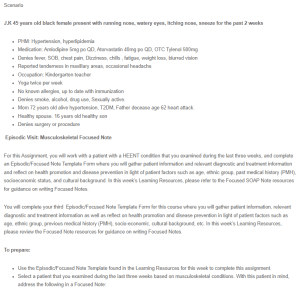
J.K 45 years old black female present with running nose, watery eyes, itching nose, sneeze for the past 2 weeks
- PHM: Hypertension, hyperlipidemia

Musculoskeletal Focused Note
- Medication: Amlodipine 5mg po QD, Atorvastatin 40mg po QD, OTC Tylenol 500mg
- Denies fever, SOB, chest pain, Dizziness, chills , fatigue, weight loss, blurred vision
- Reported tenderness in maxillary areas, occasional headache
- Occupation: Kindergarten teacher
- Yoga twice per week
- No known allergies, up to date with immunization
- Denies smoke, alcohol, drug use, Sexually active.
- Mom 72 years old alive hypertension, T2DM, Father decease age 62 heart attack.
- Healthy spouse. 16 years old healthy son
- Denies surgery or procedure
Episodic Visit: Musculoskeletal Focused Note
For this Assignment, you will work with a patient with a HEENT condition that you examined during the last three weeks, and complete an Episodic/Focused Note Template Form where you will gather patient information and relevant diagnostic and treatment information and reflect on health promotion and disease prevention in light of patient factors such as age, ethnic group, past medical history (PMH), socioeconomic status, and cultural background. In this week’s Learning Resources, please refer to the Focused SOAP Note resources for guidance on writing Focused Notes.
You will complete your third Episodic/Focused Note Template Form for this course where you will gather patient information, relevant diagnostic and treatment information as well as reflect on health promotion and disease prevention in light of patient factors such as age, ethnic group, previous medical history (PMH), socio-economic, cultural background, etc. In this week’s Learning Resources, please review the Focused Note resources for guidance on writing Focused Notes.
To prepare:
- Use the Episodic/Focused Note Template found in the Learning Resources for this week to complete this assignment.
- Select a patient that you examined during the last three weeks based on musculoskeletal conditions. With this patient in mind, address the following in a Focused Note:
Assignment:
- Subjective: What details did the patient provide regarding her personal and medical history?
- Objective: What observations did you make during the physical assessment?
- Assessment: What were your differential diagnoses? Provide a minimum of three possible diagnoses. List them from highest priority to lowest priority. What was your primary diagnosis and why?
- Plan: What was your plan for diagnostics and primary diagnosis? What was your plan for treatment and management, including alternative therapies? Include pharmacologic and nonpharmacologic treatments, alternative therapies, and follow-up parameters as well as a rationale for this treatment and management plan.
- Reflection notes: What would you do differently in a similar patient evaluation?
 Complete the order form and upload all of your files, including any instructions, rubrics, or other materials provided by your instructor.
  Complete the order payment after filling in the order form. We’ll receive your order and assign it to a writer.
 The assigned writer will complete your paper and forward it to our Editing Team for review and approval.
 Once approved by the editor, the completed paper will be uploaded to your account for you to download, review and approve.